Euphilotes allyni
El segundo blue butterfly
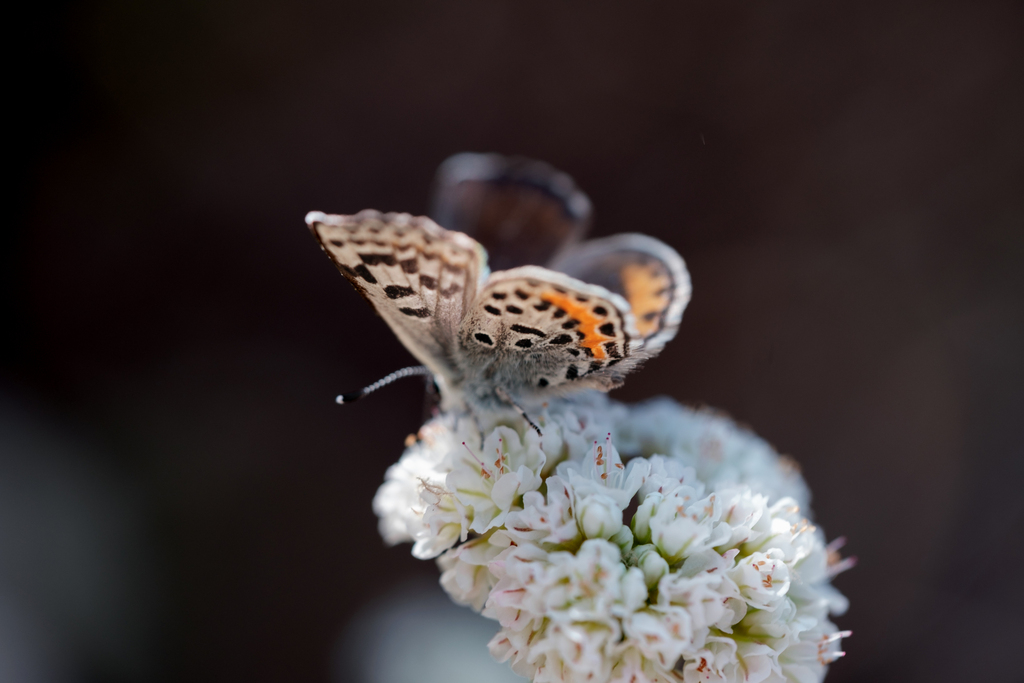
no rights reserved · CC0
Family: Lycaenidae · Class: Insecta · Order: Lepidoptera
Conservation status: Endangered · G1? S1
Euphilotes allyni (El segundo blue butterfly) is a California animal in the Lycaenidae family.
The El Segundo blue butterfly is a small lycaenid endemic to coastal dune systems in Southern California. Adults have a wingspan of approximately 19 to 25 mm (0.75 to 1 inch). Males display iridescent blue dorsal wing surfaces with narrow dark borders, while females are brown with blue scaling at the wing bases and orange marginal spots on the hindwings. The ventral wing surfaces of both sexes are pale gray with distinctive black spots and orange crescents along the hindwing margins. The species is distinguished from other Euphilotes by its association with seacliff buckwheat and its restricted coastal distribution. Historically, the El Segundo blue occurred along coastal sand dunes from Santa Monica to San Pedro in Los Angeles County, California. Named for the dune system it inhabits, the species has experienced severe range contraction due to extensive habitat loss. Currently, the butterfly persists on only three fragmented habitat sites, with the largest population located adjacent to Los Angeles International Airport. The other two sites are significantly smaller remnants of the original dune ecosystem. The El Segundo blue requires coastal dune habitat dominated by seacliff buckwheat (Eriogonum parvifolium), the species' only known host plant. These dunes occur in areas with sandy, well-drained soils and are subject to marine influence. The butterfly depends on dynamic dune systems where sand movement creates the open conditions necessary for seacliff buckwheat establishment and growth. Elevation ranges from near sea level to approximately 60 meters (200 feet). Adult El Segundo blues are active from June through August, with peak flight occurring in July. Males are territorial and engage in perching behavior on or near host plants. Females lay single eggs on flower buds and young leaves of seacliff buckwheat. Larvae feed exclusively on the flowers, developing fruits, and occasionally leaves of their host plant. The species completes one generation per year, with larvae entering diapause during winter months. Pupation occurs in spring, with adults emerging in early summer. The U.S. Fish and Wildlife Service listed the El Segundo blue as endangered in 1976. Airport construction, oil refining, sand mining, and urban development have eliminated large portions of the species' dune habitat. According to the California Department of Fish and Wildlife, the species is listed by USFWS as Euphilotes battoides allyni, reflecting ongoing taxonomic uncertainty. While development threats have been largely halted, invasive plant species now compete with seacliff buckwheat for space and resources. Several introduced plants actually stabilize dune systems, preventing the natural sand movement that creates optimal conditions for the host plant. Current population estimates suggest fewer than 500 individuals remain across all sites, making this one of the rarest butterflies in North America.
Classification
Class: Insecta · Order: Lepidoptera · Family: Lycaenidae
Conservation status
Endangered · G1? S1
Frequently asked questions
How is Euphilotes allyni classified?
Euphilotes allyni belongs to class Insecta, order Lepidoptera, family Lycaenidae.
What family does Euphilotes allyni belong to?
Euphilotes allyni is in the Lycaenidae family.
Is Euphilotes allyni protected or of conservation concern?
Euphilotes allyni carries the following status: Endangered · G1? S1.
What is Euphilotes allyni?
The El Segundo blue butterfly is a small lycaenid endemic to coastal dune systems in Southern California.
Is Euphilotes allyni found in California?
Yes. Euphilotes allyni is recorded in California in The California Species Project's catalogue.
Related species
Other California species in the same genus, family, or bioregion.
Data from The California Species Project — 14,000+ California species with verified data from CNPS, CDFW, USFWS, and more.