Euphilotes ancilla
Rocky Mountain Dotted-Blue
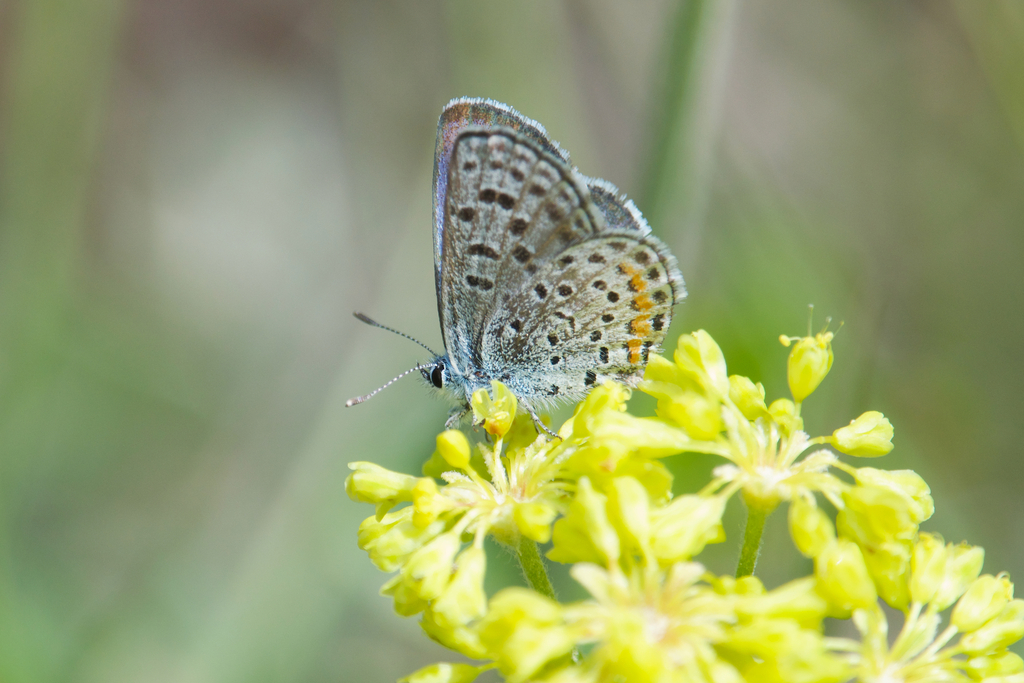
(c) Owen Strickland, some rights reserved (CC BY) · licence
Family: Lycaenidae · Class: Insecta · Order: Lepidoptera
Euphilotes ancilla (Rocky Mountain Dotted-Blue) is a California animal in the Lycaenidae family.
The Rocky Mountain Dotted-Blue (Euphilotes ancilla) is a small butterfly in the family Lycaenidae. Adults have a wingspan of 18 to 25 mm (0.7 to 1.0 inches). Males display bright blue dorsal wing surfaces with a narrow dark border, while females are brown to brownish-gray above with blue scaling near the wing bases. The ventral wing surfaces of both sexes are pale gray to white with distinctive black spots and orange marginal spots, giving this species its "dotted" common name. The hindwings feature orange crescents along the outer margin with metallic blue-green spots. This species ranges from Washington south to California and from southern Alberta and Saskatchewan south through the Rocky Mountains and high plains to Wyoming, Colorado, Utah, and northwestern New Mexico. In California, populations occur primarily in the eastern Sierra Nevada, Cascade Range, and northeastern counties including Mono, Inyo, Modoc, and Lassen counties. The species occupies montane and subalpine environments, typically at elevations between 1,220 and 3,350 meters (4,000 to 11,000 feet). Rocky Mountain Dotted-Blues inhabit open, arid to semi-arid areas including sagebrush steppe, mountain meadows, rocky slopes, and forest clearings. Adults are closely associated with their host plants and are most commonly found in areas with abundant Eriogonum species. The species prefers sites with well-drained soils and full sun exposure, often on south-facing slopes where buckwheat species thrive. Adults are active from late May through August, with peak flight occurring in July. Males patrol territories around host plant clusters, engaging in aerial encounters with other males and seeking females for mating. Females lay eggs singly on flower buds or young flowers of various Eriogonum species, especially sulphur-flower (Eriogonum umbellatum). Larvae feed within the flower heads, consuming developing seeds and flowers. The species overwinters as eggs, which hatch the following spring when host plants begin flowering. Development from egg to adult takes approximately one year, with a single generation annually. Larvae are tended by ants, particularly species in the genus Formica, which protect them from predators and parasitoids in exchange for sugary secretions produced by specialized glands. This mutualistic relationship is common among lycaenid butterflies and enhances larval survival rates. The Rocky Mountain Dotted-Blue is not federally listed and appears to have stable populations across much of its range. However, local populations may face threats from habitat loss due to development, livestock grazing, and invasive plant species that displace native Eriogonum. Climate change may affect the species by altering the distribution and phenology of host plants, particularly at higher elevations. The species' dependence on specific buckwheat species makes it vulnerable to changes in plant community composition. Conservation efforts focus on maintaining healthy sagebrush steppe and montane ecosystems where native Eriogonum species can persist.
Classification
Class: Insecta · Order: Lepidoptera · Family: Lycaenidae
Frequently asked questions
How is Euphilotes ancilla classified?
Euphilotes ancilla belongs to class Insecta, order Lepidoptera, family Lycaenidae.
What family does Euphilotes ancilla belong to?
Euphilotes ancilla is in the Lycaenidae family.
What is Euphilotes ancilla?
The Rocky Mountain Dotted-Blue (Euphilotes ancilla) is a small butterfly in the family Lycaenidae.
Is Euphilotes ancilla found in California?
Yes. Euphilotes ancilla is recorded in California in The California Species Project's catalogue.
Related species
Other California species in the same genus, family, or bioregion.
Data from The California Species Project — 14,000+ California species with verified data from CNPS, CDFW, USFWS, and more.