Euphilotes battoides
Western Square-dotted Blue
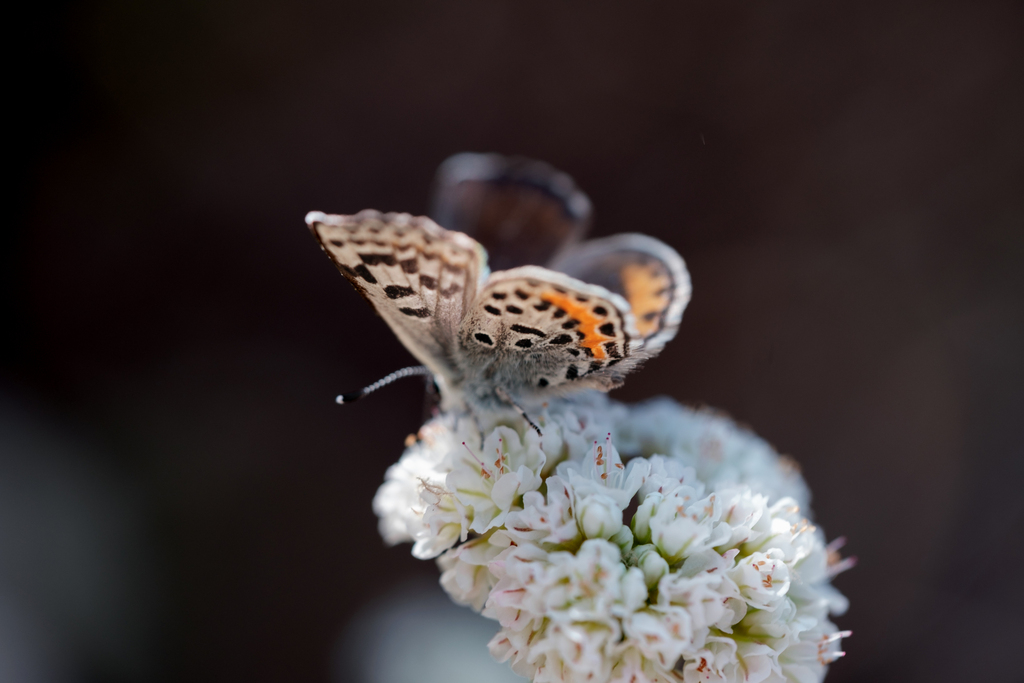
no rights reserved · CC0
Family: Lycaenidae · Class: Insecta · Order: Lepidoptera
Euphilotes battoides (Western Square-dotted Blue) is a California animal in the Lycaenidae family.
The Western Square-dotted Blue is a small butterfly in the family Lycaenidae, characterized by distinctive square-shaped spots on the underside of its wings. Males display bright blue dorsal wing surfaces with narrow dark borders, while females are predominantly brown with blue scaling at the wing bases. The underwings are pale gray to white with prominent dark square or rectangular spots arranged in regular rows, giving the species its common name. Adults measure 20 to 28 millimeters (0.8 to 1.1 inches) in wingspan, making them among the smaller North American blue butterflies. This species exhibits a spotty distribution from Washington south to Baja California Norte, extending east to southern Colorado and New Mexico. Within California, populations occur primarily in coastal ranges, the Sierra Nevada foothills, and desert mountain ranges. The fragmented distribution reflects the patchy occurrence of suitable host plants and appropriate habitat conditions across this broad geographic range. Western Square-dotted Blues inhabit open, arid environments including chaparral, oak woodlands, desert scrub, and grasslands. The species occurs from sea level to elevations exceeding 2,400 meters (7,900 feet), demonstrating considerable ecological flexibility. Adults are most commonly encountered on hillsides and slopes where host plants flourish in well-drained soils with full sun exposure. The species exhibits an obligate relationship with various wild buckwheats (Eriogonum species), including coastal buckwheat and sulphur-flower. Females deposit eggs singly on flower buds or young leaves of the host plant. Larvae feed exclusively on buckwheat flowers and developing seeds, completing development within the flower heads. This specialized feeding relationship makes populations vulnerable to changes in host plant abundance or phenology. The species typically produces one to two generations annually, depending on elevation and local climate conditions. Flight periods vary geographically but generally occur from April through September, with peak activity during summer months when buckwheat plants are flowering. Adults exhibit strong site fidelity, often remaining within small areas containing suitable host plants. Males establish territories on or near host plants, engaging in aerial pursuits to locate females. Mating occurs on or adjacent to buckwheat plants, with females subsequently searching for optimal oviposition sites on flower clusters. While not federally or state-listed, Western Square-dotted Blue populations face ongoing pressures from habitat loss and fragmentation. Urban development, agricultural conversion, and altered fire regimes threaten buckwheat communities throughout the species' range. Climate change may disrupt the synchronization between butterfly life cycles and host plant phenology. Invasive plant species can outcompete native buckwheats, reducing habitat quality. Some local populations have experienced declines due to habitat destruction, though the species' broad distribution provides some resilience. Conservation efforts focus on protecting buckwheat habitats and maintaining natural disturbance regimes that support host plant communities.
Classification
Class: Insecta · Order: Lepidoptera · Family: Lycaenidae
Frequently asked questions
How is Euphilotes battoides classified?
Euphilotes battoides belongs to class Insecta, order Lepidoptera, family Lycaenidae.
What family does Euphilotes battoides belong to?
Euphilotes battoides is in the Lycaenidae family.
What is Euphilotes battoides?
The Western Square-dotted Blue is a small butterfly in the family Lycaenidae, characterized by distinctive square-shaped spots on the underside of its wings.
Is Euphilotes battoides found in California?
Yes. Euphilotes battoides is recorded in California in The California Species Project's catalogue.
Related species
Other California species in the same genus, family, or bioregion.
Data from The California Species Project — 14,000+ California species with verified data from CNPS, CDFW, USFWS, and more.