Euphilotes baueri
Bauer's dotted-blue
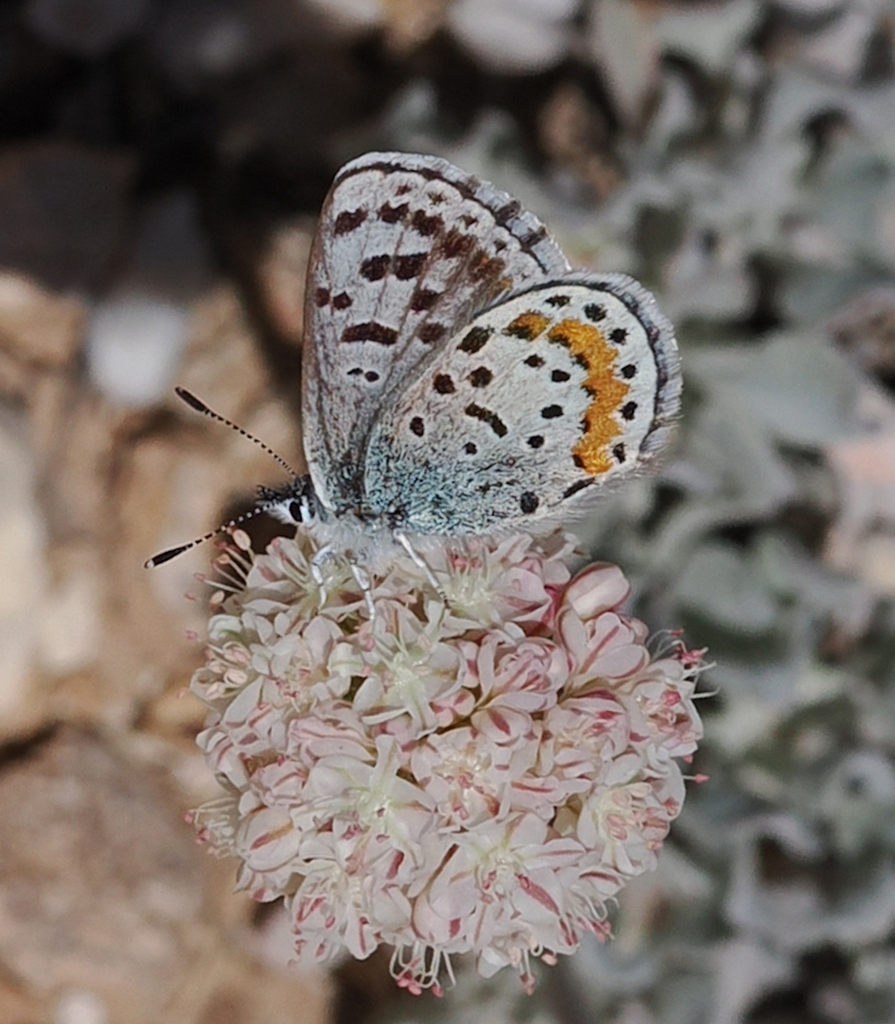
(c) Wendy McCrady, some rights reserved (CC BY) · licence
Family: Lycaenidae · Class: Insecta · Order: Lepidoptera
Conservation status: G2 S1S2
Euphilotes baueri (Bauer's dotted-blue) is a California animal in the Lycaenidae family.
Bauer's dotted-blue (Euphilotes baueri) is a small butterfly in the family Lycaenidae with a wingspan typically ranging from 19 to 25 millimeters (0.75 to 1.0 inches). Males display blue dorsal wing surfaces with narrow black borders, while females are predominantly brown with blue scaling near the wing bases. The ventral wing surfaces are pale gray to white with distinctive black spots arranged in regular rows, giving the species its common name. The hindwings feature small orange crescents along the outer margins, and males possess a characteristic orange-red eyespot near the tail of each hindwing. This species has a very limited distribution in the western United States, occurring in east and northeastern California, central Nevada, and northwestern Arizona. It may also occur in southwestern Utah. Within California, populations are documented from the eastern Sierra Nevada and Mojave Desert regions, including areas of Mono, Inyo, San Bernardino, and Riverside counties. The species occupies scattered localities within its range, with populations often separated by considerable distances. Bauer's dotted-blue inhabits dry slopes and desert flats characterized by scattered short brush communities. The species is closely associated with areas where wild buckwheats (Eriogonum species) grow, as these serve as the exclusive larval host plants. Typical habitat consists of sagebrush scrub, pinyon-juniper woodland, and desert shrub communities at elevations ranging from approximately 1,200 to 2,400 meters (4,000 to 8,000 feet). The butterfly requires open areas with sparse vegetation cover and well-drained soils where buckwheat species can establish. Adults are active from late spring through early fall, with peak flight periods varying by elevation and local climate conditions. Females lay eggs singly on flower heads and young leaves of various Eriogonum species. Larvae feed within the flower heads and developing seed structures, completing development over several weeks. The species overwinters as eggs or early-instar larvae, with development resuming the following spring. Males engage in perching behavior, establishing territories on hilltops and prominent vegetation where they await females. Adults nectar on their buckwheat host plants as well as other available flowering plants within their habitat. Bauer's dotted-blue is ranked G2 S1S2, indicating it is globally imperiled to vulnerable and critically imperiled to imperiled within California. The major threat to this species is habitat loss due to invasive alien plants, primarily cheatgrass (Bromus tectorum), which may out-compete buckwheat host plants and increase fire risk in desert ecosystems. Fire frequency has increased in many areas within the species' range, potentially eliminating both adult nectar sources and larval host plants. Additional threats include habitat degradation from off-road vehicle use, urban development, and climate change impacts such as altered precipitation patterns and increased drought frequency. The species' naturally fragmented distribution and small population sizes make it particularly vulnerable to local extirpations and environmental stochasticity.
Classification
Class: Insecta · Order: Lepidoptera · Family: Lycaenidae
Conservation status
G2 S1S2
Frequently asked questions
How is Euphilotes baueri classified?
Euphilotes baueri belongs to class Insecta, order Lepidoptera, family Lycaenidae.
What family does Euphilotes baueri belong to?
Euphilotes baueri is in the Lycaenidae family.
Is Euphilotes baueri protected or of conservation concern?
Euphilotes baueri carries the following status: G2 S1S2.
What is Euphilotes baueri?
Bauer's dotted-blue (Euphilotes baueri) is a small butterfly in the family Lycaenidae with a wingspan typically ranging from 19 to 25 millimeters (0.75 to 1.0 inches).
Is Euphilotes baueri found in California?
Yes. Euphilotes baueri is recorded in California in The California Species Project's catalogue.
Related species
Other California species in the same genus, family, or bioregion.
Data from The California Species Project — 14,000+ California species with verified data from CNPS, CDFW, USFWS, and more.