Euphilotes bernardino
Bernardino Blue
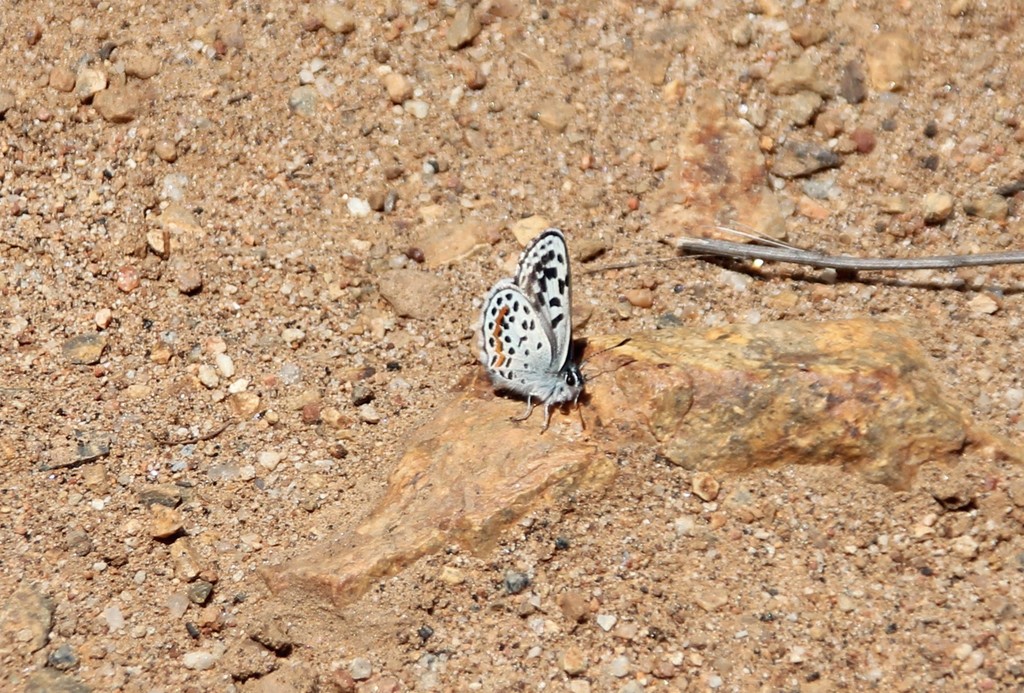
(c) Millie Basden, some rights reserved (CC BY) · licence
Family: Lycaenidae · Class: Insecta · Order: Lepidoptera
Euphilotes bernardino (Bernardino Blue) is a California animal in the Lycaenidae family.
The Bernardino blue is a small butterfly belonging to the gossamer-wing family (Lycaenidae). Adults have a wingspan of approximately 19-25 mm (0.75-1.0 inches). Males display bright blue dorsal wing surfaces with narrow black borders, while females are predominantly brown with varying amounts of blue coloration near the wing bases. The ventral surfaces of both sexes are pale gray to white with small black spots circled in white, and orange submarginal spots along the hindwing edges. The species can be distinguished from related Euphilotes blues by subtle differences in wing pattern, size, and host plant associations. The Bernardino blue occurs in southern California, extending south to northern Baja California, southern Nevada, and western Arizona. In California, populations are documented from the Transverse and Peninsular Ranges, including areas of the San Bernardino, San Gabriel, and Santa Rosa Mountains. The species also occurs in desert regions of Riverside, Imperial, and eastern San Diego Counties. Populations extend eastward through the Mojave Desert into Nevada and Arizona at various elevations from low desert to montane areas. This species inhabits arid and semi-arid environments including desert scrub, chaparral, and pinyon-juniper woodlands. The butterflies are closely associated with various wild buckwheat species (Eriogonum), which serve as larval host plants. Common host plants include desert buckwheat (E. deserti), nude buckwheat (E. nudum), and cliff buckwheat (E. parvifolium). Adults are typically found in areas with scattered buckwheat plants growing on rocky slopes, washes, and desert flats. Bernardino blue larvae feed exclusively on Eriogonum flowers and developing seeds. The species produces multiple generations per year in favorable conditions, with adults flying from spring through fall when host plants are available. Flight periods vary with elevation and local weather patterns, typically peaking during periods when buckwheat plants are flowering. Males patrol territories around host plants, engaging in rapid, erratic flight patterns. Females deposit eggs singly on flower heads or developing seed clusters of host plants. The species may enter extended dormancy during drought conditions, emerging when adequate rainfall stimulates buckwheat flowering. The Bernardino blue lacks federal or state listing status but faces ongoing habitat pressures throughout its range. Urban development, off-road vehicle use, and invasive plant species threaten suitable habitat in many areas. Climate change may alter precipitation patterns that affect buckwheat flowering cycles critical to the species' reproduction. Mining, livestock grazing, and recreational activities can degrade habitat quality in desert regions. Conservation efforts focus on protecting key habitat areas and managing disturbance factors that affect host plant communities. Continued monitoring is needed to assess population trends and identify areas requiring habitat protection.
Classification
Class: Insecta · Order: Lepidoptera · Family: Lycaenidae
Frequently asked questions
How is Euphilotes bernardino classified?
Euphilotes bernardino belongs to class Insecta, order Lepidoptera, family Lycaenidae.
What family does Euphilotes bernardino belong to?
Euphilotes bernardino is in the Lycaenidae family.
What is Euphilotes bernardino?
The Bernardino blue is a small butterfly belonging to the gossamer-wing family (Lycaenidae).
Is Euphilotes bernardino found in California?
Yes. Euphilotes bernardino is recorded in California in The California Species Project's catalogue.
Related species
Other California species in the same genus, family, or bioregion.
Data from The California Species Project — 14,000+ California species with verified data from CNPS, CDFW, USFWS, and more.