Euphilotes ellisi
Ellis' Dotted-Blue
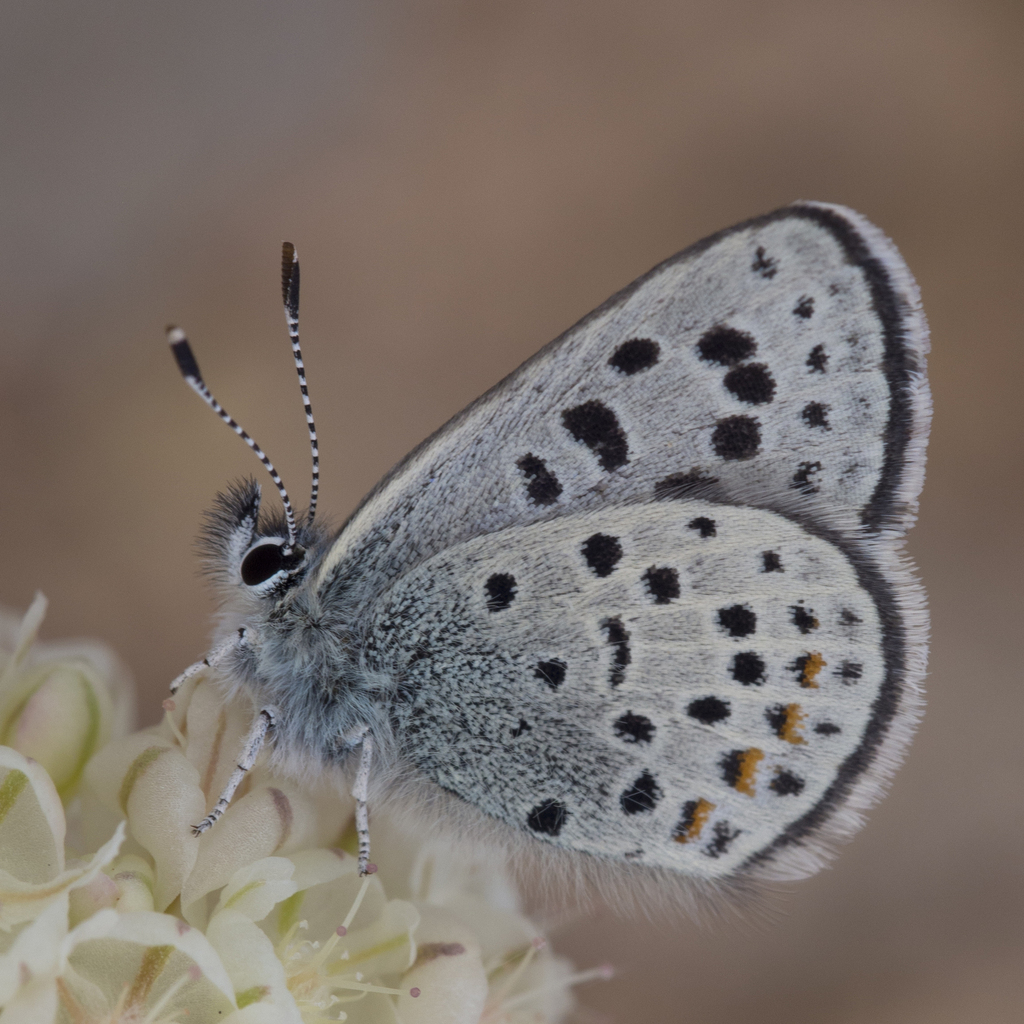
no rights reserved · CC0
Family: Lycaenidae · Class: Insecta · Order: Lepidoptera
Euphilotes ellisi (Ellis' Dotted-Blue) is a California animal in the Lycaenidae family.
Ellis' Dotted-Blue is a small butterfly in the family Lycaenidae, endemic to the western United States. Adults have a wingspan of approximately 20-25 mm (0.8-1.0 inches). Males display bright blue dorsal wing surfaces with narrow black borders, while females are predominantly brown with blue scaling near the wing bases. The ventral wing surfaces of both sexes are pale gray to whitish with distinctive black dots arranged in regular patterns, giving the species its common name. The hindwings feature orange marginal spots along the outer edges. The species ranges from Utah and western Colorado south to northwestern New Mexico and northern Arizona, extending west to Nevada and eastern California. In California, populations occur primarily in the eastern Sierra Nevada and adjacent desert regions, including areas of Mono and Inyo counties. The distribution encompasses elevations from approximately 1,200 to 2,400 meters (4,000 to 8,000 feet) in suitable habitat. Ellis' Dotted-Blue inhabits arid and semi-arid environments, including sagebrush scrub, pinyon-juniper woodland, and desert mountain slopes. The species shows strict host plant specialization, with larvae feeding exclusively on Corybose buckwheat (Eriogonum corymbosoides) and Heerman buckwheat (Eriogonum heermanii). These perennial shrubs typically grow on rocky slopes, canyon walls, and desert washes with well-drained soils. Adults are most commonly observed in areas with scattered host plants interspersed with open spaces for flight and nectar sources. Adults are active during spring and early summer, typically from April through July, depending on elevation and local weather conditions. The species exhibits a single generation per year. Females deposit eggs singly on flower buds or young leaves of host buckwheat plants. Larvae feed on flowers, developing seeds, and occasionally young leaves. The species overwinters as a pupa, with adults emerging the following spring when host plants begin flowering. Adults are weak fliers, typically remaining within a few hundred meters of host plant colonies. Males establish territories near host plants and engage in perching behavior to locate females. Ellis' Dotted-Blue is not currently listed under the federal Endangered Species Act or California's endangered species legislation. However, like many specialist butterflies dependent on specific host plants in arid environments, populations may be vulnerable to habitat degradation and climate change. Primary threats include urban development, mining activities, recreational vehicle use, and invasive plant species that compete with native buckwheat hosts. Drought conditions and shifting precipitation patterns associated with climate change may affect host plant abundance and distribution. Population monitoring data for this species is limited, making assessment of long-term trends difficult. Conservation efforts focus on protecting intact buckwheat communities and managing grazing and recreational impacts in occupied habitats.
Classification
Class: Insecta · Order: Lepidoptera · Family: Lycaenidae
Frequently asked questions
How is Euphilotes ellisi classified?
Euphilotes ellisi belongs to class Insecta, order Lepidoptera, family Lycaenidae.
What family does Euphilotes ellisi belong to?
Euphilotes ellisi is in the Lycaenidae family.
What is Euphilotes ellisi?
Ellis' Dotted-Blue is a small butterfly in the family Lycaenidae, endemic to the western United States.
Is Euphilotes ellisi found in California?
Yes. Euphilotes ellisi is recorded in California in The California Species Project's catalogue.
Related species
Other California species in the same genus, family, or bioregion.
Data from The California Species Project — 14,000+ California species with verified data from CNPS, CDFW, USFWS, and more.