Euphilotes enoptes
Pacific Dotted-Blue
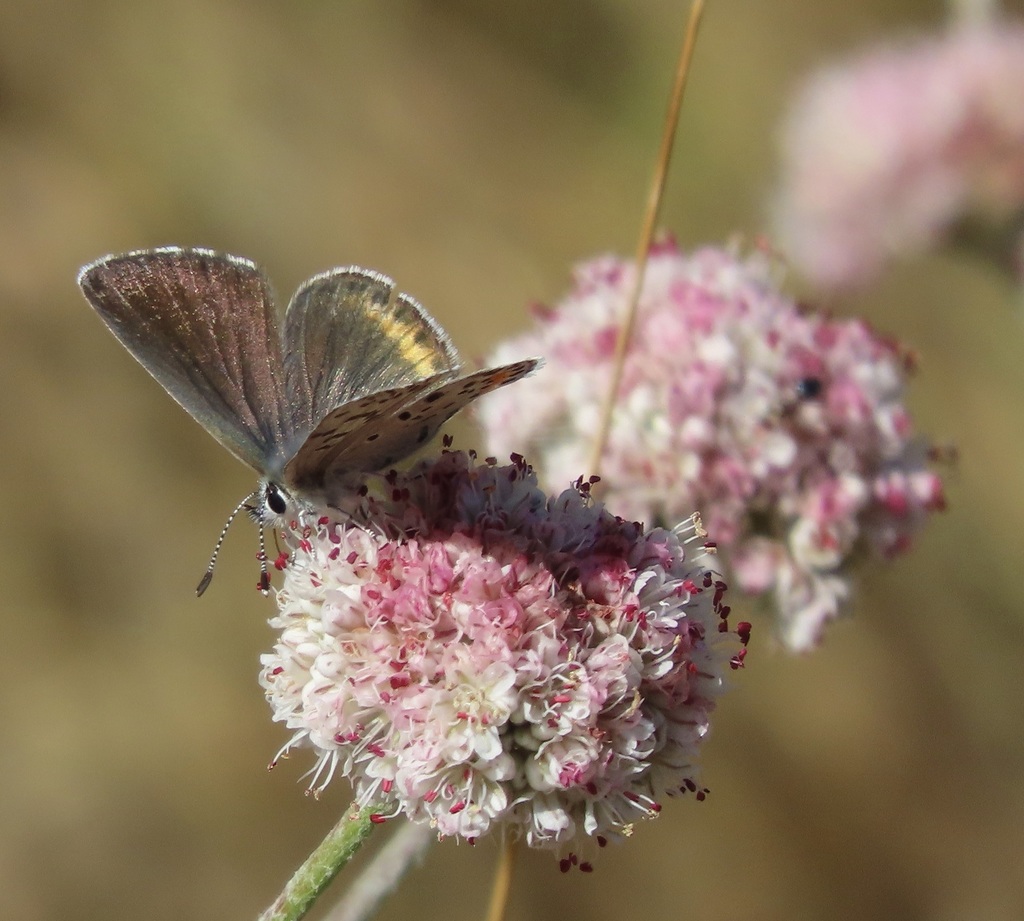
(c) John Hibbard, some rights reserved (CC BY) · licence
Family: Lycaenidae · Class: Insecta · Order: Lepidoptera
Euphilotes enoptes (Pacific Dotted-Blue) is a California animal in the Lycaenidae family.
The Pacific Dotted-Blue is a small butterfly in the family Lycaenidae, with adults measuring approximately 20-25 mm (0.8-1.0 inches) in wingspan. Males display bright blue dorsal wing surfaces with narrow black margins, while females are predominantly brown with blue scaling near the wing bases. The undersides of both sexes are pale gray to white with distinctive black spots arranged in regular patterns across the forewings and hindwings, giving the species its common name. A row of orange submarginal spots is typically present on the hindwing undersides. This species has a scattered distribution throughout the western United States, ranging from Washington south through Pacific Coast states to northern Baja California, with additional populations in Nevada and northwest Arizona. In California, Pacific Dotted-Blue populations occur in various mountain ranges and desert regions where suitable host plants are present. The distribution is often patchy and closely tied to the availability of specific Eriogonum species. Pacific Dotted-Blue butterflies inhabit open, arid to semi-arid environments including chaparral, sagebrush scrub, pinyon-juniper woodlands, and desert regions. They are typically found at elevations ranging from sea level to approximately 2,400 meters (8,000 feet), depending on the geographic location and host plant distribution. The species shows strong fidelity to areas supporting various Eriogonum species, including Nude Buckwheat, Wright's Buckwheat, and Inflated Buckwheat. The species is multivoltine in warmer climates, producing two to three generations per year, while cooler regions may support only one generation annually. Flight periods typically extend from March through October, with peak activity during spring and early summer months. Females deposit eggs singly on flower heads or young leaves of host buckwheat plants. Larvae feed exclusively on Eriogonum flowers and developing seeds, with development closely synchronized to host plant phenology. Caterpillars are often attended by ants, which provide protection in exchange for honeydew secretions. Adults nectar on various wildflowers but show preference for buckwheat blossoms when available. While the Pacific Dotted-Blue is not federally or state-listed as threatened or endangered, local populations may face conservation challenges due to habitat loss and degradation. Urban development, agricultural conversion, and invasive plant species pose threats to native buckwheat communities essential for the butterfly's reproduction. Climate change may alter the distribution and timing of host plant flowering, potentially affecting larval survival and adult emergence patterns. Fire management practices that eliminate or significantly reduce Eriogonum populations can impact local butterfly colonies. Conservation efforts focus on protecting native plant communities and maintaining habitat connectivity across the species' fragmented range.
Classification
Class: Insecta · Order: Lepidoptera · Family: Lycaenidae
Frequently asked questions
How is Euphilotes enoptes classified?
Euphilotes enoptes belongs to class Insecta, order Lepidoptera, family Lycaenidae.
What family does Euphilotes enoptes belong to?
Euphilotes enoptes is in the Lycaenidae family.
What is Euphilotes enoptes?
The Pacific Dotted-Blue is a small butterfly in the family Lycaenidae, with adults measuring approximately 20-25 mm (0.8-1.0 inches) in wingspan.
Is Euphilotes enoptes found in California?
Yes. Euphilotes enoptes is recorded in California in The California Species Project's catalogue.
Related species
Other California species in the same genus, family, or bioregion.
Data from The California Species Project — 14,000+ California species with verified data from CNPS, CDFW, USFWS, and more.