Euphilotes enoptes smithi
Smith’s blue butterfly
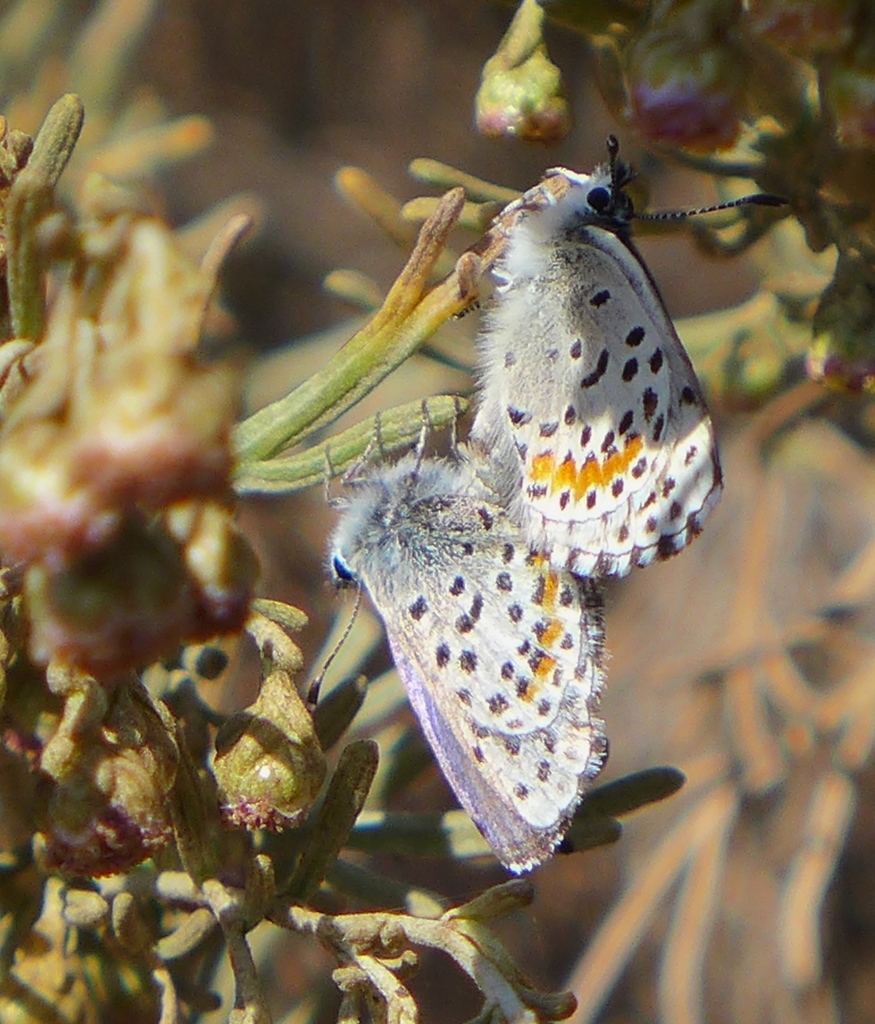
(c) John Hibbard, some rights reserved (CC BY) · licence
Family: Lycaenidae · Class: Insecta · Order: Lepidoptera
Conservation status: Endangered · G5T2 S2
Euphilotes enoptes smithi (Smith’s blue butterfly) is a California animal in the Lycaenidae family.
Smith's blue butterfly (Euphilotes enoptes smithi) is a small lycaenid butterfly endemic to coastal California. Males display bright blue dorsal wing surfaces with narrow black borders, while females are predominantly brown with blue scaling limited to the wing bases. The ventral surfaces of both sexes are pale gray with distinctive black spots circled in white. Adults measure 19 to 25 mm (0.75 to 1.0 inches) in wingspan, making this one of the smaller North American blues. Smith's blue butterfly occurs along a narrow coastal strip from Santa Cruz County south to northern San Luis Obispo County. The species has been documented at fewer than 20 locations, including sites in Monterey Peninsula, Big Sur coast, and scattered populations in Santa Cruz and San Mateo counties. Historical records suggest a more extensive range, but coastal development has eliminated numerous populations. The butterfly's distribution closely follows the range of its host plants along marine terraces and coastal bluffs. The species inhabits coastal dune systems, maritime chaparral, and grassland areas within three kilometers of the Pacific Ocean. Smith's blue butterfly is restricted to elevations below 300 meters (984 feet) where its host plants occur. Critical habitat includes stabilized dunes, coastal scrub communities, and openings in coastal forest. The butterfly requires areas with moderate to high densities of host plants and sheltered microsites for courtship and mating. Smith's blue butterfly is obligately dependent on two host plants in the buckwheat family: seacliff buckwheat (Eriogonum parvifolium) and coast buckwheat (Eriogonum latifolium). Females deposit single eggs on flower buds and developing flower heads of these plants. Larvae feed exclusively on flowers and developing seeds, completing development within the flower heads. The species is univoltine, with adults flying from June through September, peaking in July and August. Males establish territories near host plants and engage in hilltopping behavior on elevated areas. Mating occurs on or near host plants, with females selecting flower heads for oviposition based on developmental stage and plant vigor. The U.S. Fish and Wildlife Service listed Smith's blue butterfly as endangered in 1976, making it one of the first insects to receive federal protection. According to USFWS, populations have declined by more than 90 percent since the 1960s due to coastal development, recreational activities, and habitat degradation. Primary threats include urban development, off-road vehicle use, trampling, invasive plant species, and climate change effects on coastal vegetation. The Monterey Peninsula population faces additional pressure from golf course maintenance and residential development. Recovery efforts focus on habitat protection, invasive species control, and population monitoring. Current population estimates suggest fewer than 3,000 individuals remain across all known sites, with several populations containing fewer than 50 adults.
Classification
Class: Insecta · Order: Lepidoptera · Family: Lycaenidae
Conservation status
Endangered · G5T2 S2
Frequently asked questions
How is Euphilotes enoptes smithi classified?
Euphilotes enoptes smithi belongs to class Insecta, order Lepidoptera, family Lycaenidae.
What family does Euphilotes enoptes smithi belong to?
Euphilotes enoptes smithi is in the Lycaenidae family.
Is Euphilotes enoptes smithi protected or of conservation concern?
Euphilotes enoptes smithi carries the following status: Endangered · G5T2 S2.
What is Euphilotes enoptes smithi?
Smith's blue butterfly (Euphilotes enoptes smithi) is a small lycaenid butterfly endemic to coastal California.
Is Euphilotes enoptes smithi found in California?
Yes. Euphilotes enoptes smithi is recorded in California in The California Species Project's catalogue.
Related species
Other California species in the same genus, family, or bioregion.
Data from The California Species Project — 14,000+ California species with verified data from CNPS, CDFW, USFWS, and more.