Euphilotes glaucon
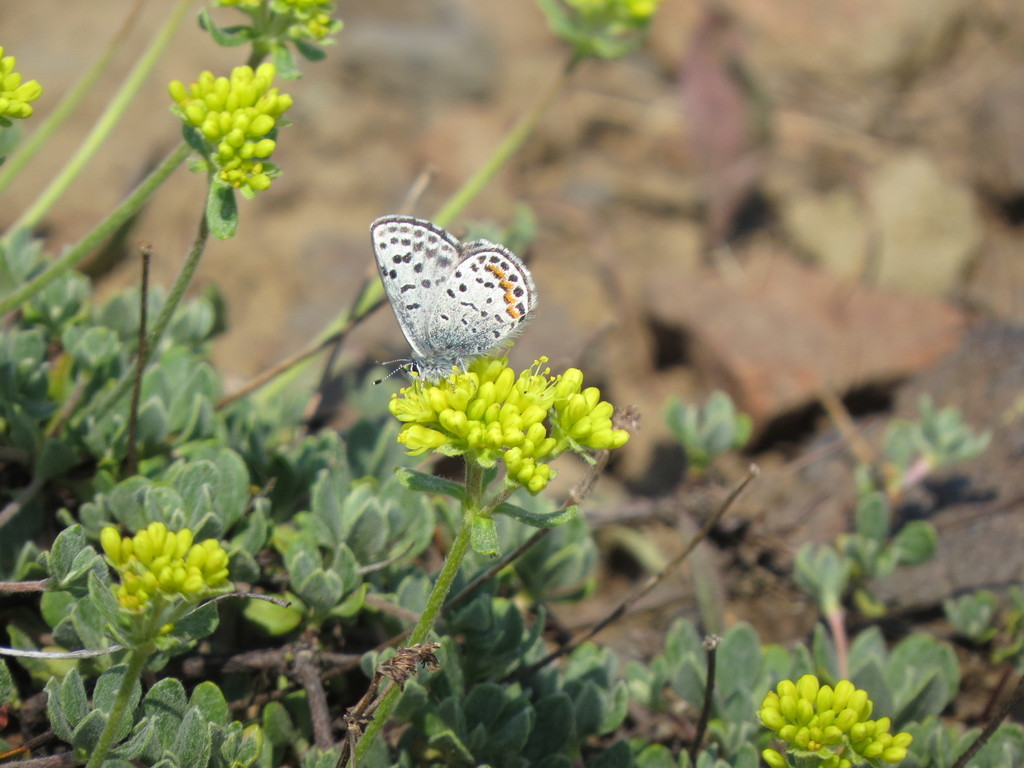
(c) Garth Harwood, some rights reserved (CC BY) · licence
Family: Lycaenidae · Class: Insecta · Order: Lepidoptera
Euphilotes glaucon is a California animal in the Lycaenidae family.
Euphilotes glaucon is a small butterfly in the family Lycaenidae, commonly known as blues, coppers, and hairstreaks. This species belongs to the genus Euphilotes, which comprises several closely related blues found in western North America. Adults are small with a wingspan typically ranging from 19 to 25 mm (0.75 to 1.0 inches). Males display bright blue dorsal wing surfaces with narrow dark borders, while females are generally brown with blue scaling near the wing bases. The ventral wing surfaces of both sexes are pale gray to white with distinctive patterns of small black spots surrounded by white rings, and orange submarginal spots along the hindwing edges. The range and distribution of Euphilotes glaucon remains poorly documented in the scientific literature. This species appears to have a limited distribution within western North America, though specific locality records and the extent of its current range require further taxonomic and field research. The lack of comprehensive survey data makes it difficult to determine whether populations are stable, declining, or fragmented across its range. Habitat requirements for this species are closely tied to the presence of its host plants, which are typically members of the buckwheat family (Eriogonum species). These butterflies inhabit arid and semi-arid environments where wild buckwheats grow, including desert scrublands, chaparral margins, and open woodlands. Elevational preferences and specific microhabitat requirements remain inadequately studied, though related Euphilotes species often occur at elevations ranging from near sea level to over 2,000 meters. Like other members of the genus Euphilotes, this species likely has a close ecological relationship with its Eriogonum host plants. Females deposit eggs on flower buds or young leaves of the host plant, and larvae develop by feeding on flowers, seeds, and occasionally leaves. The larvae are typically tended by ants, which provide protection in exchange for sugary secretions produced by specialized glands. This mutualistic relationship is characteristic of many Lycaenidae species. Adults are active during warm periods and visit flowers for nectar, with males often establishing territories near host plants. The conservation status of Euphilotes glaucon is uncertain due to limited taxonomic clarity and insufficient survey data. The species lacks federal or state conservation listings, though this may reflect knowledge gaps rather than population stability. Many Euphilotes species face threats from habitat loss due to urban development, agricultural conversion, and invasive plant species that displace native buckwheat host plants. Climate change may also affect this species through altered precipitation patterns and temperature regimes that impact both the butterfly and its host plants. Improved taxonomic research and systematic surveys are needed to assess population trends and conservation needs for this poorly known species.
Classification
Class: Insecta · Order: Lepidoptera · Family: Lycaenidae
Frequently asked questions
How is Euphilotes glaucon classified?
Euphilotes glaucon belongs to class Insecta, order Lepidoptera, family Lycaenidae.
What family does Euphilotes glaucon belong to?
Euphilotes glaucon is in the Lycaenidae family.
What is Euphilotes glaucon?
Euphilotes glaucon is a small butterfly in the family Lycaenidae, commonly known as blues, coppers, and hairstreaks.
Is Euphilotes glaucon found in California?
Yes. Euphilotes glaucon is recorded in California in The California Species Project's catalogue.
Related species
Other California species in the same genus, family, or bioregion.
Data from The California Species Project — 14,000+ California species with verified data from CNPS, CDFW, USFWS, and more.