Euphilotes glaucon comstocki
Comstock's Blue Butterfly
no rights reserved · CC0
Family: Lycaenidae · Class: Insecta · Order: Lepidoptera
Conservation status: G5T2 S2
Euphilotes glaucon comstocki (Comstock's Blue Butterfly) is a California animal in the Lycaenidae family.
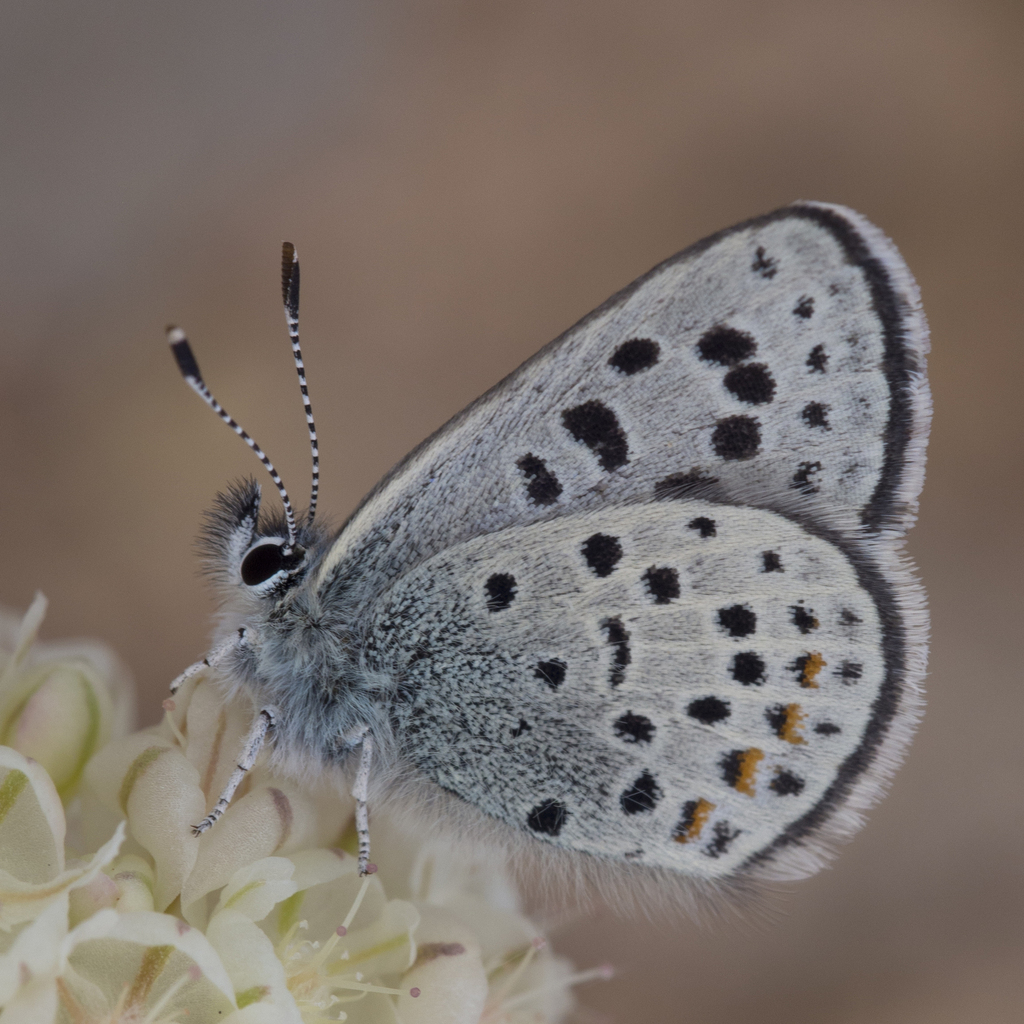
Comstock's Blue Butterfly (Euphilotes glaucon comstocki) is a small lycaenid butterfly subspecies endemic to California. Adults have a wingspan of approximately 18-25 mm (0.7-1.0 inches), with males displaying bright blue dorsal wing surfaces bordered by thin dark margins. Females are brown with blue scaling near the wing bases and orange marginal spots on the hindwings. The ventral wing surfaces of both sexes are pale gray with distinctive black spots and orange submarginal crescents, typical of the Euphilotes genus. This subspecies is restricted to a limited range in California, primarily occurring in the coastal mountains and valleys of central and southern regions. Historical records indicate populations in San Luis Obispo, Santa Barbara, and Monterey counties, though current distribution may be more fragmented. The subspecies represents one of several geographic variants within the broader Euphilotes glaucon complex, which extends from California to Texas. Comstock's Blue Butterfly inhabits areas where its host plants occur, typically in coastal sage scrub, chaparral, and oak woodland environments at elevations ranging from sea level to approximately 1,500 meters (4,920 feet). The species shows strong fidelity to sites supporting its larval host plants from the stonecrop family (Crassulaceae), particularly Dudleya species. Adults are most commonly observed on hillsides and canyon slopes where these succulent plants grow in rocky or sandy soils. Adults typically fly during spring months, with peak activity occurring from March through May depending on elevation and local weather conditions. Males engage in territorial behavior, perching on prominent vegetation or rocks while searching for females. Mated females deposit eggs singly on or near host plant buds and leaves. Larvae feed within the developing flower heads and seed capsules of Dudleya plants, completing their development before pupating in the soil or plant debris nearby. The species exhibits an annual life cycle, overwintering as pupae. With a Global/State Rank of G5T2 S2, Comstock's Blue Butterfly is considered imperiled both globally as a subspecies and within California. The T2 ranking indicates this subspecies faces a high risk of extinction, while the S2 designation reflects similar vulnerability within the state. Primary threats include habitat loss from urban development, particularly in coastal California where suitable habitat overlaps with areas of high development pressure. Additional threats may include invasive plant species that displace native host plants, altered fire regimes, and climate change effects on the specialized relationship between the butterfly and its Dudleya hosts. The species' narrow host plant requirements and restricted distribution make it particularly vulnerable to environmental changes. Conservation efforts would benefit from habitat protection, invasive species management, and monitoring of remaining populations to assess population trends and habitat quality.
Classification
Class: Insecta · Order: Lepidoptera · Family: Lycaenidae
Conservation status
G5T2 S2
Frequently asked questions
How is Euphilotes glaucon comstocki classified?
Euphilotes glaucon comstocki belongs to class Insecta, order Lepidoptera, family Lycaenidae.
What family does Euphilotes glaucon comstocki belong to?
Euphilotes glaucon comstocki is in the Lycaenidae family.
Is Euphilotes glaucon comstocki protected or of conservation concern?
Euphilotes glaucon comstocki carries the following status: G5T2 S2.
What is Euphilotes glaucon comstocki?
Comstock's Blue Butterfly (Euphilotes glaucon comstocki) is a small lycaenid butterfly subspecies endemic to California.
Is Euphilotes glaucon comstocki found in California?
Yes. Euphilotes glaucon comstocki is recorded in California in The California Species Project's catalogue.
Related species
Other California species in the same genus, family, or bioregion.
Data from The California Species Project — 14,000+ California species with verified data from CNPS, CDFW, USFWS, and more.