Euphilotes mojave
Mojave Dotted-blue
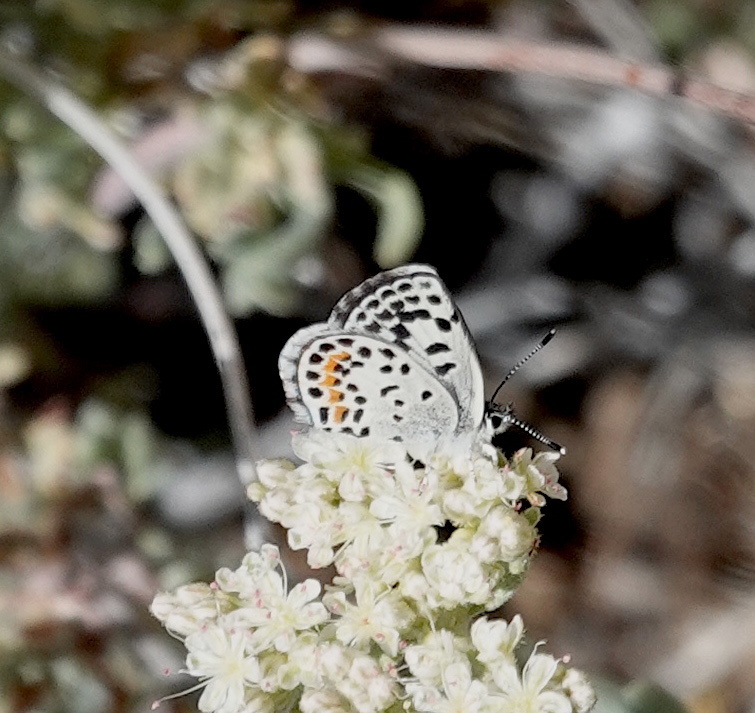
(c) desertnaturalist, some rights reserved (CC BY) · licence
Family: Lycaenidae · Class: Insecta · Order: Lepidoptera
Conservation status: G3 S3
Euphilotes mojave (Mojave Dotted-blue) is a California animal in the Lycaenidae family.
The Mojave Dotted-blue is a small butterfly endemic to the southwestern United States and northwestern Mexico. Adults have a wingspan of 15 to 20 mm (0.6 to 0.8 inches), making it one of the smaller lycaenid butterflies in North America. Males display bright blue dorsal wing surfaces with narrow black margins, while females are predominantly brown with blue scaling limited to the wing bases. The ventral wing surfaces of both sexes are pale gray to white with distinctive black spots arranged in regular rows, giving the species its common name. A submarginal band of orange crescents is present on the hindwings. The species occurs in the Mojave Desert region of southeastern California, southern Nevada, southeastern Utah, and northwestern Arizona, with a small isolated population in northern Baja California. In California, the butterfly is documented from the eastern Mojave Desert, including areas in San Bernardino County. The distribution closely follows that of its host plants across desert basins and bajadas between 300 and 1,500 meters (980 to 4,920 feet) elevation. Mojave Dotted-blue butterflies inhabit open desert scrubland characterized by sparse vegetation and sandy or gravelly soils. The species shows strict fidelity to areas containing its host plants, low-growing buckwheat species including Eriogonum pusillum and Eriogonum reniforme. These perennial herbs typically grow in washes, flats, and gentle slopes where winter moisture accumulates. The butterflies are most commonly observed in microhabitats with scattered shrubs providing wind protection and nectar sources. Adults are active from March through May, with peak flight occurring in April during favorable weather conditions. Males establish territories near host plant patches and engage in aerial encounters with intruders. Mating occurs on or near the host plants, where females subsequently deposit single eggs on flower buds and young leaves. Larvae feed exclusively on the flowers, developing seeds, and tender foliage of Eriogonum species. The species completes one generation per year, with larvae entering diapause during summer heat and pupating the following spring. Adults nectar on various desert wildflowers including desert lupine, desert marigold, and brittlebush when available. The Mojave Dotted-blue has a Global Conservation Status of G3 (vulnerable) and State Conservation Status of S3 (vulnerable) in California, indicating moderate risk of extinction. The species faces threats from habitat destruction due to urban development, off-road vehicle use, and renewable energy projects in desert areas. Climate change poses additional risks through altered precipitation patterns and increased drought frequency, which affect host plant availability and quality. Livestock grazing can degrade habitat by trampling host plants and altering soil structure. The fragmented nature of suitable habitat and the species' limited dispersal ability make populations vulnerable to local extirpations. Conservation efforts focus on habitat protection within existing reserves and monitoring of known populations to track population trends.
Classification
Class: Insecta · Order: Lepidoptera · Family: Lycaenidae
Conservation status
G3 S3
Frequently asked questions
How is Euphilotes mojave classified?
Euphilotes mojave belongs to class Insecta, order Lepidoptera, family Lycaenidae.
What family does Euphilotes mojave belong to?
Euphilotes mojave is in the Lycaenidae family.
Is Euphilotes mojave protected or of conservation concern?
Euphilotes mojave carries the following status: G3 S3.
What is Euphilotes mojave?
The Mojave Dotted-blue is a small butterfly endemic to the southwestern United States and northwestern Mexico.
Is Euphilotes mojave found in California?
Yes. Euphilotes mojave is recorded in California in The California Species Project's catalogue.
Related species
Other California species in the same genus, family, or bioregion.
Data from The California Species Project — 14,000+ California species with verified data from CNPS, CDFW, USFWS, and more.