Euphilotes pallescens
Pallid Dotted-Blue
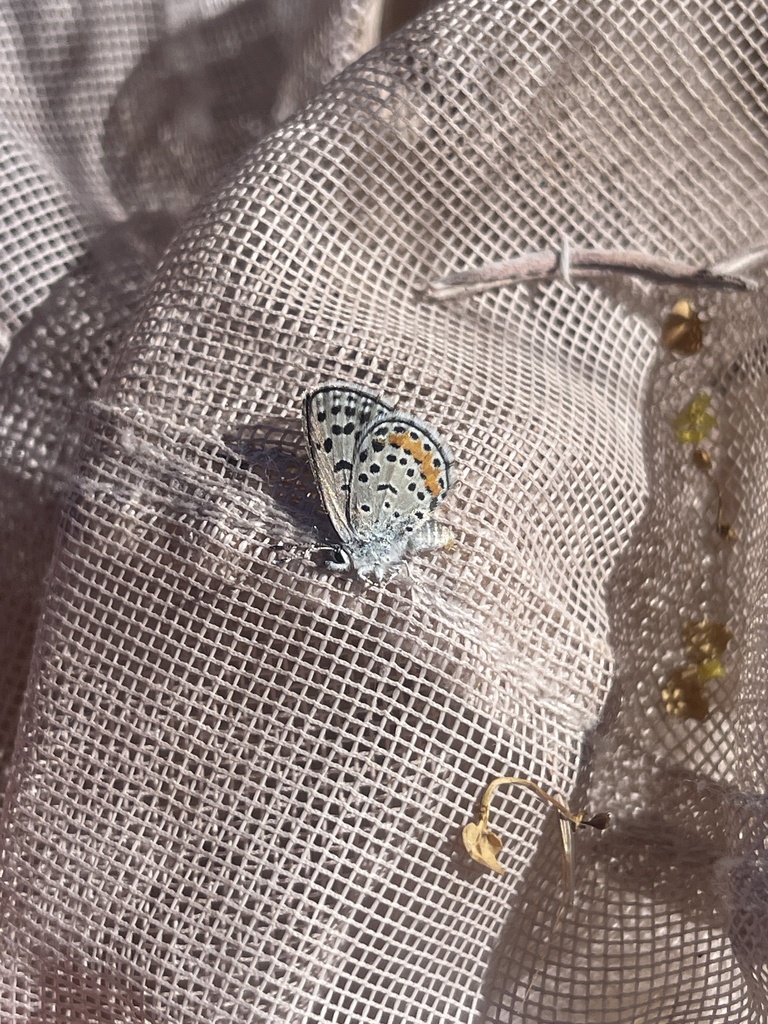
no rights reserved · CC0
Family: Lycaenidae · Class: Insecta · Order: Lepidoptera
Euphilotes pallescens (Pallid Dotted-Blue) is a California animal in the Lycaenidae family.
The Pallid Dotted-Blue is a small butterfly in the family Lycaenidae, characterized by its diminutive size and distinctive pale coloration. Adults have a wingspan measuring approximately 18 to 22 mm (0.7 to 0.9 inches). The dorsal wing surfaces of males display a pale blue-gray coloration with subtle iridescent qualities, while females exhibit brownish-gray tones. The ventral wing surfaces are pale gray to whitish with a series of small dark spots arranged in regular patterns, giving the species its common name. The wings have delicate white fringes, and the hindwings lack tails, distinguishing this species from related lycaenids. The Pallid Dotted-Blue occupies a range spanning southeast California, Nevada, southern Utah, and northern Arizona. In California, the species is documented from the Mojave Desert region, including areas of San Bernardino County and portions of Riverside and Imperial counties. This distribution represents the western extent of the species' range, which extends eastward through the Great Basin and Colorado Plateau regions. This butterfly inhabits arid shrubland and desert communities at elevations ranging from approximately 300 to 1,500 meters (980 to 4,920 feet). The species shows strong habitat association with areas supporting its host plants, wild buckwheat species including Kearney's Buckwheat (Eriogonum kearneyi) and Plumate Buckwheat (Eriogonum plumatella). These host plants typically occur on sandy or gravelly soils in desert washes, alluvial fans, and gentle slopes within creosote bush scrub and mixed desert shrub communities. Adult Pallid Dotted-Blues are active during spring months, typically from March through May, coinciding with the flowering period of their buckwheat hosts. Males engage in territorial behavior, perching on elevated positions near host plants and pursuing other males that enter their territories. Mating occurs on or near the host plants, with females laying eggs singly on flower buds or young leaves of buckwheat species. Larvae develop within the flower heads, feeding on developing seeds and flowers. The species completes one generation per year, with pupation occurring in late spring or early summer. Adults exhibit close behavioral association with their host plants, rarely venturing far from buckwheat patches. The conservation status of the Pallid Dotted-Blue reflects the challenges facing many desert-adapted insects. While not federally or state-listed, the species faces ongoing threats from habitat loss due to urban development, renewable energy projects, and off-road vehicle activities within its desert range. Climate change poses additional concerns through altered precipitation patterns that affect host plant phenology and distribution. The species' dependence on specific buckwheat hosts makes it vulnerable to factors affecting these plants, including drought, invasive species competition, and habitat fragmentation. Populations may be naturally patchy due to the scattered distribution of suitable host plant communities across the desert landscape.
Classification
Class: Insecta · Order: Lepidoptera · Family: Lycaenidae
Frequently asked questions
How is Euphilotes pallescens classified?
Euphilotes pallescens belongs to class Insecta, order Lepidoptera, family Lycaenidae.
What family does Euphilotes pallescens belong to?
Euphilotes pallescens is in the Lycaenidae family.
What is Euphilotes pallescens?
The Pallid Dotted-Blue is a small butterfly in the family Lycaenidae, characterized by its diminutive size and distinctive pale coloration.
Is Euphilotes pallescens found in California?
Yes. Euphilotes pallescens is recorded in California in The California Species Project's catalogue.
Related species
Other California species in the same genus, family, or bioregion.
Data from The California Species Project — 14,000+ California species with verified data from CNPS, CDFW, USFWS, and more.