Euphydryas chalcedona
Chalcedon Checkerspot
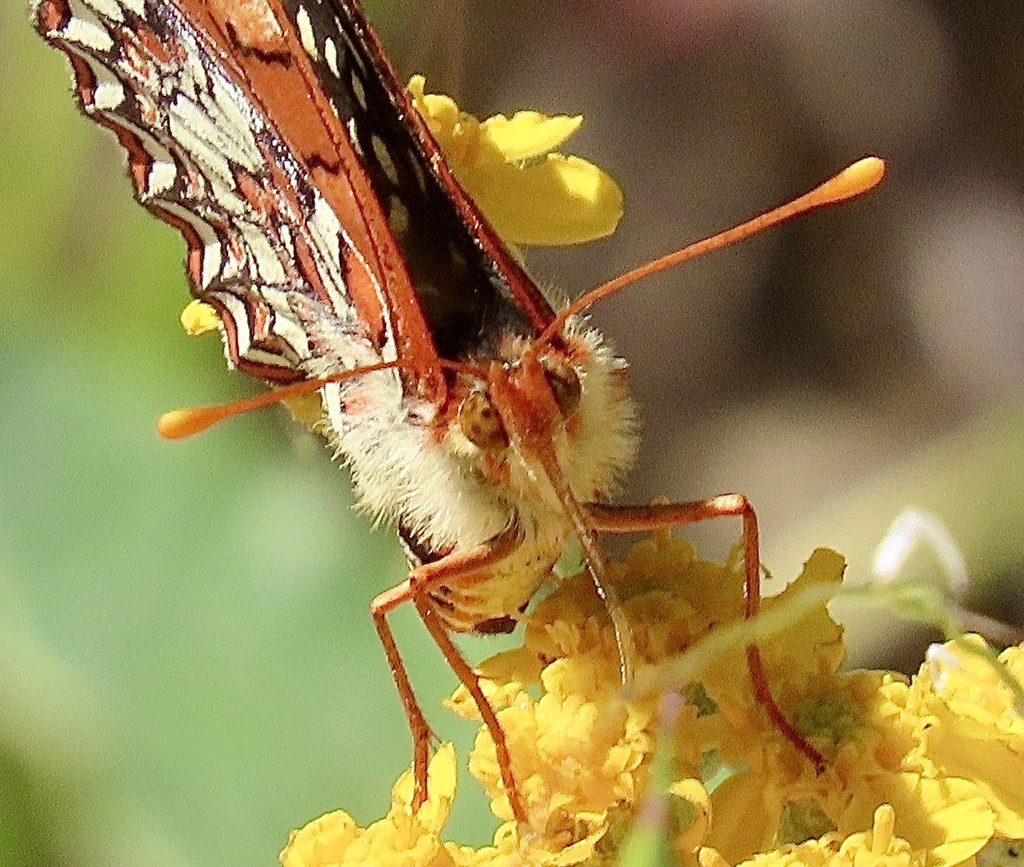
no rights reserved · CC0
Family: Nymphalidae · Class: Insecta · Order: Lepidoptera
Euphydryas chalcedona (Chalcedon Checkerspot) is a California animal in the Nymphalidae family.
The Chalcedon Checkerspot is a medium-sized butterfly in the family Nymphalidae, with a wingspan typically ranging from 38 to 51 mm (1.5 to 2.0 inches). Adults display a distinctive checkerboard pattern of black markings on an orange-red background, with white spots scattered across the wings. The forewings show a series of orange and black bands, while the hindwings feature rows of white and orange spots bordered by black lines. Sexual dimorphism is evident, with females generally larger and displaying more muted coloration compared to males. The ventral wing surfaces are lighter, with cream-colored spots and reduced black markings. The Chalcedon Checkerspot has an extensive range extending from Alaska south along the Pacific Coast through California and Arizona to Baja California and Mexico, and eastward to Montana, the Dakotas, Wyoming, Colorado, and New Mexico. In California, the species occurs throughout much of the state, from coastal areas to montane regions, demonstrating considerable ecological adaptability across diverse geographic zones. This species inhabits a variety of open habitats including grasslands, chaparral, oak woodlands, mountain meadows, and sagebrush communities. Elevation range extends from sea level to approximately 3,000 meters (9,840 feet), with populations adapted to local climatic conditions. The butterflies prefer areas with scattered shrubs and trees that provide nectar sources and shelter, often found on hillsides, canyon bottoms, and forest clearings with adequate sun exposure. Chalcedon Checkerspots are univoltine, producing one generation per year. Adults typically emerge from late spring through early fall, with flight periods varying by elevation and latitude. Peak activity occurs during warm, sunny days when adults engage in nectar feeding and mating behaviors. The species demonstrates extensive host plant diversity, utilizing plants from the Scrophulariaceae family including Besseya, penstemon, and Indian paintbrush, as well as snowberry and honeysuckle from Caprifoliaceae. Additional host plants span several families including Boraginaceae and Rosaceae. Females lay eggs in clusters on host plant leaves, and larvae feed gregariously during early instars before becoming solitary. The species overwinters as partially grown larvae, resuming development the following spring. Currently, the Chalcedon Checkerspot holds no federal or state conservation listing status, reflecting its relatively stable population across its broad geographic range. The species' extensive host plant repertoire and habitat flexibility contribute to its ecological resilience. However, localized populations may face pressures from habitat modification, urbanization, and altered fire regimes in some regions. Climate change could affect montane populations through shifting temperature and precipitation patterns, potentially altering the timing of life cycle events and host plant phenology.
Classification
Class: Insecta · Order: Lepidoptera · Family: Nymphalidae
Frequently asked questions
How is Euphydryas chalcedona classified?
Euphydryas chalcedona belongs to class Insecta, order Lepidoptera, family Nymphalidae.
What family does Euphydryas chalcedona belong to?
Euphydryas chalcedona is in the Nymphalidae family.
What is Euphydryas chalcedona?
The Chalcedon Checkerspot is a medium-sized butterfly in the family Nymphalidae, with a wingspan typically ranging from 38 to 51 mm (1.5 to 2.0 inches).
Is Euphydryas chalcedona found in California?
Yes. Euphydryas chalcedona is recorded in California in The California Species Project's catalogue.
Related species
Other California species in the same genus, family, or bioregion.
Data from The California Species Project — 14,000+ California species with verified data from CNPS, CDFW, USFWS, and more.