Euphydryas editha
Edith's Checkerspot
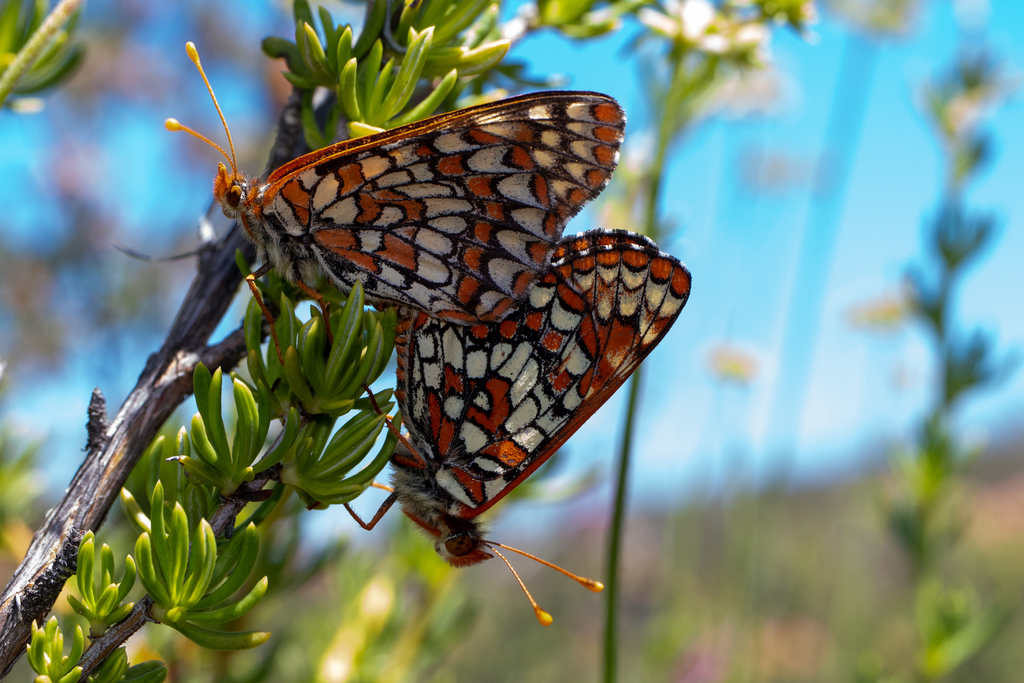
(c) Jess Mullins, some rights reserved (CC BY) · licence
Family: Nymphalidae · Class: Insecta · Order: Lepidoptera
Euphydryas editha (Edith's Checkerspot) is a California animal in the Nymphalidae family.
Edith's checkerspot is a medium-sized butterfly with a wingspan ranging from 32 to 51 mm (1.3 to 2.0 inches). The dorsal wing surfaces display a distinctive checkerboard pattern of orange, black, and cream-colored spots, with significant variation among populations and subspecies. Males are typically smaller and more brightly colored than females. The ventral hindwings feature bands of red-orange and cream spots bordered by black lines. Adults exhibit considerable geographic variation in size, coloration, and wing pattern across their range. This species occurs from southern British Columbia and Alberta south through the western United States to Baja California, Nevada, Utah, and Colorado. In California, Edith's checkerspot populations are distributed across multiple mountain ranges and elevations, from coastal areas to high-elevation meadows. The species demonstrates extensive local adaptation, with distinct populations often isolated by geographic barriers and habitat fragmentation. Edith's checkerspot inhabits diverse environments including serpentine grasslands, chaparral openings, montane meadows, and alpine zones. Elevational range extends from near sea level to over 3,000 meters (9,800 feet). The species requires areas with suitable host plants and nectar sources in close proximity. Many populations are associated with specific soil types, particularly serpentine soils in coastal California, which support specialized plant communities. This butterfly is univoltine, producing one generation per year. Adults typically emerge in late spring or early summer, depending on elevation and local climate conditions. Mating occurs shortly after emergence, and females deposit clusters of eggs on or near host plants. Larvae feed on various species of paintbrush (Castilleja), beardtongues (Penstemon), lousewort (Pedicularis), owl's clover (Orthocarpus), Chinese houses (Collinsia), and plantain (Plantago). Caterpillars undergo diapause during late larval stages, allowing them to survive through winter and early spring when host plants may be dormant or unavailable. Development is closely synchronized with host plant phenology. While Edith's checkerspot as a species is not federally listed, several subspecies face conservation concerns due to habitat loss and fragmentation. The Bay checkerspot (E. e. bayensis) is federally endangered, and Quino checkerspot (E. e. quino) is federally endangered. Primary threats include urban development, agricultural conversion, invasive plant species, altered fire regimes, and climate change. Many populations are restricted to small, isolated habitat patches, making them vulnerable to local extinction. Conservation efforts focus on habitat protection, restoration of native plant communities, and management of grazing and fire cycles to maintain suitable conditions for both the butterfly and its host plants.
Classification
Class: Insecta · Order: Lepidoptera · Family: Nymphalidae
Frequently asked questions
How is Euphydryas editha classified?
Euphydryas editha belongs to class Insecta, order Lepidoptera, family Nymphalidae.
What family does Euphydryas editha belong to?
Euphydryas editha is in the Nymphalidae family.
What is Euphydryas editha?
Edith's checkerspot is a medium-sized butterfly with a wingspan ranging from 32 to 51 mm (1.3 to 2.0 inches).
Is Euphydryas editha found in California?
Yes. Euphydryas editha is recorded in California in The California Species Project's catalogue.
Related species
Other California species in the same genus, family, or bioregion.
Data from The California Species Project — 14,000+ California species with verified data from CNPS, CDFW, USFWS, and more.