Euphydryas editha bayensis
Bay checkerspot butterfly
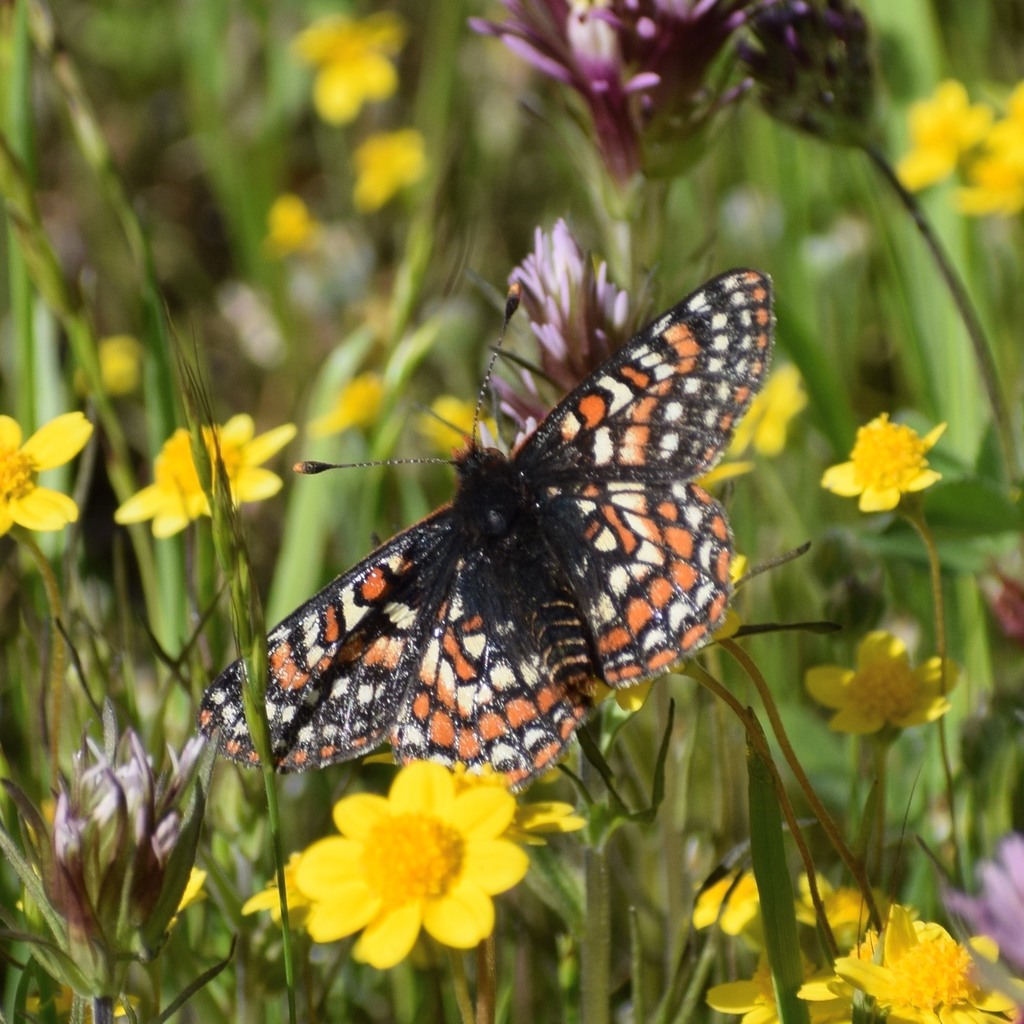
no rights reserved · CC0
Family: Nymphalidae · Class: Insecta · Order: Lepidoptera
Conservation status: Threatened · G4G5T1 S3
Euphydryas editha bayensis (Bay checkerspot butterfly) is a California animal in the Nymphalidae family.
The Bay checkerspot butterfly is a medium-sized butterfly with a wingspan of 4.4 to 6.0 centimeters (1.7 to 2.4 inches). Adults display a distinctive checkerboard pattern of orange, white, and black markings on the dorsal wing surfaces. The forewings feature rows of orange and white spots separated by black bands, while the hindwings show similar but more muted coloration. Females are typically larger than males and have broader wings with more pronounced orange coloration. The ventral wing surfaces are lighter, with cream and pale orange spots bordered by thin black lines. Historically, the Bay checkerspot butterfly was widely distributed to the east, west, and south of San Francisco Bay. The species is now limited to six core areas on the west and southern edges of the Bay, representing a dramatic range reduction from its original distribution. Current populations are documented in San Mateo County, Santa Clara County, and Alameda County, with the largest remaining populations occurring at Edgewood County Park, Coyote Ridge, and areas within the Santa Clara Valley. The Bay checkerspot butterfly is restricted to specialized habitat on serpentine-derived soils that support native grasslands. These serpentine grasslands are characterized by sparse vegetation, shallow soils with high concentrations of heavy metals, and distinct seasonal moisture patterns. The species occurs primarily on south-facing slopes and ridge tops at elevations ranging from 30 to 500 meters (100 to 1,640 feet). The habitat experiences Mediterranean climate conditions with wet winters and dry summers, creating the seasonally dry conditions essential for the butterfly's host plants. Bay checkerspot larvae are dependent on two primary larval host plants: dwarf plantain (Plantago erecta) and owl's clover (Castilleja species), both adapted to the specialized serpentine soil conditions. Adults emerge in March and April, with peak flight activity occurring during warm, sunny days. Mating occurs shortly after emergence, and females deposit clusters of 20 to 300 pale yellow eggs on or near host plants. Larvae feed communally in early instars, then overwinter as partially grown caterpillars in a state of diapause. The species completes one generation per year, with development closely synchronized to the phenology of its host plants and the Mediterranean climate cycle. The U.S. Fish and Wildlife Service listed the Bay checkerspot butterfly as threatened under the Endangered Species Act in 1987. The species is in long-term decline throughout its range due to habitat loss from urban development, recreational activities, and inappropriate land management practices such as overgrazing and invasive species introduction. Climate change poses additional threats through altered precipitation patterns that can disrupt the timing between larval development and host plant availability. Current population estimates indicate fewer than 25,000 individuals remain across all sites, with several populations experiencing significant year-to-year fluctuations. Conservation efforts include habitat restoration, invasive species control, and protection of remaining serpentine grassland areas through land acquisition and management agreements.
Classification
Class: Insecta · Order: Lepidoptera · Family: Nymphalidae
Conservation status
Threatened · G4G5T1 S3
Frequently asked questions
How is Euphydryas editha bayensis classified?
Euphydryas editha bayensis belongs to class Insecta, order Lepidoptera, family Nymphalidae.
What family does Euphydryas editha bayensis belong to?
Euphydryas editha bayensis is in the Nymphalidae family.
Is Euphydryas editha bayensis protected or of conservation concern?
Euphydryas editha bayensis carries the following status: Threatened · G4G5T1 S3.
What is Euphydryas editha bayensis?
The Bay checkerspot butterfly is a medium-sized butterfly with a wingspan of 4.4 to 6.0 centimeters (1.7 to 2.4 inches).
Is Euphydryas editha bayensis found in California?
Yes. Euphydryas editha bayensis is recorded in California in The California Species Project's catalogue.
Related species
Other California species in the same genus, family, or bioregion.
Data from The California Species Project — 14,000+ California species with verified data from CNPS, CDFW, USFWS, and more.