Euphydryas editha quino
Quino checkerspot butterfly
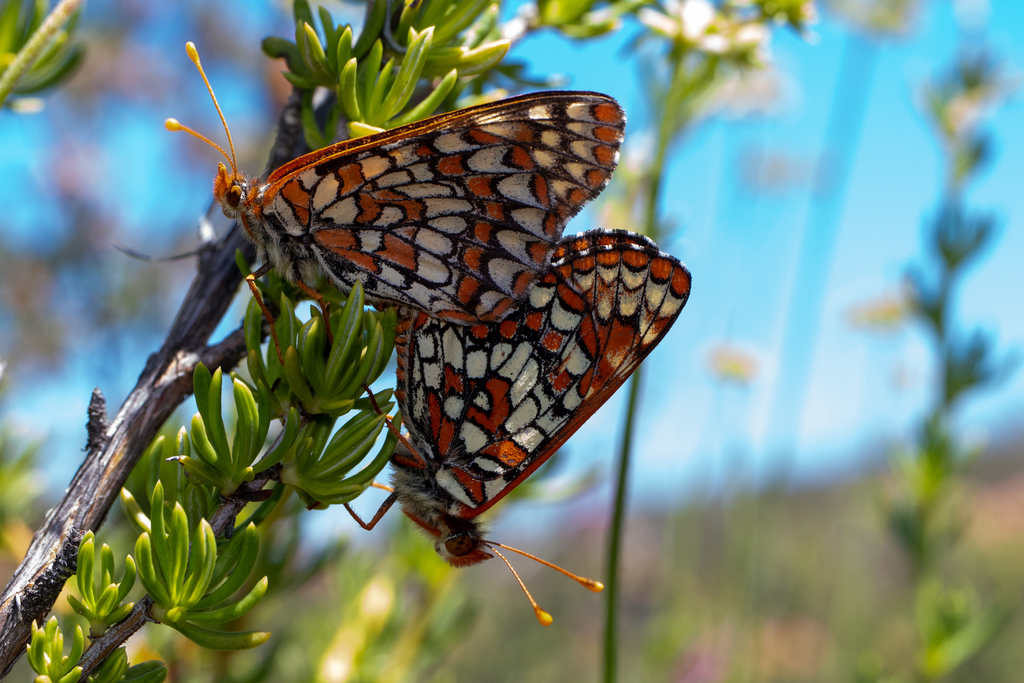
(c) Jess Mullins, some rights reserved (CC BY) · licence
Family: Nymphalidae · Class: Insecta · Order: Lepidoptera
Conservation status: Endangered · G4G5T1T2 S1S2
Euphydryas editha quino (Quino checkerspot butterfly) is a California animal in the Nymphalidae family.
The Quino checkerspot butterfly (Euphydryas editha quino) is a medium-sized butterfly with a wingspan of 32 to 51 mm (1.3 to 2.0 inches). Adults display a distinctive checkerboard pattern of orange, red, and cream-colored spots bordered by black lines on the dorsal wing surfaces. The ventral hindwings are predominantly cream to white with orange and black markings. Males are typically smaller than females and exhibit more vibrant coloration. The species is synonymous with Euphydryas editha wrighti, according to the California Department of Fish and Wildlife. The Quino checkerspot butterfly occurs in southern California and northern Mexico. In California, the species is found primarily in Riverside, Orange, and San Diego counties, with historical records from Los Angeles County. The butterfly inhabits areas below 1,500 meters (4,900 feet) in elevation, though most populations occur between 400 and 1,000 meters (1,300 to 3,300 feet). Current populations are highly fragmented, with fewer than 20 known occupied sites remaining. This species requires specific habitat conditions including open areas with sparse shrub cover, gentle slopes, and appropriate host plants. The butterfly occurs in coastal sage scrub, chaparral openings, grasslands, and disturbed areas such as dirt roads and firebreaks. Soils are typically clay-based with good water retention. The patchy distribution of suitable microhabitat creates a metapopulation structure essential for the species' persistence. Quino checkerspot larvae feed exclusively on native annual plants including dwarf plantain (Plantago erecta), woolly plantain (P. patagonica), white snapdragon (Antirrhinum coulterianum), rigid bird's-beak (Cordylanthus rigidus), and Indian paintbrush (Castilleja exserta). Adults emerge from late February through May, depending on elevation and seasonal conditions. Females deposit clusters of 50 to 300 eggs on host plants. Larvae develop through six instars, entering diapause as fourth instars during summer drought. The species has a one-year life cycle, though some individuals may remain dormant for multiple years during unfavorable conditions. The U.S. Fish and Wildlife Service listed the Quino checkerspot butterfly as endangered in 1997. Population surveys indicate severe decline, with estimates suggesting fewer than 4,000 individuals remain across all known sites. Primary threats include habitat loss and fragmentation due to urban development, agriculture, and infrastructure projects. Altered fire regimes, invasive plant species, nitrogen deposition, and climate change further compromise remaining habitat. The species is particularly vulnerable to extended drought periods that reduce host plant availability. Recovery efforts focus on habitat protection, restoration of degraded areas, and captive breeding programs. Several populations occur on protected lands including state parks and military installations, though long-term viability remains uncertain without continued conservation intervention.
Classification
Class: Insecta · Order: Lepidoptera · Family: Nymphalidae
Conservation status
Endangered · G4G5T1T2 S1S2
Frequently asked questions
How is Euphydryas editha quino classified?
Euphydryas editha quino belongs to class Insecta, order Lepidoptera, family Nymphalidae.
What family does Euphydryas editha quino belong to?
Euphydryas editha quino is in the Nymphalidae family.
Is Euphydryas editha quino protected or of conservation concern?
Euphydryas editha quino carries the following status: Endangered · G4G5T1T2 S1S2.
What is Euphydryas editha quino?
The Quino checkerspot butterfly (Euphydryas editha quino) is a medium-sized butterfly with a wingspan of 32 to 51 mm (1.3 to 2.0 inches).
Is Euphydryas editha quino found in California?
Yes. Euphydryas editha quino is recorded in California in The California Species Project's catalogue.
Related species
Other California species in the same genus, family, or bioregion.
Data from The California Species Project — 14,000+ California species with verified data from CNPS, CDFW, USFWS, and more.