Euphydryas editha taylori
Taylor's (=whulge) Checkerspot
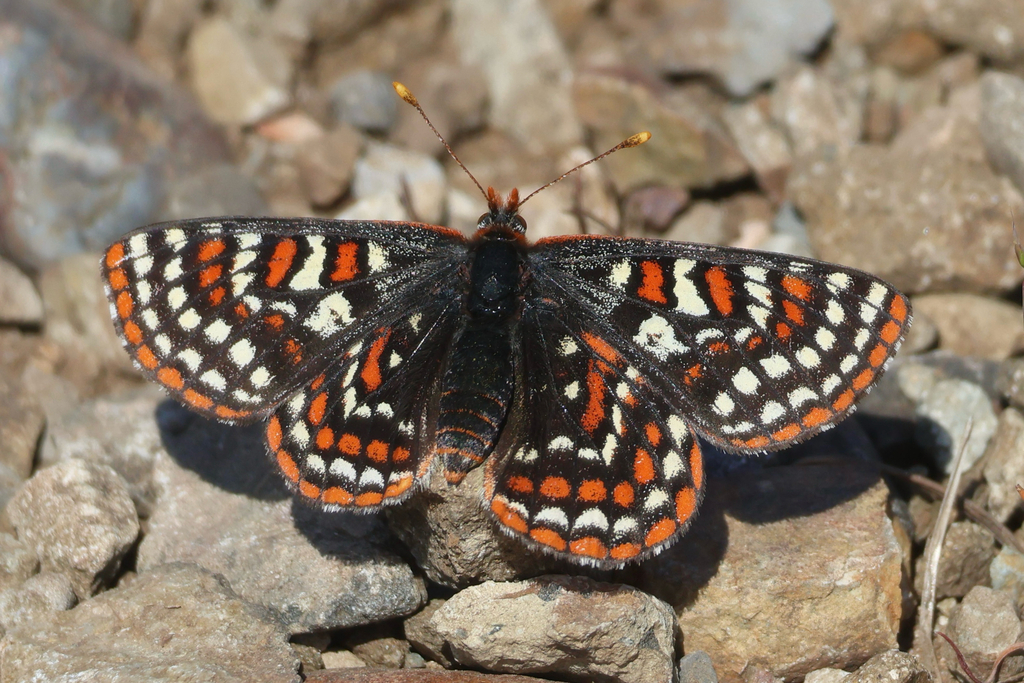
no rights reserved · CC0
Family: Nymphalidae · Class: Insecta · Order: Lepidoptera
Conservation status: Endangered
Euphydryas editha taylori (Taylor's (=whulge) Checkerspot) is a California animal in the Nymphalidae family.
Taylor's checkerspot is a medium-sized butterfly with a wingspan of 5.7 centimeters (2.25 inches), distinguished by its conspicuous checkered pattern of orange to brick red, black, and cream coloration (USFWS). The ventral wing surfaces are primarily black and orange with bands of cream cells, while the dorsal wings display a proportionate mix of black, orange, and cream. This subspecies is one of the smallest of the Edith's checkerspots, characterized by short, stubby wings that differentiate it from other members of the complex. Historically, Taylor's checkerspot occurred throughout native prairies of western Washington, Oregon, and southwest British Columbia. The species was once found across grasslands in the Willamette Valley, Puget Sound region, and southern Vancouver Island (USFWS). Currently, the butterfly exists only at a small handful of sites within this reduced range, representing a dramatic contraction from its original distribution. Taylor's checkerspot inhabits native prairie ecosystems that were historically maintained through periodic burning by Native Americans. These open grassland habitats require active management methods, including controlled burning and mowing, to prevent establishment of trees and shrubs that would eliminate suitable habitat conditions. The species depends on specific host plants within these prairie systems, though detailed host plant relationships require further documentation. The butterfly is nonmigratory, with populations persisting in semi-discrete colonies that may move short distances between years (USFWS Species Biological Report). Like other checkerspot butterflies, Taylor's checkerspot likely exhibits a single generation per year with distinct seasonal flight periods, though specific timing and reproductive biology details warrant additional research. The species' life cycle is closely tied to the phenology of its prairie habitat and associated plant communities. The U.S. Fish and Wildlife Service listed Taylor's checkerspot as endangered under the Endangered Species Act, with critical habitat designation covering wherever the species is found (USFWS ECOS, as of December 2025). The dramatic decline of this butterfly directly parallels the loss of prairie ecosystems throughout the Pacific Northwest region. Primary threats include habitat destruction, fragmentation of remaining prairie sites, altered fire regimes, livestock grazing impacts, and invasion by both native and non-native plant species that modify prairie structure and composition. Climate change poses additional challenges by potentially altering the timing of plant growth cycles and butterfly emergence patterns. Conservation efforts focus on protecting and restoring remaining prairie habitats through prescribed burning, mechanical management, and invasive species control. The species' persistence depends on maintaining the open grassland conditions that characterize healthy Pacific Northwest prairies. Recovery requires coordinated habitat management across the butterfly's remaining range, along with potential reintroduction efforts to suitable restored sites. The extremely limited current distribution makes Taylor's checkerspot particularly vulnerable to stochastic events and local extinctions.
Classification
Class: Insecta · Order: Lepidoptera · Family: Nymphalidae
Conservation status
Endangered
Frequently asked questions
How is Euphydryas editha taylori classified?
Euphydryas editha taylori belongs to class Insecta, order Lepidoptera, family Nymphalidae.
What family does Euphydryas editha taylori belong to?
Euphydryas editha taylori is in the Nymphalidae family.
Is Euphydryas editha taylori protected or of conservation concern?
Euphydryas editha taylori carries the following status: Endangered.
What is Euphydryas editha taylori?
Taylor's checkerspot is a medium-sized butterfly with a wingspan of 5.7 centimeters (2.25 inches), distinguished by its conspicuous checkered pattern of orange to brick red, black, and cream coloration (USFWS).
Is Euphydryas editha taylori found in California?
Yes. Euphydryas editha taylori is recorded in California in The California Species Project's catalogue.
Related species
Other California species in the same genus, family, or bioregion.
Data from The California Species Project — 14,000+ California species with verified data from CNPS, CDFW, USFWS, and more.