Eupithecia misturata
Misturata Eupithecia
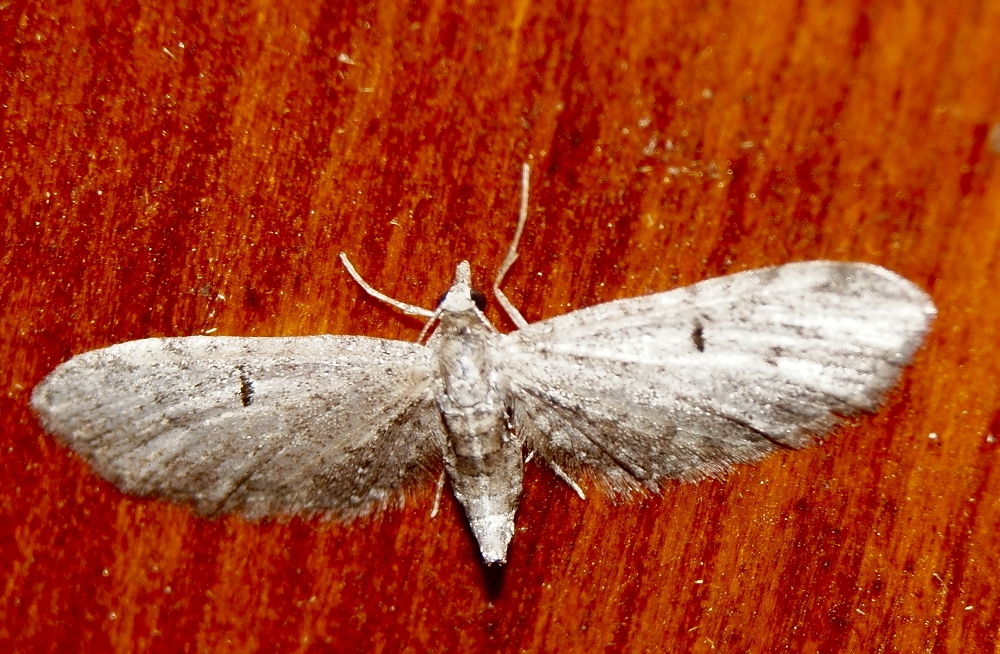
(c) psweet, some rights reserved (CC BY-SA) · licence
Family: Geometridae · Class: Insecta · Order: Lepidoptera
Eupithecia misturata (Misturata Eupithecia) is a California animal in the Geometridae family.
Eupithecia misturata is a small geometrid moth in the family Geometridae, subfamily Larentiinae. Adults have a forewing length of 8 to 11 mm (0.3 to 0.4 inches), with wingspans typically measuring 16 to 22 mm (0.6 to 0.9 inches) (BugGuide). The species displays the characteristic cryptic coloration typical of Eupithecia moths, with mottled gray and brown patterns that provide effective camouflage when resting on tree bark or lichen-covered surfaces. Originally described by Hulst in 1896 as Tephroclystia misturata, the species is also known by the synonym Eupithecia harveyata. This moth has an extensive range across North America, occurring from Yukon to Newfoundland and Nova Scotia in Canada, and throughout the western United States south to southern California and New Mexico. In the eastern United States, populations extend south to North Carolina (BugGuide). California records include observations from multiple counties, with documented occurrences in San Benito County, Madera County, Calaveras County, and the San Bruno Mountains of San Mateo County. The species has been recorded at elevations ranging from 1,500 feet in the Central Valley to over 8,800 feet in montane environments. Eupithecia misturata occupies diverse habitats across its range, from coastal chaparral and live oak woodlands to montane coniferous forests. In California, the species has been documented in ponderosa pine and lodgepole pine associations, as well as mixed coniferous forests with fir components. Adults are frequently attracted to ultraviolet and mercury vapor lights, making them regular captures at moth survey stations. The flight period extends from March through October in most areas, with peak activity varying by elevation and latitude (BugGuide). In California's Central Valley, specimens have been recorded from January through May, while montane populations typically fly from June through August. Larvae are polyphagous, feeding on a diverse array of broadleaf trees, conifers, and shrubs. Documented host plants include Heuchera macrantha (alum root), with larvae successfully reared from this host at the San Bruno Mountains (Lepidoptera Society records, 1989). The species' ability to utilize multiple host plant families contributes to its wide distribution and ecological adaptability. Like many Eupithecia species, E. misturata requires careful examination of genitalia or DNA analysis for definitive identification, as several closely related species share similar external morphology. Hulst noted that the genitalia of E. bivittata are very similar to those of E. misturata, highlighting the taxonomic challenges within this genus (BugGuide). The species shows no current conservation concerns and maintains stable populations across its extensive range. Its ability to exploit diverse habitats and host plants, combined with its broad geographic distribution, suggests ecological resilience. However, like many native moths, populations may face localized impacts from habitat conversion and light pollution in urban areas.
Classification
Class: Insecta · Order: Lepidoptera · Family: Geometridae
Frequently asked questions
How is Eupithecia misturata classified?
Eupithecia misturata belongs to class Insecta, order Lepidoptera, family Geometridae.
What family does Eupithecia misturata belong to?
Eupithecia misturata is in the Geometridae family.
What is Eupithecia misturata?
Eupithecia misturata is a small geometrid moth in the family Geometridae, subfamily Larentiinae.
Is Eupithecia misturata found in California?
Yes. Eupithecia misturata is recorded in California in The California Species Project's catalogue.
Related species
Other California species in the same genus, family, or bioregion.
Data from The California Species Project — 14,000+ California species with verified data from CNPS, CDFW, USFWS, and more.