Eupithecia ravocostaliata
Tawny Eupithecia Moth
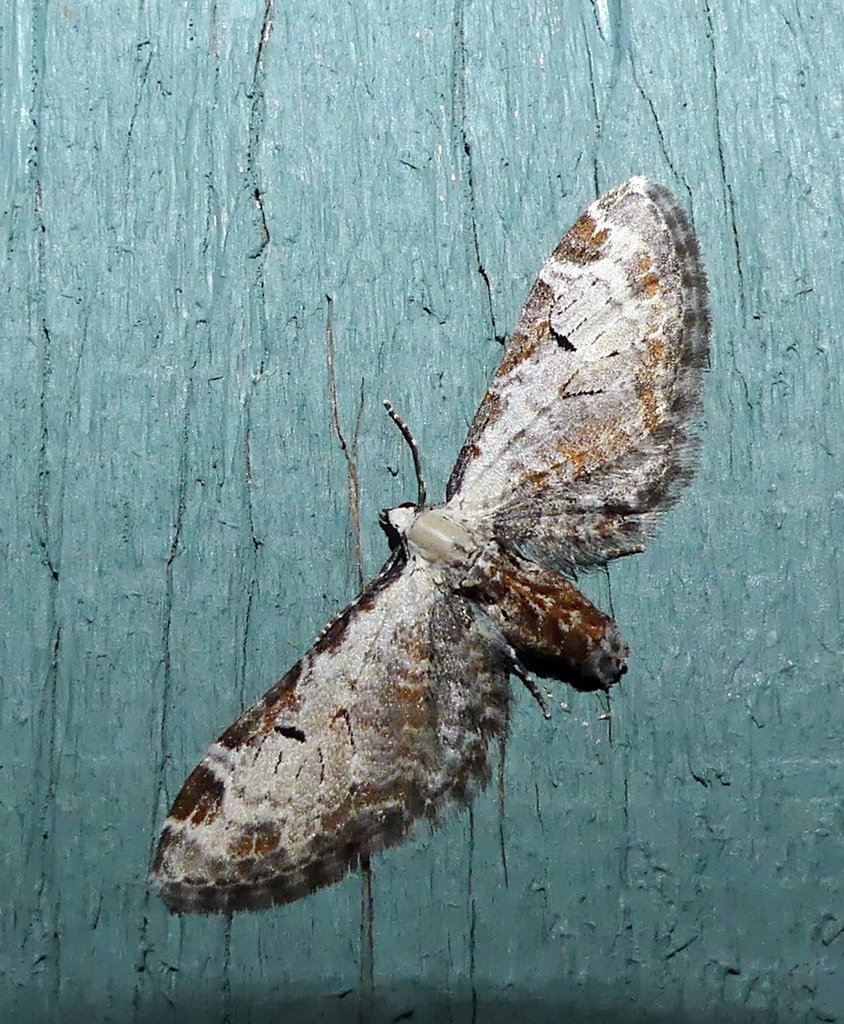
(c) Susan Blayney, some rights reserved (CC BY) · licence
Family: Geometridae · Class: Insecta · Order: Lepidoptera
Eupithecia ravocostaliata (Tawny Eupithecia Moth) is a California animal in the Geometridae family.
The Tawny Eupithecia Moth is a small geometrid moth with muted coloration typical of the genus Eupithecia. Adults display subtle patterns of brown and gray tones that provide effective camouflage against tree bark and vegetation. Like other members of the pug moth group, this species exhibits the characteristic compact body form and relatively broad wings that distinguish geometrids from other moth families. Eupithecia ravocostaliata has an extensive North American distribution, ranging from British Columbia east to Nova Scotia, extending south to central California, and reaching east to northern Colorado and western South Dakota. This broad transcontinental range indicates the species' adaptability to diverse climatic conditions across temperate North America. In California, the species represents the southern extent of its western distribution. The moth inhabits various forested and woodland environments that support its diverse host plant requirements. According to the Moth Photographers Group, larvae feed on multiple plant families including Betulaceae, Adoxaceae, Rhamnaceae, Rosaceae, and Salicaceae, with documented host genera including Alnus, Betula, Frangula, Populus, Prunus, Salix, and Viburnum (Shropshire & Douglas 2025). Powell and Opler noted that Salix species serve as the primary host plants (Powell & Opler 2009). This broad host plant range allows the species to occupy diverse habitats from riparian corridors dominated by willows to mixed deciduous and coniferous forests containing birches, poplars, and other suitable host trees. Like other Eupithecia species, larvae are external feeders that consume flowers, developing seeds, and young foliage of their host plants. The cryptic coloration of adults suggests they are primarily nocturnal, likely attracted to artificial lights during their active periods. Adult flight periods and specific breeding behaviors have not been extensively documented in the literature, reflecting the limited ecological research conducted on many geometrid species. The broad geographic distribution suggests multiple generations per year may occur in warmer portions of the range, while northern populations likely complete a single annual generation. Eupithecia ravocostaliata is not federally or state listed as threatened or endangered. NatureServe assigned the species a global rank of G5, indicating it is demonstrably secure globally with no significant conservation concerns. The extensive geographic range and diverse host plant associations suggest stable populations across most of the species' distribution. However, like many forest-associated moths, local populations may face impacts from habitat fragmentation, forest management practices, and climate change effects on host plant distributions. Detailed population monitoring data for this species are not available, reflecting the challenges of surveying small, cryptic moth species across their extensive ranges. The species appears in various regional lepidopteran surveys and collecting records, suggesting it maintains viable populations throughout its documented range. Conservation efforts focused on maintaining diverse forest ecosystems and riparian habitats will benefit this species along with the broader community of forest-associated moths.
Classification
Class: Insecta · Order: Lepidoptera · Family: Geometridae
Frequently asked questions
How is Eupithecia ravocostaliata classified?
Eupithecia ravocostaliata belongs to class Insecta, order Lepidoptera, family Geometridae.
What family does Eupithecia ravocostaliata belong to?
Eupithecia ravocostaliata is in the Geometridae family.
What is Eupithecia ravocostaliata?
The Tawny Eupithecia Moth is a small geometrid moth with muted coloration typical of the genus Eupithecia.
Is Eupithecia ravocostaliata found in California?
Yes. Eupithecia ravocostaliata is recorded in California in The California Species Project's catalogue.
Related species
Other California species in the same genus, family, or bioregion.
Data from The California Species Project — 14,000+ California species with verified data from CNPS, CDFW, USFWS, and more.