Euplectes franciscanus
Northern Red Bishop
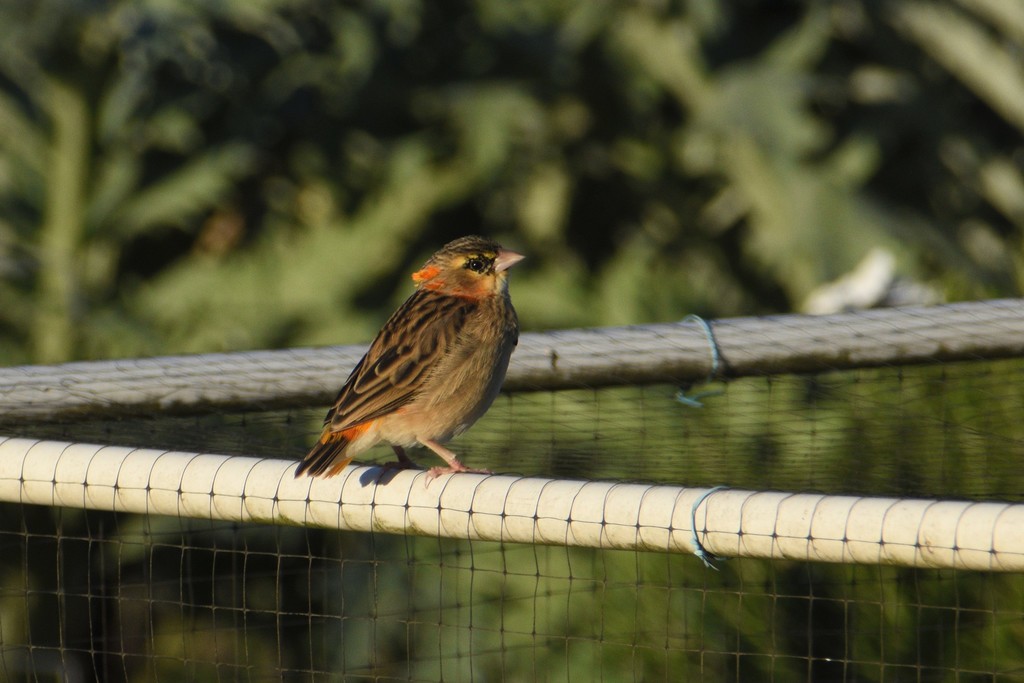
no rights reserved · CC0
Family: Ploceidae · Class: Aves · Order: Passeriformes
Euplectes franciscanus (Northern Red Bishop) is a California animal in the Ploceidae family.
The Northern Red Bishop is a small passerine bird in the weaver family (Ploceidae), native to sub-Saharan Africa but established in several introduced populations worldwide. Males in breeding plumage display vibrant red-orange coloration on the head, breast, and rump, contrasting with black wings, tail, and belly. The species is also known as the Orange Bishop. Non-breeding males and females are brown and streaked, resembling sparrows, making field identification challenging outside the breeding season. Adults measure approximately 10-11 centimeters (4-4.3 inches) in length with a conical seed-eating bill typical of weavers. The Northern Red Bishop has established populations in parts of southern Europe and the United States, as well as in the Neotropics (Birds of the World). In the Caribbean region, the species was first reported from Puerto Rico around 1971, though it likely arrived during the previous decade, possibly from Senegal (Birds of the World). Since the 1980s, populations have become established in the Lesser Antilles, including Martinica and Guadalupe, with more recent records from Santa Cruz, Jamaica, and Cuba. The species has also been documented in northern Venezuela, representing its South American range extension. Northern Red Bishops inhabit open grasslands, agricultural areas, and wetland margins. In Puerto Rico, the species is locally uncommon on the north coast and rare elsewhere in the island's coastal lowlands (Birds of the World). The birds show a preference for areas with tall grasses and reed beds, particularly near water sources. They are commonly found in rice-growing regions and other agricultural landscapes that provide suitable nesting sites and food resources. The species exhibits typical weaver behavior, with males constructing multiple spherical grass nests suspended from vegetation during breeding season. Males are polygamous, attracting females to their territories through elaborate displays that showcase their bright breeding plumage. The birds feed primarily on grass seeds and small insects, with documented feeding on rice seedlings in agricultural areas (Birds of the World). Northern Red Bishops are gregarious outside the breeding season, often forming mixed flocks with other seed-eating species. Their diet consists mainly of grass seeds, though they also consume insects, particularly when feeding young. As an introduced species, the Northern Red Bishop has no special conservation status in its non-native range. The species' establishment in multiple regions demonstrates its adaptability to new environments, though populations remain localized. In agricultural areas, the birds may be considered minor crop pests due to their feeding on rice seedlings, but they do not appear to cause significant economic damage. The species' continued range expansion in the Caribbean and documented presence in new locations suggests ongoing colonization efforts, likely facilitated by both natural dispersal and human-mediated introductions. Long-term monitoring of established populations would provide valuable insights into the species' ecological impact in non-native habitats.
Classification
Class: Aves · Order: Passeriformes · Family: Ploceidae
Frequently asked questions
How is Euplectes franciscanus classified?
Euplectes franciscanus belongs to class Aves, order Passeriformes, family Ploceidae.
What family does Euplectes franciscanus belong to?
Euplectes franciscanus is in the Ploceidae family.
What is Euplectes franciscanus?
The Northern Red Bishop is a small passerine bird in the weaver family (Ploceidae), native to sub-Saharan Africa but established in several introduced populations worldwide.
Is Euplectes franciscanus found in California?
Yes. Euplectes franciscanus is recorded in California in The California Species Project's catalogue.
More California species
This species has no close relatives in our California data — here are other species to explore.
Data from The California Species Project — 14,000+ California species with verified data from CNPS, CDFW, USFWS, and more.