Euproserpinus euterpe
Kern primrose sphinx moth
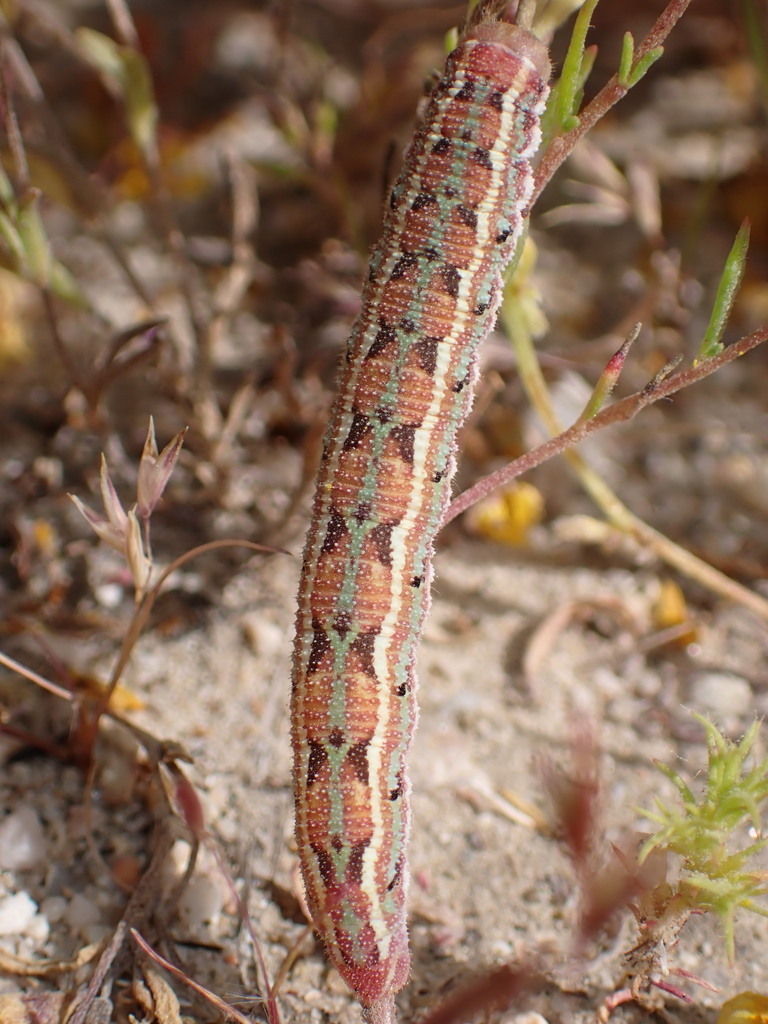
(c) Cricket Raspet, some rights reserved (CC BY) · licence
Family: Sphingidae · Class: Insecta · Order: Lepidoptera
Conservation status: Threatened · G1G2 S1
Euproserpinus euterpe (Kern primrose sphinx moth) is a California animal in the Sphingidae family.
The Kern primrose sphinx moth is a small hawkmoth endemic to Walker Basin in Kern County, southern California. Adults have a wingspan ranging from 38 to 46 mm (1.5 to 1.8 inches). The forewings are olive-brown to grayish-brown with darker cross-bands and pale marginal markings. The hindwings are orange-yellow at the base, transitioning to dark brown at the margins with white fringe scales. The thorax is olive-brown with pale longitudinal stripes, while the abdomen displays alternating light and dark bands. The species can be distinguished from other sphinx moths by its relatively small size and distinctive wing pattern. The Kern primrose sphinx moth occurs exclusively in Walker Basin, a closed drainage basin in Kern County, southern California. This represents one of the most restricted ranges of any North American hawkmoth. The species' distribution is limited to elevations between 760 and 1,070 meters (2,500 to 3,500 feet) within this basin. Walker Basin encompasses approximately 1,036 square kilometers (400 square miles) of the southern Sierra Nevada foothills. The moth inhabits alkali sink scrubland and chenopod scrub communities characterized by poorly drained alkaline soils. These habitats support sparse vegetation adapted to high soil salinity and periodic flooding. The species requires areas where its host plant, Camissonia contorta epilobioides, a subspecies of contorted primrose in the evening primrose family (Onagraceae), occurs in sufficient density. This host plant grows in disturbed alkaline soils, often along washes and in areas with subsurface water. Kern primrose sphinx moths are active during spring months, typically from March through May, coinciding with the flowering period of their host plant. Adults are crepuscular, flying at dusk and dawn to feed on nectar from various flowers. Larvae feed exclusively on Camissonia contorta epilobioides, consuming leaves and flowers. The species completes one generation per year, with pupation occurring in the soil. Adults emerge following winter rains when host plants are most vigorous. Mating occurs shortly after emergence, and females deposit eggs on or near host plants. The U.S. Fish and Wildlife Service listed the Kern primrose sphinx moth as threatened in 1980. Population estimates indicate fewer than 10,000 individuals remain, distributed across approximately 20 known locations within Walker Basin. Primary threats include habitat loss from agricultural conversion, urban development, and water diversions that alter natural flooding cycles essential for host plant regeneration. Groundwater pumping has lowered water tables, reducing the productivity of alkaline sink habitats. Additional threats include livestock grazing, off-road vehicle use, and invasive plant species that compete with the host plant. Climate change poses long-term risks through altered precipitation patterns and increased drought frequency, potentially reducing host plant availability and suitable habitat conditions.
Classification
Class: Insecta · Order: Lepidoptera · Family: Sphingidae
Conservation status
Threatened · G1G2 S1
Frequently asked questions
How is Euproserpinus euterpe classified?
Euproserpinus euterpe belongs to class Insecta, order Lepidoptera, family Sphingidae.
What family does Euproserpinus euterpe belong to?
Euproserpinus euterpe is in the Sphingidae family.
Is Euproserpinus euterpe protected or of conservation concern?
Euproserpinus euterpe carries the following status: Threatened · G1G2 S1.
What is Euproserpinus euterpe?
The Kern primrose sphinx moth is a small hawkmoth endemic to Walker Basin in Kern County, southern California.
Is Euproserpinus euterpe found in California?
Yes. Euproserpinus euterpe is recorded in California in The California Species Project's catalogue.
Related species
Other California species in the same genus, family, or bioregion.
Data from The California Species Project — 14,000+ California species with verified data from CNPS, CDFW, USFWS, and more.