Euptoieta claudia
Variegated Fritillary
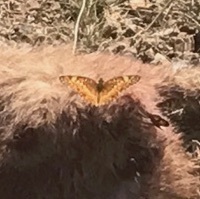
(c) Clifton Ladd, C.W.B., some rights reserved (CC BY) · licence
Family: Nymphalidae · Class: Insecta · Order: Lepidoptera
Euptoieta claudia (Variegated Fritillary) is a California animal in the Nymphalidae family.
The Variegated Fritillary is a medium-sized butterfly with a wingspan ranging from 4.4 to 7.0 centimeters (1.7 to 2.8 inches). The dorsal wing surfaces display a distinctive orange-brown base color marked with black spots and irregular dark lines. The forewings feature prominent black markings along the outer margins and a series of black spots across the wing surface. The hindwings exhibit a similar pattern with additional silver-white spots along the underwing margins. Males and females are similar in appearance, though females are typically larger with slightly duller coloration. The species lacks the distinctive black zigzag lines found on the forewings of the closely related Great Spangled Fritillary. The Variegated Fritillary ranges from higher elevations of Argentina through Central America and Mexico to the southern United States, including Cuba and Jamaica. The species regularly colonizes north through most of the United States except the Pacific Northwest. In California, it occurs primarily in the southern and central regions, with populations fluctuating based on seasonal migrations and local breeding success. The species is considered a strong migrant and colonizer, with northern populations often representing temporary establishments rather than permanent residents. This butterfly inhabits a variety of open habitats including fields, meadows, roadsides, gardens, and disturbed areas from sea level to moderate elevations. The species prefers sunny locations with abundant nectar sources and suitable host plants. Variegated Fritillaries are commonly found in agricultural areas, suburban gardens, and areas with mixed vegetation that provide both larval host plants and adult nectar sources. Adult Variegated Fritillaries feed on nectar from a wide variety of flowers, showing particular preference for composites, mint family plants, and other shallow-flowered species. The species utilizes a variety of plants in several families as larval hosts, including maypops (Passiflora incarnata), may apple (Podophyllum peltata), violets (Viola), purslane (Portulaca), stonecrop (Sedum), and moonseed (Menispermum). Females deposit eggs singly on host plant leaves or nearby surfaces. Larvae are dark-colored with branching spines and feed primarily at night. The species produces multiple generations per year in warmer climates, with continuous broods in southern regions and fewer generations in northern areas. The Variegated Fritillary is not federally or state-listed and appears to maintain stable populations across much of its range. The species benefits from its broad host plant range and adaptability to disturbed habitats, though local populations may fluctuate based on weather patterns and habitat availability. Climate change may be facilitating northward range expansion, with the species increasingly reported from areas previously outside its regular range. Agricultural practices and urban development can both negatively and positively impact populations, depending on the maintenance of suitable habitat and host plant availability.
Classification
Class: Insecta · Order: Lepidoptera · Family: Nymphalidae
Frequently asked questions
How is Euptoieta claudia classified?
Euptoieta claudia belongs to class Insecta, order Lepidoptera, family Nymphalidae.
What family does Euptoieta claudia belong to?
Euptoieta claudia is in the Nymphalidae family.
What is Euptoieta claudia?
The Variegated Fritillary is a medium-sized butterfly with a wingspan ranging from 4.4 to 7.0 centimeters (1.7 to 2.8 inches).
Is Euptoieta claudia found in California?
Yes. Euptoieta claudia is recorded in California in The California Species Project's catalogue.
Related species
Other California species in the same genus, family, or bioregion.
Data from The California Species Project — 14,000+ California species with verified data from CNPS, CDFW, USFWS, and more.