Euptoieta hegesia
Mexican Fritillary
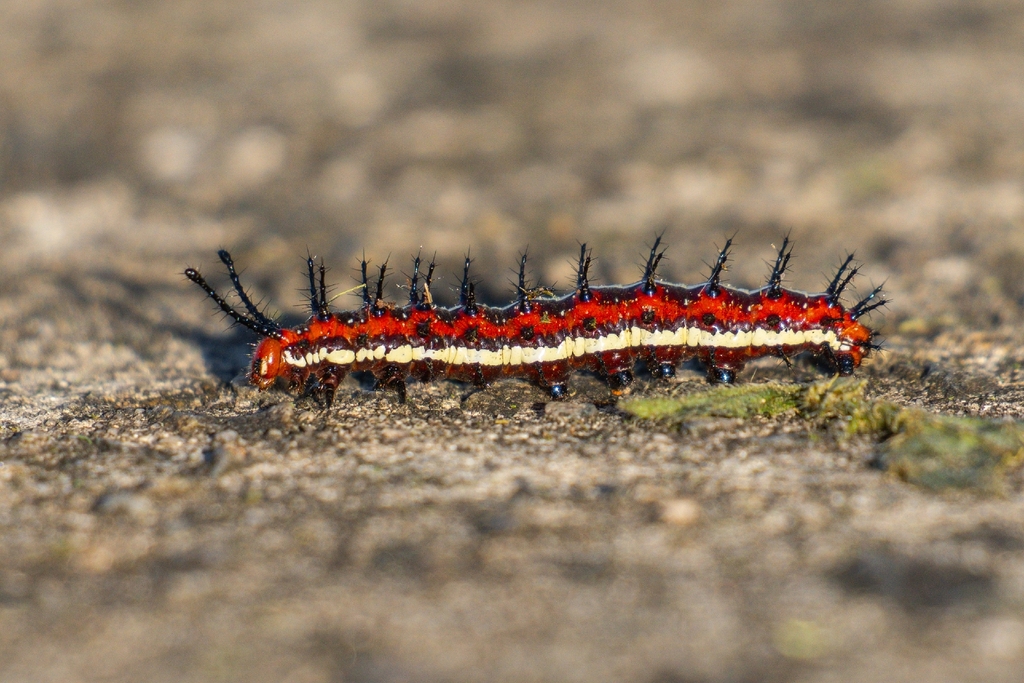
(c) lucas, some rights reserved (CC BY-SA) · licence
Family: Nymphalidae · Class: Insecta · Order: Lepidoptera
Euptoieta hegesia (Mexican Fritillary) is a California animal in the Nymphalidae family.
The Mexican fritillary is a medium-sized butterfly with forewings spanning 55 to 70 mm (2.2 to 2.8 inches). The dorsal wing surfaces display bright orange-red coloration with black markings including scattered spots and lines. The forewings feature prominent black borders and distinctive black spots arranged in rows across the wing surface. The hindwings show similar orange-red coloration with black marginal borders and submarginal spots. The ventral wing surfaces are paler orange with white and silver spots, particularly prominent on the hindwings. Males and females exhibit similar coloration patterns, though females are typically slightly larger. The Mexican fritillary is resident throughout Central America, Mexico, and the West Indies. In the United States, this species occurs as a stray in southern California, central Arizona, and central Texas. California records are primarily from the southernmost counties, with most observations occurring in San Diego and Imperial counties. The species' northward dispersal appears to be limited by temperature and host plant availability. This species inhabits open areas including gardens, parks, fields, and woodland edges where host plants are present. Mexican fritillaries prefer sunny locations with abundant nectar sources and are commonly found from sea level to moderate elevations. In California, sightings typically occur in urban and suburban environments where ornamental passion vines are cultivated, as well as in natural areas along the Mexican border where native Passiflora species may occur. Mexican fritillaries utilize multiple host plant families for larval development, including passion-vines (Passiflora), morning glories (Convolvulaceae), and Turnera species. Females deposit pale yellow eggs singly on host plant leaves and stems. Larvae are orange-red with black spines and stripes, feeding on leaves throughout their development. The species is multivoltine in tropical regions, producing continuous broods throughout the year where climate permits. Adults are active fliers and feed on nectar from various flowering plants including lantana, pentas, and other garden flowers. Males engage in patrolling behavior to locate females, typically flying 1 to 3 meters above the ground in open areas. The Mexican fritillary is not federally or state listed in California and appears to face no significant conservation concerns within its native range. As a tropical species, its occurrence in California is primarily as a vagrant or temporary colonist rather than an established breeding population. Climate change may potentially expand the species' range northward, though establishment would depend on host plant availability and winter survival. The species benefits from urban gardening practices that include native and ornamental Passiflora species. In California, Mexican fritillaries represent part of the natural cross-border butterfly fauna that occasionally disperses north from established Mexican populations.
Classification
Class: Insecta · Order: Lepidoptera · Family: Nymphalidae
Frequently asked questions
How is Euptoieta hegesia classified?
Euptoieta hegesia belongs to class Insecta, order Lepidoptera, family Nymphalidae.
What family does Euptoieta hegesia belong to?
Euptoieta hegesia is in the Nymphalidae family.
What is Euptoieta hegesia?
The Mexican fritillary is a medium-sized butterfly with forewings spanning 55 to 70 mm (2.2 to 2.8 inches).
Is Euptoieta hegesia found in California?
Yes. Euptoieta hegesia is recorded in California in The California Species Project's catalogue.
Related species
Other California species in the same genus, family, or bioregion.
Data from The California Species Project — 14,000+ California species with verified data from CNPS, CDFW, USFWS, and more.