Eurema mexicana
Mexican Yellow
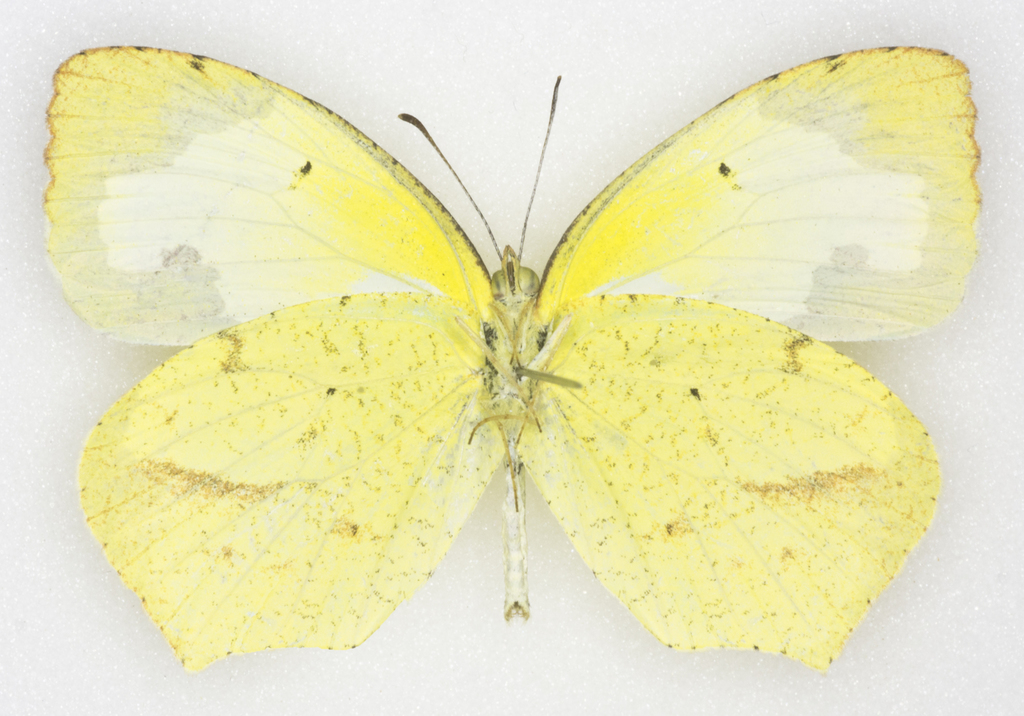
no rights reserved · CC0
Family: Pieridae · Class: Insecta · Order: Lepidoptera
Eurema mexicana (Mexican Yellow) is a California animal in the Pieridae family.
The Mexican Yellow is a small butterfly in the sulfur family (Pieridae), with males displaying bright yellow wings marked by distinctive black borders along the forewing margins. Males typically measure 32-38 mm (1.3-1.5 inches) in wingspan, while females are slightly larger at 35-42 mm (1.4-1.7 inches). Females exhibit more subdued coloration with pale yellow to white wings and reduced black markings. The undersides of both sexes are pale yellow with small dark spots, and males possess specialized scent patches called androconia on their forewings. During flight, the species exhibits rapid, erratic movement typical of sulfur butterflies. The Mexican Yellow maintains a resident population from Central America north to South Texas and the Southwest United States, including Arizona, New Mexico, and southern California. The species functions as a common vagrant in Great Plains and Southwest desert regions, with documented occurrences extending north to Colorado and Nevada. Rare migrant records exist for Mississippi, Arkansas, Illinois, and Michigan, typically occurring during periods of population expansion from southern breeding areas. In California, the species is most frequently encountered in desert regions of Imperial, Riverside, and San Bernardino counties. This butterfly inhabits arid and semi-arid environments, favoring desert washes, canyon bottoms, and areas with scattered acacia growth. The species occurs from sea level to approximately 1,500 meters (4,900 feet) in elevation, though it is most common below 900 meters (2,950 feet). Mexican Yellows require access to their larval host plants and seek areas with reliable moisture sources, often concentrating near water courses in otherwise dry landscapes. Adults frequently visit flowers for nectar, particularly favoring composite flowers and other desert blooms. Mexican Yellow larvae feed exclusively on plants in the pea family (Fabaceae), with Acacia and Diphysa serving as primary host plants. Females deposit single eggs on young leaves and growing tips of host plants. The species exhibits continuous brooding in favorable climates, with multiple overlapping generations per year in southern portions of its range. Development from egg to adult requires approximately 30-40 days under optimal conditions. Adults are active throughout the year in frost-free areas, though activity peaks during warmer months. Males engage in territorial behavior around host plants and patrol areas for receptive females. The Mexican Yellow lacks formal conservation listing status at federal, state, or international levels. Population trends appear stable within the species' core range, though specific monitoring data is limited. Climate change may affect the species' northern range limits and migration patterns, potentially enabling expansion into previously unsuitable areas as temperatures warm. Urban development and habitat modification in desert regions represent localized threats to breeding populations, particularly where host plant communities are eliminated. The species' broad geographic range and apparent ecological adaptability suggest resilience to moderate environmental changes.
Classification
Class: Insecta · Order: Lepidoptera · Family: Pieridae
Frequently asked questions
How is Eurema mexicana classified?
Eurema mexicana belongs to class Insecta, order Lepidoptera, family Pieridae.
What family does Eurema mexicana belong to?
Eurema mexicana is in the Pieridae family.
What is Eurema mexicana?
The Mexican Yellow is a small butterfly in the sulfur family (Pieridae), with males displaying bright yellow wings marked by distinctive black borders along the forewing margins.
Is Eurema mexicana found in California?
Yes. Eurema mexicana is recorded in California in The California Species Project's catalogue.
Related species
Other California species in the same genus, family, or bioregion.
Data from The California Species Project — 14,000+ California species with verified data from CNPS, CDFW, USFWS, and more.