Euschistus servus
Brown Stink Bug
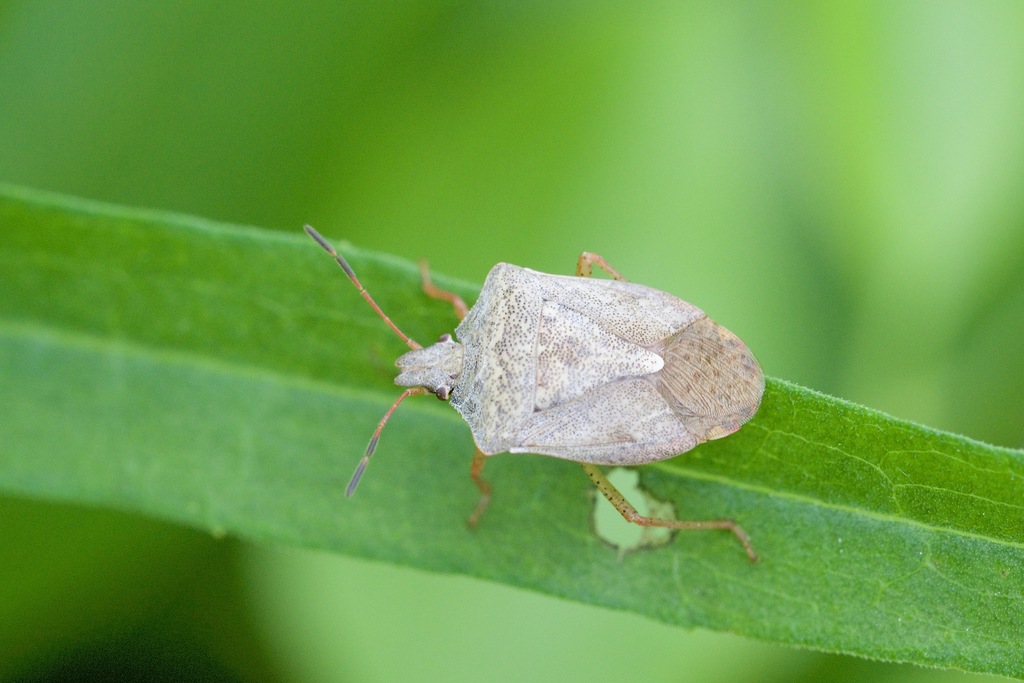
(c) Owen Strickland, some rights reserved (CC BY) · licence
Family: Pentatomidae · Class: Insecta · Order: Hemiptera
Euschistus servus (Brown Stink Bug) is a California animal in the Pentatomidae family.
The Brown Stink Bug (Euschistus servus) is a medium-sized shield bug in the family Pentatomidae, measuring 8-14 mm in length. Adults display the characteristic pentagonal body shape of stink bugs, with a broad, flattened appearance. The body coloration ranges from light brown to dark brown, often with mottled patterns that provide effective camouflage against bark and dead vegetation. The head features prominent compound eyes and moderately long antennae with five segments. Like other stink bugs, this species possesses well-developed scent glands that release defensive chemicals when threatened or disturbed. Euschistus servus occurs throughout much of North America, with a range extending from southern Canada to Central America. In the United States, the species is documented from coast to coast, including California, Arizona, Texas, Florida, and Georgia (BugGuide). The distribution extends south through Mexico, including Baja California, where populations occur in both mainland and peninsular regions. The species shows considerable geographic variation across this extensive range, leading to recognition of multiple subspecies. Brown Stink Bugs inhabit diverse environments including agricultural areas, grasslands, forest edges, and urban landscapes. They are commonly found on herbaceous plants and shrubs, where they feed by inserting their piercing-sucking mouthparts into plant tissues. The species demonstrates considerable habitat flexibility, occurring from sea level to moderate elevations. Adults and nymphs are frequently observed on crop plants, ornamental vegetation, and native plant communities. This species exhibits typical hemipteran development with incomplete metamorphosis. Eggs are laid in clusters on host plant surfaces, typically on the undersides of leaves. The barrel-shaped eggs are initially pale but darken as development progresses. Five nymphal stages occur before reaching adulthood, with each instar resembling a smaller, wingless version of the adult. Brown Stink Bugs are primarily phytophagous, feeding on plant juices from stems, leaves, and developing seeds. Adults overwinter in protected locations such as leaf litter, bark crevices, or building foundations, becoming active again with warming spring temperatures. Euschistus servus is not currently listed under federal or state endangered species acts and appears to maintain stable populations across most of its range. The species' broad host plant range and habitat tolerance contribute to its ecological success. In some regions, Brown Stink Bugs are considered minor agricultural pests on crops including soybeans, cotton, and vegetables, though they rarely reach economically damaging levels. Climate change may influence future distribution patterns, potentially expanding the northern range limit as temperatures warm. The species serves as prey for various natural enemies including parasitoid wasps, predatory insects, and birds, playing a role in regional food webs.
Classification
Class: Insecta · Order: Hemiptera · Family: Pentatomidae
Frequently asked questions
How is Euschistus servus classified?
Euschistus servus belongs to class Insecta, order Hemiptera, family Pentatomidae.
What family does Euschistus servus belong to?
Euschistus servus is in the Pentatomidae family.
What is Euschistus servus?
The Brown Stink Bug (Euschistus servus) is a medium-sized shield bug in the family Pentatomidae, measuring 8-14 mm in length.
Is Euschistus servus found in California?
Yes. Euschistus servus is recorded in California in The California Species Project's catalogue.
Related species
Other California species in the same genus, family, or bioregion.
Data from The California Species Project — 14,000+ California species with verified data from CNPS, CDFW, USFWS, and more.