Eustenopus villosus
Yellow Starthistle Hairy Weevil
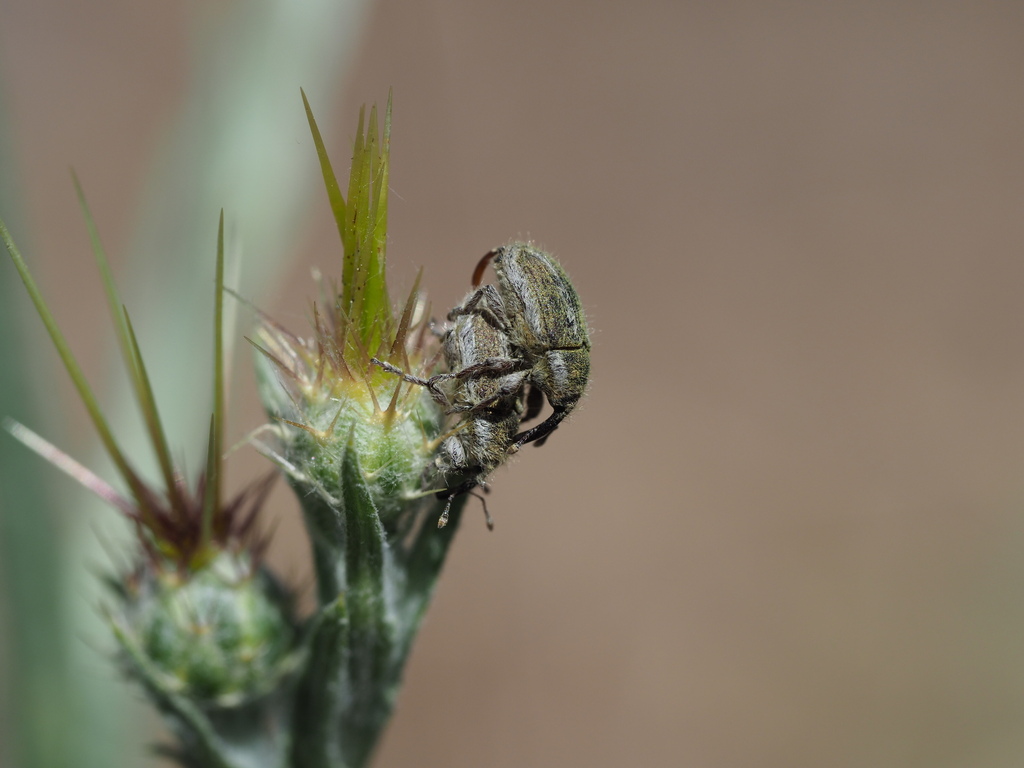
(c) Nathan Earley, some rights reserved (CC BY) · licence
Family: Curculionidae · Class: Insecta · Order: Coleoptera
Eustenopus villosus (Yellow Starthistle Hairy Weevil) is a California animal in the Curculionidae family.
The Yellow Starthistle Hairy Weevil is a small beetle in the family Curculionidae, subfamily Lixinae. Adults are characterized by their hairy vestiture, which gives the species its common name, though individuals can appear quite different once this hair covering is lost (BugGuide). The species exhibits typical weevil morphology with an elongated snout (rostrum) used for feeding and egg-laying. Native to the Mediterranean region, Eustenopus villosus has been established in the western United States, including Washington, Idaho, and California (BugGuide). The species was deliberately introduced to California in 1990 as part of a classical biological control program targeting the invasive yellow starthistle (Centaurea solstitialis) (BugGuide). This introduction represents part of broader biological control efforts, as several weevil species have been released to manage invasive thistle species across North America. The Yellow Starthistle Hairy Weevil inhabits areas where its host plant occurs, primarily in grasslands, rangelands, and disturbed habitats where yellow starthistle has become established. Yellow starthistle typically colonizes areas with Mediterranean-type climates, including annual grasslands, oak woodlands, and chaparral margins. The weevil's distribution closely follows that of its host plant across suitable habitat in the western states. This species is a specialist herbivore with a highly specific host relationship to yellow starthistle (Centaurea solstitialis). Adults feed on the plant's foliage and flower heads, while larvae develop within the plant tissues. The weevil's life cycle is synchronized with that of its host plant, which is an annual herb that germinates with fall rains, overwinters as a rosette, and flowers from late spring through summer. Female weevils deposit eggs in yellow starthistle tissues, and the developing larvae consume plant material from within, ultimately reducing the host plant's reproductive capacity and overall vigor. As an intentionally introduced biological control agent, Eustenopus villosus serves an important ecological function in managing yellow starthistle populations. Yellow starthistle is considered one of the most problematic invasive weeds in California and other western states, displacing native vegetation and reducing forage quality in rangelands. The introduction of this weevil species, along with other biological control agents, aims to provide sustainable, long-term management of this invasive plant. Classical biological control programs undergo extensive host-specificity testing before release to ensure introduced species will not impact non-target plants. The establishment success of the Yellow Starthistle Hairy Weevil varies across different regions and habitats. Biological control effectiveness depends on multiple factors including climate matching between the agent's native and introduced ranges, host plant density, and interactions with other biological control agents. Monitoring programs track both the weevil's establishment and its impact on yellow starthistle populations to assess the success of this biological control effort. The species does not have special conservation status, as it was introduced specifically for pest management purposes.
Classification
Class: Insecta · Order: Coleoptera · Family: Curculionidae
Frequently asked questions
How is Eustenopus villosus classified?
Eustenopus villosus belongs to class Insecta, order Coleoptera, family Curculionidae.
What family does Eustenopus villosus belong to?
Eustenopus villosus is in the Curculionidae family.
What is Eustenopus villosus?
The Yellow Starthistle Hairy Weevil is a small beetle in the family Curculionidae, subfamily Lixinae.
Is Eustenopus villosus found in California?
Yes. Eustenopus villosus is recorded in California in The California Species Project's catalogue.
Related species
Other California species in the same genus, family, or bioregion.
Data from The California Species Project — 14,000+ California species with verified data from CNPS, CDFW, USFWS, and more.