Euxoa auxiliaris
Army Cutworm
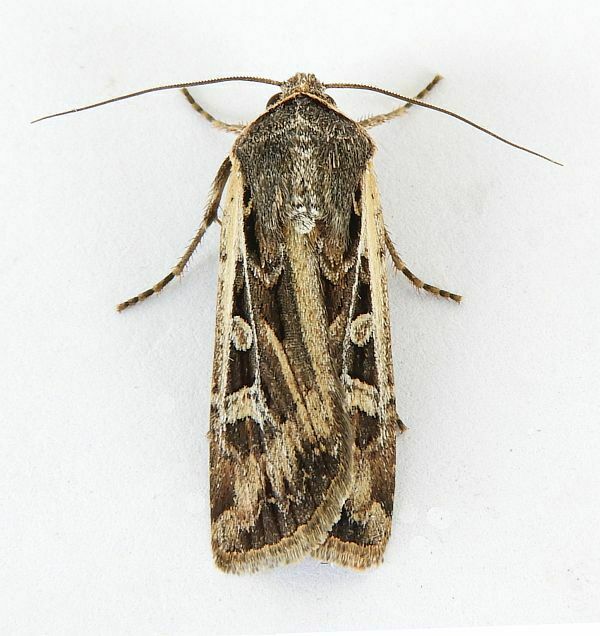
(c) jimeckert49, some rights reserved (CC BY) · licence
Family: Noctuidae · Class: Insecta · Order: Lepidoptera
Euxoa auxiliaris (Army Cutworm) is a California animal in the Noctuidae family.
The army cutworm (Euxoa auxiliaris) is a medium-sized moth in the family Noctuidae, with adults measuring 35 to 45 millimeters (1.4 to 1.8 inches) in wingspan. The forewings are typically grayish-brown with darker markings, including distinct reniform and orbicular spots characteristic of noctuids. The hindwings are pale gray to white with darker borders. Males can be distinguished from females by their more feathered antennae and slightly smaller size. Army cutworms have a broad distribution across western North America, ranging from British Columbia south to California and east to the Great Plains. In California, the species occurs throughout much of the state, from sea level to elevations exceeding 3,000 meters (9,800 feet). Populations are documented from the Central Valley, Coast Ranges, Sierra Nevada, and desert regions, with highest densities typically occurring in agricultural areas and grasslands. This species inhabits diverse environments including agricultural fields, grasslands, prairies, and disturbed areas. Larvae develop in soil and are most commonly found in areas with adequate moisture and organic matter. Adults are attracted to artificial lights and nectar sources, including various wildflowers. The species demonstrates documented altitudinal migration behavior, with adults traveling from lower elevation breeding areas to high mountain meadows during summer months. Army cutworm larvae are polyphagous, feeding on numerous plant families including grasses, forbs, and crop plants. Common host plants include wheat, barley, alfalfa, corn, and various weeds such as Russian thistle and lamb's quarters. The species typically completes one generation per year in most areas. Adults emerge in late fall and early spring, mate, and lay eggs in soil. Larvae develop through six instars over several months, pupating in earthen cells 5 to 15 centimeters below ground surface. A distinctive behavioral trait is the mass migration of adults to high-elevation sites, where they estivate in talus slopes and rock crevices during hot summer months before returning to lower elevations for reproduction. The army cutworm is not federally or state listed and is considered secure across its range. However, the species plays significant ecological and economic roles. Larvae can cause substantial agricultural damage, particularly to small grains and forage crops, leading to the species being classified as an agricultural pest in many regions. Conversely, the massive congregations of estivating adults in alpine areas serve as crucial food sources for grizzly bears in the northern Rocky Mountains and various bird species. Population levels fluctuate naturally based on weather conditions, with outbreak years typically following favorable spring conditions. Climate change may affect migration patterns and phenology, though the species' broad ecological tolerance suggests it will likely remain widespread. Management focuses primarily on agricultural pest control rather than conservation, with integrated pest management strategies employed to minimize crop damage while maintaining ecosystem functions.
Classification
Class: Insecta · Order: Lepidoptera · Family: Noctuidae
Frequently asked questions
How is Euxoa auxiliaris classified?
Euxoa auxiliaris belongs to class Insecta, order Lepidoptera, family Noctuidae.
What family does Euxoa auxiliaris belong to?
Euxoa auxiliaris is in the Noctuidae family.
What is Euxoa auxiliaris?
The army cutworm (Euxoa auxiliaris) is a medium-sized moth in the family Noctuidae, with adults measuring 35 to 45 millimeters (1.4 to 1.8 inches) in wingspan.
Is Euxoa auxiliaris found in California?
Yes. Euxoa auxiliaris is recorded in California in The California Species Project's catalogue.
Related species
Other California species in the same genus, family, or bioregion.
Data from The California Species Project — 14,000+ California species with verified data from CNPS, CDFW, USFWS, and more.