Euxoa messoria
Reaper Dart
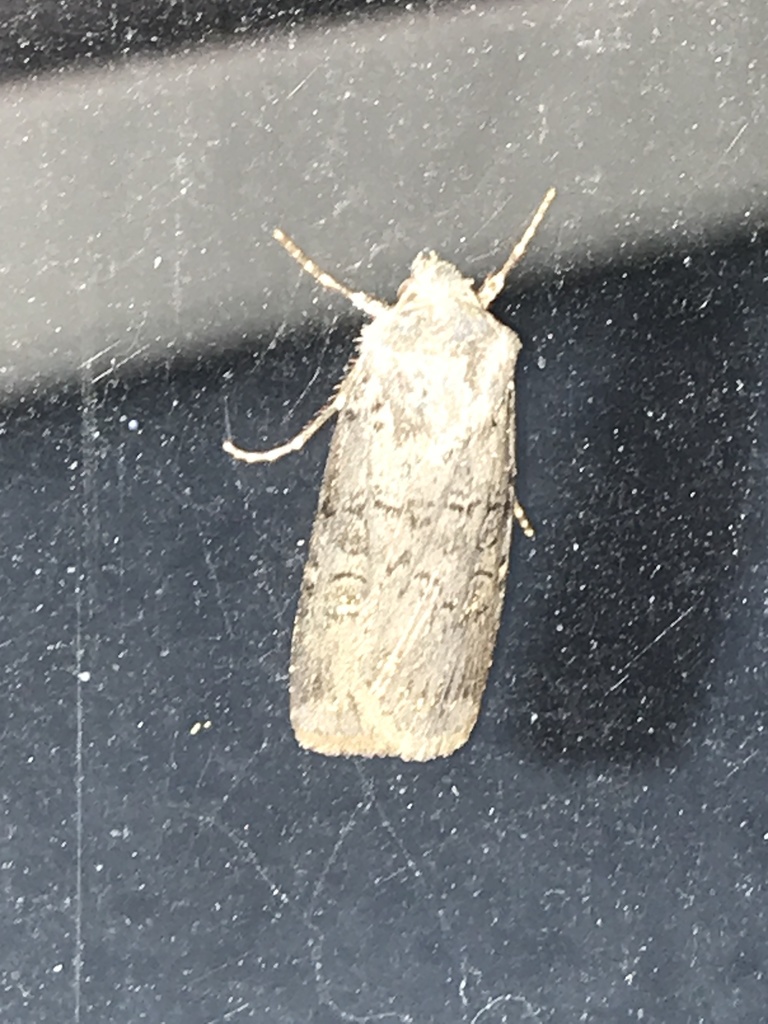
(c) Elliot Greiner, some rights reserved (CC BY) · licence
Family: Noctuidae · Class: Insecta · Order: Lepidoptera
Euxoa messoria (Reaper Dart) is a California animal in the Noctuidae family.
The Reaper Dart (Euxoa messoria) is a medium-sized cutworm moth in the family Noctuidae, characterized by its cryptic coloration and nocturnal habits. Adults typically measure 35 to 45 mm (1.4 to 1.8 inches) in wingspan. The forewings display a mottled pattern of brown, gray, and tan scales, providing effective camouflage against tree bark and soil surfaces. The hindwings are pale gray to whitish with darker marginal bands. Key identifying features include distinct reniform and orbicular spots on the forewings, though these markings can vary in prominence among individuals. Euxoa messoria occurs across much of western North America, with its range extending from British Columbia south through California. In California, the species has been documented from the northern counties southward through the Central Valley and into the southern regions of the state. The distribution encompasses both coastal and inland areas, though specific county-level occurrence data remains limited in the literature. This species inhabits diverse terrestrial environments, including grasslands, agricultural areas, and open woodland margins. Adults are typically found from sea level to moderate elevations, though the precise altitudinal range in California requires further documentation. The species shows adaptability to both natural and human-modified landscapes, including cultivated fields and disturbed habitats with suitable host vegetation. As with other Euxoa species, the Reaper Dart exhibits a complete metamorphosis with distinct larval and adult stages. Adults are active during late summer and fall months, typically from August through October. Males are attracted to artificial lights and pheromone sources during nocturnal flight periods. Larvae, known as cutworms, feed on various herbaceous plants and grasses, developing through multiple instars before pupating in soil chambers. The species appears to be univoltine, producing one generation per year. Mating occurs during the adult flight period, with females depositing eggs singly or in small clusters on or near host plants. Larvae emerge and feed primarily at night, cutting plant stems at ground level, which gives cutworms their common name. Overwintering typically occurs in the pupal stage, with adults emerging the following late summer. The conservation status of Euxoa messoria in California is not well-documented, and the species currently lacks federal or state protection. Like many moths, populations may be affected by habitat loss, agricultural practices, and artificial lighting that disrupts natural behavior patterns. The use of broad-spectrum insecticides in agricultural areas where the species occurs could impact local populations. Additionally, conversion of natural grasslands and the intensification of land use may reduce available habitat. Further research is needed to establish baseline population data, clarify the species' distribution within California, and assess potential conservation needs. Standardized moth surveys and habitat monitoring would provide valuable information for understanding population trends and ecological requirements of this nocturnal lepidopteran.
Classification
Class: Insecta · Order: Lepidoptera · Family: Noctuidae
Frequently asked questions
How is Euxoa messoria classified?
Euxoa messoria belongs to class Insecta, order Lepidoptera, family Noctuidae.
What family does Euxoa messoria belong to?
Euxoa messoria is in the Noctuidae family.
What is Euxoa messoria?
The Reaper Dart (Euxoa messoria) is a medium-sized cutworm moth in the family Noctuidae, characterized by its cryptic coloration and nocturnal habits.
Is Euxoa messoria found in California?
Yes. Euxoa messoria is recorded in California in The California Species Project's catalogue.
Related species
Other California species in the same genus, family, or bioregion.
Data from The California Species Project — 14,000+ California species with verified data from CNPS, CDFW, USFWS, and more.