Evania appendigaster
Blue-eyed Ensign Wasp
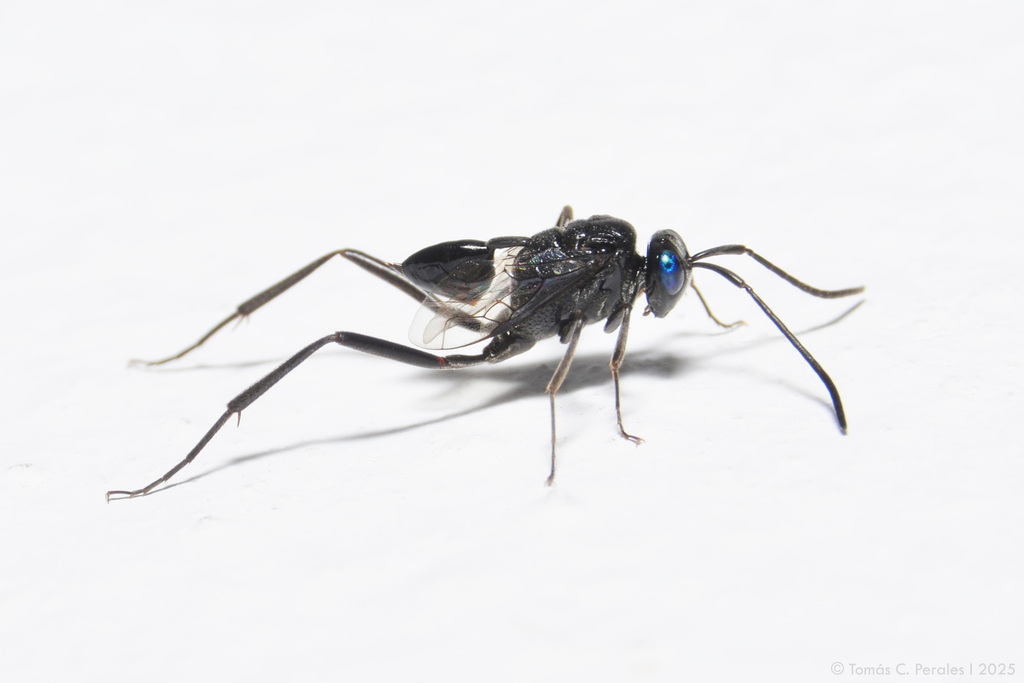
(c) Tomás Carranza Perales, some rights reserved (CC BY) · licence
Family: Evaniidae · Class: Insecta · Order: Hymenoptera
Evania appendigaster (Blue-eyed Ensign Wasp) is a California animal in the Evaniidae family.
The blue-eyed ensign wasp is a small, distinctive parasitoid wasp measuring approximately 10-15 mm in length. The species is characterized by its dark metallic body, prominent blue compound eyes, and notably reduced abdomen that appears almost petiolate or stalk-like. The wings are clear to slightly smoky, and the antennae are relatively short and thick. Males and females show similar coloration, though females are typically slightly larger with more robust ovipositors adapted for penetrating cockroach egg cases. Evania appendigaster has a cosmopolitan distribution, occurring across much of North America including California, where it is found throughout the state from sea level to moderate elevations. According to NatureServe, the species has a global conservation rank of G5, indicating it is secure globally (NatureServe 2025). The wasp has been documented in urban, suburban, and rural environments across diverse climatic zones, demonstrating considerable ecological adaptability. This species inhabits a wide range of environments but shows a strong association with areas where its cockroach hosts are present. Blue-eyed ensign wasps are commonly found in residential areas, commercial buildings, warehouses, and other structures where American cockroaches and other large cockroach species establish populations. They also occur in natural habitats including woodlands, chaparral, and riparian areas where native cockroach species are present. The blue-eyed ensign wasp is a specialized parasitoid that exclusively targets cockroach egg cases (oothecae). Females locate cockroach egg cases through chemical cues and insert their ovipositor to deposit a single egg inside the ootheca. The developing wasp larva consumes the cockroach eggs, preventing their development. This species particularly targets American cockroach (Periplaneta americana) egg cases but may also parasitize other large cockroach species. Adults are active during warmer months and may be seen flying in characteristic jerky patterns or walking on surfaces while searching for host egg cases. The species exhibits multivoltine reproduction in favorable climates, with multiple generations possible per year. Evania appendigaster is not listed under state or federal endangered species legislation and faces no significant conservation concerns. The species' widespread distribution and association with synanthropic cockroach hosts actually benefits from human activities that create suitable habitat for its prey. As urban environments expand, populations of this beneficial parasitoid may increase correspondingly. The wasp provides valuable ecosystem services through biological control of cockroach populations, making it beneficial to human communities. Climate change impacts on the species are likely minimal given its broad ecological tolerance and cosmopolitan range. No specific conservation actions are needed for this secure species.
Classification
Class: Insecta · Order: Hymenoptera · Family: Evaniidae
Frequently asked questions
How is Evania appendigaster classified?
Evania appendigaster belongs to class Insecta, order Hymenoptera, family Evaniidae.
What family does Evania appendigaster belong to?
Evania appendigaster is in the Evaniidae family.
What is Evania appendigaster?
The blue-eyed ensign wasp is a small, distinctive parasitoid wasp measuring approximately 10-15 mm in length.
Is Evania appendigaster found in California?
Yes. Evania appendigaster is recorded in California in The California Species Project's catalogue.
More California species
This species has no close relatives in our California data — here are other species to explore.
Data from The California Species Project — 14,000+ California species with verified data from CNPS, CDFW, USFWS, and more.