Evarcha proszynskii
Proszynski's Jumping Spider
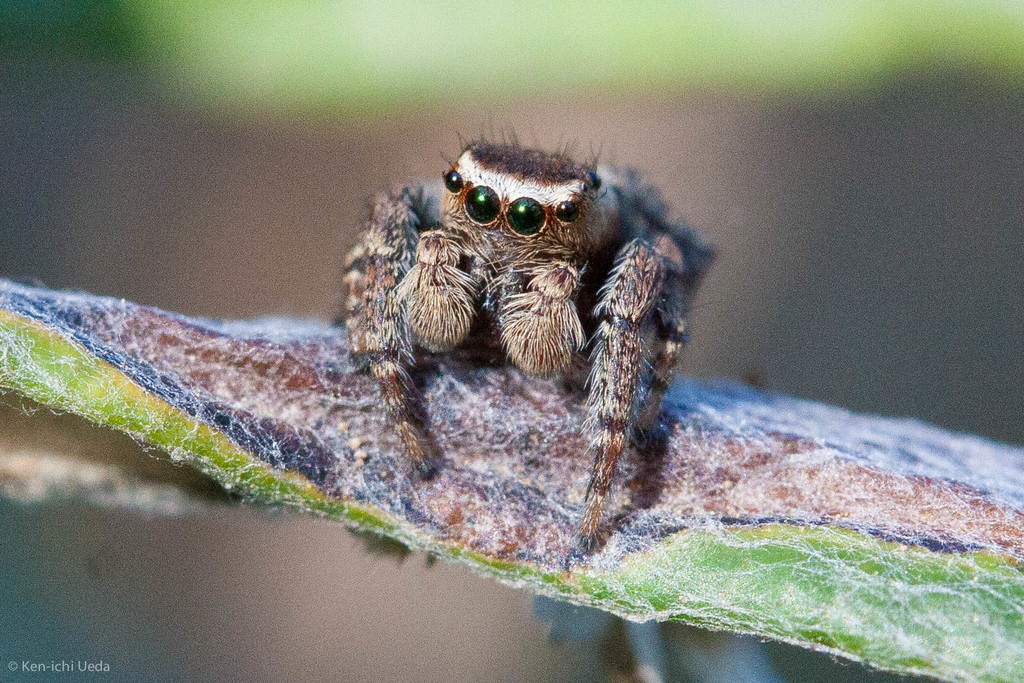
(c) Ken-ichi Ueda, some rights reserved (CC BY) · licence
Family: Salticidae · Class: Arachnida · Order: Araneae
Evarcha proszynskii (Proszynski's Jumping Spider) is a California animal in the Salticidae family.
Evarcha proszynskii is a jumping spider in the family Salticidae, first described by Marusik and Logunov in 1998. This species belongs to a taxonomically complex group where reliable identification often requires examination of reproductive structures, as individuals may not be accurately identified from external appearance alone (BugGuide.Net). The physical characteristics distinguishing E. proszynskii from closely related species primarily involve the structure of the male palp and female epigynum, specialized reproductive organs that require microscopic examination for proper identification. Like other members of the genus Evarcha, these are small jumping spiders with the characteristic robust build and large anterior median eyes typical of salticids. E. proszynskii exhibits an extensive distribution across North America. According to Marusik and Logunov, the species occurs throughout much of Canada, including Alberta, British Columbia, Manitoba, Northwest Territories, Ontario, Saskatchewan, and Yukon Territory. In the United States, confirmed records exist from Alaska, California, Colorado, Idaho, Montana, New Mexico, North Dakota, Oregon, South Dakota, Utah, Washington, and Wyoming (BugGuide.Net). A specimen record from Alabama was considered "probably mislabelled or switched" by the describing authors and is excluded from the verified range. The species also extends into the Palearctic region, occurring from Russia to Japan. Habitat preferences for this species have not been thoroughly documented in the scientific literature. The broad geographic range suggests adaptation to diverse environmental conditions, from boreal forests in Alaska and northern Canada to more temperate regions in the western United States. The presence in Kenai National Wildlife Refuge indicates occurrence in subarctic ecosystems. Like other jumping spiders, E. proszynskii likely exhibits active hunting behavior, using their excellent vision to locate and stalk prey rather than constructing webs. Salticids are visual predators that rely on their acute eyesight to detect movement and assess potential prey items. Reproductive behavior presumably follows typical salticid patterns, with males performing courtship displays involving leg movements and body positioning to attract females. However, specific behavioral observations for this species remain largely undocumented. No federal or state conservation status has been assigned to E. proszynskii. The species appears to have a stable, widespread distribution across much of northern and western North America, suggesting populations are not currently at risk. The taxonomic complexity within the Evarcha genus may complicate accurate population assessments, as field identification challenges could lead to underreporting or misidentification. As of December 2025, this species is not listed under the U.S. Endangered Species Act or included in any state wildlife action plans. Further research is needed to clarify the ecological requirements, population trends, and detailed natural history of this widespread but poorly studied jumping spider species.
Classification
Class: Arachnida · Order: Araneae · Family: Salticidae
Frequently asked questions
How is Evarcha proszynskii classified?
Evarcha proszynskii belongs to class Arachnida, order Araneae, family Salticidae.
What family does Evarcha proszynskii belong to?
Evarcha proszynskii is in the Salticidae family.
What is Evarcha proszynskii?
Evarcha proszynskii is a jumping spider in the family Salticidae, first described by Marusik and Logunov in 1998.
Is Evarcha proszynskii found in California?
Yes. Evarcha proszynskii is recorded in California in The California Species Project's catalogue.
Related species
Other California species in the same genus, family, or bioregion.
Data from The California Species Project — 14,000+ California species with verified data from CNPS, CDFW, USFWS, and more.