Evergestis angustalis
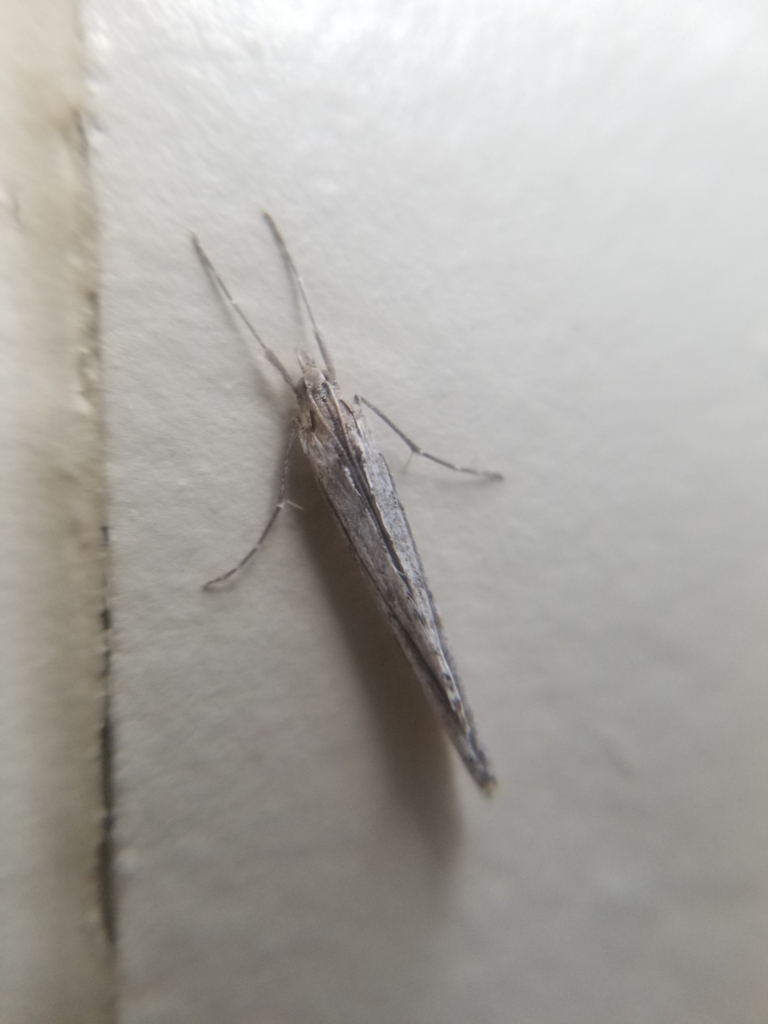
(c) Jack Byrley, some rights reserved (CC BY) · licence
Family: Crambidae · Class: Insecta · Order: Lepidoptera
Evergestis angustalis is a California animal in the Crambidae family.
Evergestis angustalis is a small moth in the family Crambidae, commonly known as the grass moth family. This species belongs to the subfamily Evergestinae, a group of moths whose larvae typically feed on cruciferous plants. Adults measure approximately 15-20 mm in wingspan, displaying the characteristic narrow-winged appearance suggested by the species name 'angustalis,' which means narrow or constricted. The forewings are typically pale brown to grayish-brown with darker transverse lines crossing the wing surface. The hindwings are lighter, often whitish or pale gray with reduced markings. At rest, the moth holds its wings in a triangular configuration typical of many crambid species. The antennae are simple and thread-like, and the legs show the long, spurred tibiae characteristic of the family. Evergestis angustalis has a widespread distribution across North America, including California. The species occurs from southern Canada south through the United States to northern Mexico. In California, it is likely present throughout much of the state where suitable host plants occur, though specific county-level distribution data are limited in the literature. The habitat consists of areas where cruciferous plants grow, including agricultural regions, disturbed sites, roadsides, and natural areas supporting wild members of the Brassicaceae family. The species can be found from sea level to moderate elevations, adapting to various environments from coastal areas to inland valleys and foothills. Larvae feed on plants in the mustard family (Brassicaceae), with documented host plants including cultivated crucifers such as cabbage, radish, and turnip, as well as wild species like field mustard and other Brassica species. The caterpillars are small, pale green to yellowish-green, and feed by boring into stems, roots, or seed pods of their host plants. This feeding behavior can occasionally cause minor damage to cultivated crops, though the species is not considered a significant agricultural pest. Adults are active during warmer months, typically from late spring through early fall, with peak activity in summer. The species is multivoltine in favorable climates, producing multiple generations per year. Moths are nocturnal and are attracted to artificial lights. Mating occurs at night, and females deposit eggs on or near host plants. Evergestis angustalis appears to have stable populations and faces no apparent conservation concerns. The species benefits from human activities that create disturbed habitats suitable for weedy cruciferous plants. Agricultural areas and urban environments may actually provide expanded habitat for this adaptable moth. No federal or state conservation status has been assigned, and the species is not tracked by conservation organizations, suggesting stable population trends throughout its range.
Classification
Class: Insecta · Order: Lepidoptera · Family: Crambidae
Frequently asked questions
How is Evergestis angustalis classified?
Evergestis angustalis belongs to class Insecta, order Lepidoptera, family Crambidae.
What family does Evergestis angustalis belong to?
Evergestis angustalis is in the Crambidae family.
What is Evergestis angustalis?
Evergestis angustalis is a small moth in the family Crambidae, commonly known as the grass moth family.
Is Evergestis angustalis found in California?
Yes. Evergestis angustalis is recorded in California in The California Species Project's catalogue.
Related species
Other California species in the same genus, family, or bioregion.
Data from The California Species Project — 14,000+ California species with verified data from CNPS, CDFW, USFWS, and more.