Falco femoralis septentrionalis
Northern Aplomado Falcon
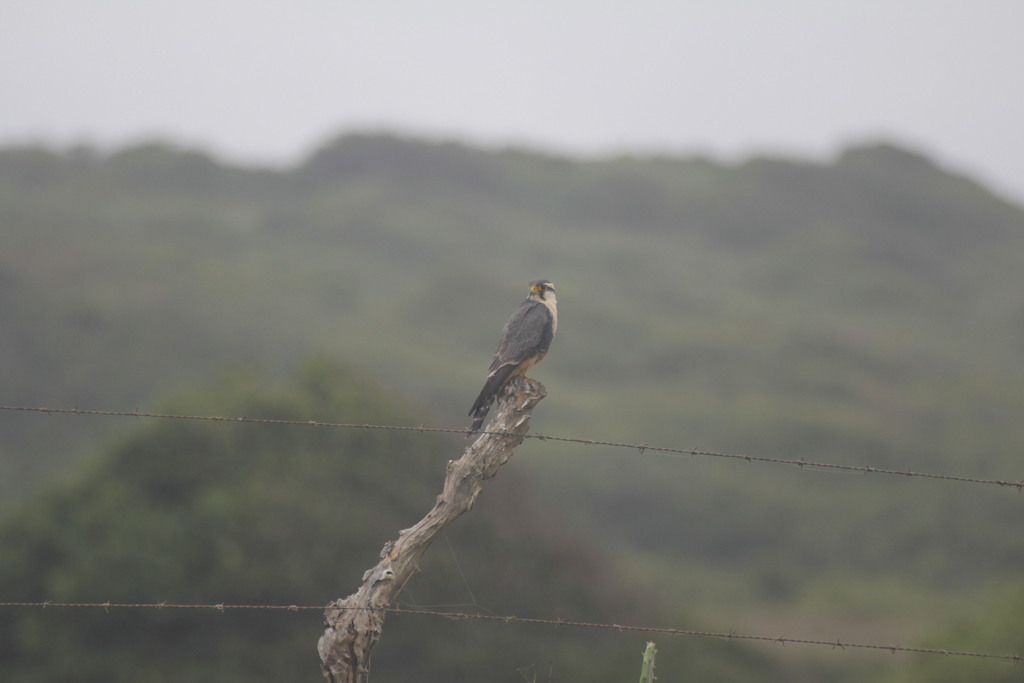
(c) Juan Cruzado Cortés, some rights reserved (CC BY-SA) · licence
Family: Falconidae · Class: Aves · Order: Falconiformes
Conservation status: Experimental Population, Non-Essential
Falco femoralis septentrionalis (Northern Aplomado Falcon) is a California animal in the Falconidae family.
The Northern Aplomado Falcon is a medium-sized raptor distinguished by its colorful plumage, long tail, and long legs. Adults measure smaller than Peregrine Falcons but larger than American Kestrels, with a distinctive silhouette that sets them apart from other North American falcons. The species displays striking field marks including a blue-gray head and back, white throat and breast, and distinctive black mustache stripes. The underparts show a black belly band contrasting with white breast and rufous thighs, while the long tail exhibits alternating dark and light bands. Historically, the Northern Aplomado Falcon ranged across Arizona, New Mexico, and Texas in the southwestern United States. The subspecies was extirpated from the United States by the 1950s but has been the subject of reintroduction efforts since the 1990s. Current experimental populations exist in Arizona and New Mexico, where the species maintains its federal status as an Experimental Population, Non-Essential. Critical habitat was designated for this subspecies on August 31, 2004 (Federal Register 2004). The species inhabits lowland Neotropical savannas, coastal prairies, and higher-elevation grasslands, ranging from sea level to over 4,000 meters elevation in South America (Rodewald 2015). In the southwestern United States, Northern Aplomado Falcons occupy desert grasslands and coastal prairie remnants. Optimal habitat consists of patches of grassland maintained in conditions that support abundant prey populations, particularly in areas with scattered shrubs or trees that provide nesting and perching sites. Northern Aplomado Falcons exhibit unique hunting behaviors among North American falcons, often behaving somewhat like accipiter hawks by perching on inner tree branches and pursuing terrestrial prey on foot. The species displays exceptional speed, agility, and persistence in aerial pursuits of medium-sized birds, particularly doves and quail. Mated pairs remain together year-round and hunt cooperatively, a behavior that distinguishes them from most other falcon species. Their diet consists primarily of birds and insects, supplemented by small mammals and reptiles. The species also engages in kleptoparasitism, stealing prey from other birds. Aplomado Falcons nest in abandoned platform nests built by other species, typically in yucca plants, mesquite trees, or other suitable structures. The Northern Aplomado Falcon was listed as endangered under the Endangered Species Act in 1986, with the current experimental population status reflecting ongoing recovery efforts (Federal Register 1986). Severe eggshell thinning and pesticide contamination in eastern Mexico contributed to the subspecies' decline and extirpation from the United States. Primary threats include habitat loss through conversion of grasslands to agriculture, overgrazing, and urban development. Desert grassland habitat continues to face pressure from irrigation, dryland farming, and introduction of exotic grasses. The species remains vulnerable to pesticide exposure, particularly organochlorines, and lead poisoning from ingesting embedded shotgun pellets in prey species. Recovery efforts focus on habitat restoration and protection of remaining grassland ecosystems in the southwestern United States.
Classification
Class: Aves · Order: Falconiformes · Family: Falconidae
Conservation status
Experimental Population, Non-Essential
Frequently asked questions
How is Falco femoralis septentrionalis classified?
Falco femoralis septentrionalis belongs to class Aves, order Falconiformes, family Falconidae.
What family does Falco femoralis septentrionalis belong to?
Falco femoralis septentrionalis is in the Falconidae family.
Is Falco femoralis septentrionalis protected or of conservation concern?
Falco femoralis septentrionalis carries the following status: Experimental Population, Non-Essential.
What is Falco femoralis septentrionalis?
The Northern Aplomado Falcon is a medium-sized raptor distinguished by its colorful plumage, long tail, and long legs.
Is Falco femoralis septentrionalis found in California?
Yes. Falco femoralis septentrionalis is recorded in California in The California Species Project's catalogue.
Related species
Other California species in the same genus, family, or bioregion.
Data from The California Species Project — 14,000+ California species with verified data from CNPS, CDFW, USFWS, and more.