Falco mexicanus
Prairie Falcon
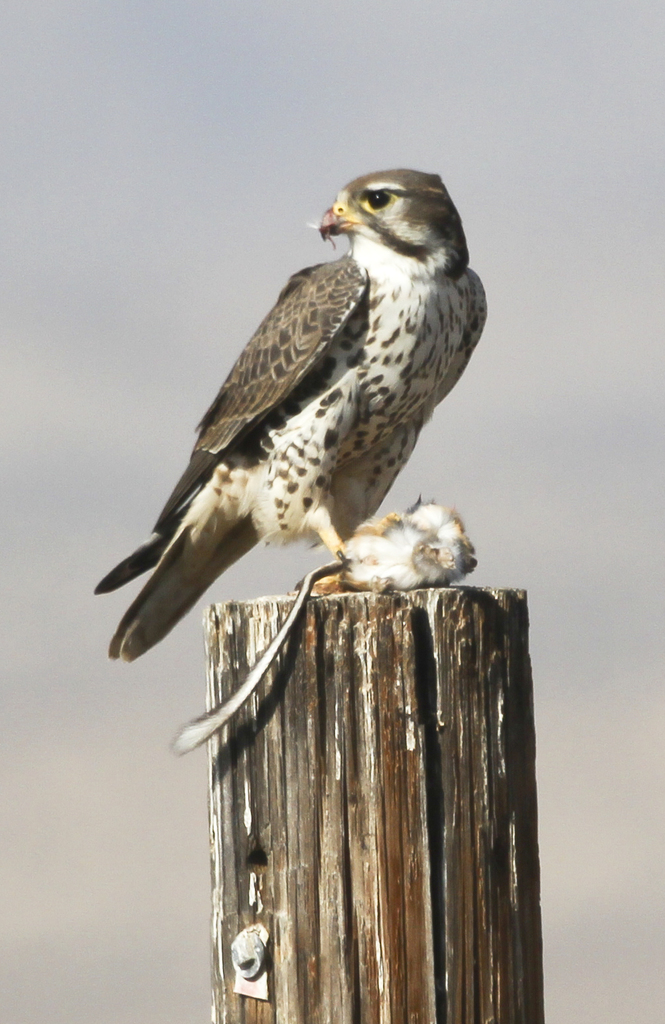
no rights reserved · CC0
Family: Falconidae · Class: Aves · Order: Falconiformes
Conservation status: WL · G5 S4
Falco mexicanus (Prairie Falcon) is a California animal in the Falconidae family.
The Prairie Falcon is a medium-sized raptor measuring 37-47 cm (14.5-18.5 inches) in length with a wingspan of 90-113 cm (35-44 inches). Adults weigh 420-635 grams (0.9-1.4 pounds), with females notably larger than males. The species displays brown upperparts with pale edges creating a scaled appearance, while underparts are white to pale buff with dark brown streaking and spotting. In flight, Prairie Falcons show distinctive dark patches on the underwing coverts and axillaries, contrasting with pale flight feathers. The facial pattern includes a narrow dark mustache stripe and pale eyebrow, less pronounced than in Peregrine Falcons. Juveniles appear similar to adults but with heavier streaking below. Prairie Falcons range across western North America from southern Canada to central Mexico. In California, the species occurs primarily in the Central Valley, Coast Ranges, Sierra Nevada foothills, and desert regions of the south and east. The species is largely absent from coastal areas and higher mountain elevations. California supports year-round resident populations as well as winter visitors from northern breeding areas. According to the North American Breeding Bird Survey, California hosts an estimated 2,000-5,000 breeding pairs. This species inhabits open, arid landscapes including grasslands, shrubsteppe, agricultural areas, and desert regions. Prairie Falcons typically nest on cliff faces, canyon walls, and occasionally tall structures, preferring sites 15-300 meters (50-1,000 feet) above surrounding terrain. Nesting elevations range from sea level to 3,200 meters (10,500 feet), though most breeding occurs below 2,000 meters. The species requires open hunting areas within 10 kilometers of nest sites and shows strong site fidelity, often using the same cliff systems for multiple years. Prairie Falcons are primarily ground squirrel specialists, with Belding's and California ground squirrels comprising up to 90% of their diet during breeding season. They also hunt small mammals, birds, and occasionally reptiles and large insects. Hunting occurs from perches or during low, coursing flights over open terrain. Breeding begins in March with courtship displays including aerial acrobatics and prey transfers. Females lay 3-6 eggs in simple scrapes on cliff ledges, incubating for 29-33 days. Young fledge after 35-42 days but remain dependent on parents for 4-6 weeks post-fledging. The species typically produces one brood annually. The Prairie Falcon is designated as a Watch List species in California (WL) due to declining population trends and habitat concerns. According to the North American Bird Conservation Initiative, the species has experienced a 2.3% annual population decline since 1968. Primary threats include habitat loss from agricultural intensification and urban development, reduced prey availability due to ground squirrel control programs, and disturbance at nest sites. Climate change may affect prey distributions and breeding phenology. Conservation efforts focus on protecting nesting cliffs, maintaining grassland habitats, and monitoring population trends through standardized surveys.
Classification
Class: Aves · Order: Falconiformes · Family: Falconidae
Conservation status
WL · G5 S4
Frequently asked questions
How is Falco mexicanus classified?
Falco mexicanus belongs to class Aves, order Falconiformes, family Falconidae.
What family does Falco mexicanus belong to?
Falco mexicanus is in the Falconidae family.
Is Falco mexicanus protected or of conservation concern?
Falco mexicanus carries the following status: WL · G5 S4.
What is Falco mexicanus?
The Prairie Falcon is a medium-sized raptor measuring 37-47 cm (14.5-18.5 inches) in length with a wingspan of 90-113 cm (35-44 inches).
Is Falco mexicanus found in California?
Yes. Falco mexicanus is recorded in California in The California Species Project's catalogue.
Related species
Other California species in the same genus, family, or bioregion.
Data from The California Species Project — 14,000+ California species with verified data from CNPS, CDFW, USFWS, and more.