Falco peregrinus
Peregrine Falcon
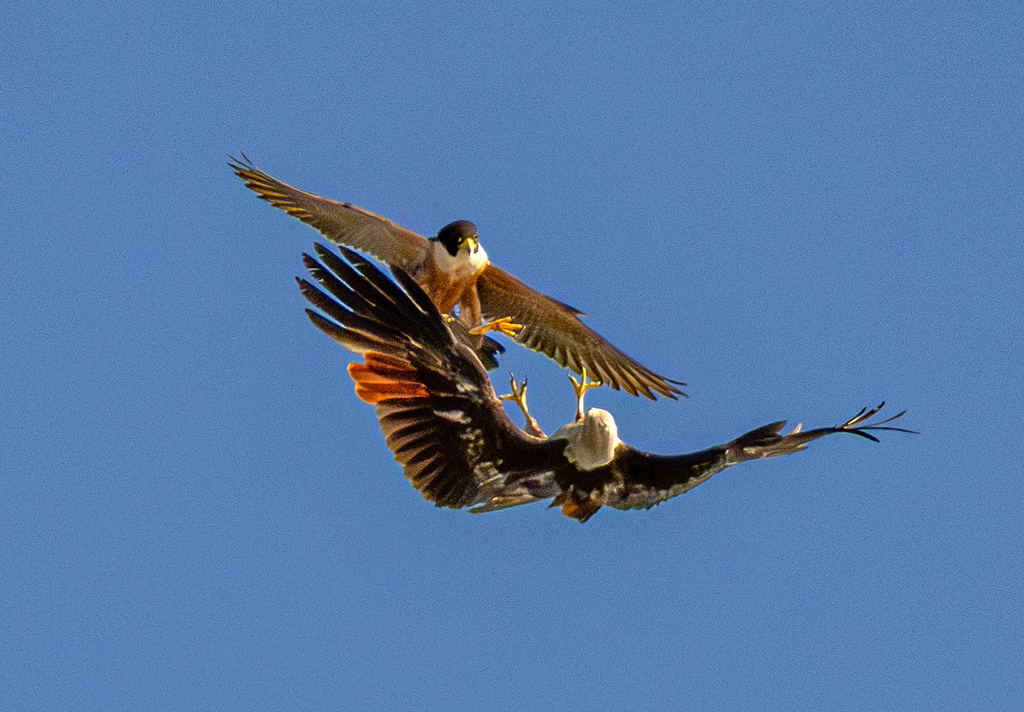
(c) sunnyjosef, some rights reserved (CC BY) · licence
Family: Falconidae · Class: Aves · Order: Falconiformes
Falco peregrinus (Peregrine Falcon) is a California animal in the Falconidae family.
The peregrine falcon is a medium-sized raptor measuring 36 to 49 cm (14 to 19 inches) in length with a wingspan of 74 to 120 cm (29 to 47 inches). Adults weigh 330 to 1,500 grams, with females significantly larger than males. The species displays distinctive plumage with blue-gray upperparts, barred underparts, and a prominent dark hood extending below the eye creating a distinctive facial pattern. The breast and belly show heavy dark barring on a white to buff background. Juveniles exhibit brown upperparts with streaked rather than barred underparts. Peregrine falcons have one of the world's most extensive distributions, occurring on every continent except Antarctica. In California, the species breeds throughout the state from sea level to over 3,000 meters elevation. Breeding populations are found along the coastline on sea cliffs, in mountainous regions on cliff faces and rock outcrops, and increasingly in urban areas on tall buildings and bridges. Historical breeding sites include the Channel Islands, coastal bluffs from San Diego to the Oregon border, the Sierra Nevada, Cascade Range, and various mountain ranges throughout the state. The species inhabits diverse environments but consistently requires open areas for hunting and vertical cliff faces or tall structures for nesting. Coastal populations utilize sea cliffs and offshore islands, while inland birds occupy canyon walls, mountain cliffs, and quarry faces. Urban populations have adapted to nest on skyscrapers, bridges, and other tall structures. Peregrine falcons require hunting territories with abundant bird prey and minimal human disturbance during the breeding season. Peregrine falcons are renowned aerial hunters, capturing prey almost exclusively during high-speed dives called stoops, reaching speeds exceeding 320 km/h (200 mph). Their diet consists primarily of medium-sized birds including shorebirds, waterfowl, pigeons, and songbirds. Breeding occurs from March through July, with pairs exhibiting strong site fidelity. Females lay 2 to 4 eggs in a simple scrape on a cliff ledge or building ledge, with incubation lasting 29 to 32 days. Both parents participate in incubation and chick-rearing, with young fledging after 35 to 42 days. The peregrine falcon was removed from the federal Endangered Species List in 1999 following successful recovery efforts. The species was nearly eliminated from much of North America by the 1960s due to DDT-induced eggshell thinning. California populations reached critically low levels, with only two known breeding pairs remaining by 1970. Recovery efforts included captive breeding programs, reintroduction efforts, and DDT restrictions implemented in 1972. Current California breeding population estimates range from 250 to 300 pairs as of recent surveys. While populations have recovered substantially, ongoing threats include habitat loss from development, human disturbance at nest sites, and collision mortality from wind turbines and vehicles.
Classification
Class: Aves · Order: Falconiformes · Family: Falconidae
Frequently asked questions
How is Falco peregrinus classified?
Falco peregrinus belongs to class Aves, order Falconiformes, family Falconidae.
What family does Falco peregrinus belong to?
Falco peregrinus is in the Falconidae family.
What is Falco peregrinus?
The peregrine falcon is a medium-sized raptor measuring 36 to 49 cm (14 to 19 inches) in length with a wingspan of 74 to 120 cm (29 to 47 inches).
Is Falco peregrinus found in California?
Yes. Falco peregrinus is recorded in California in The California Species Project's catalogue.
Related species
Other California species in the same genus, family, or bioregion.
Data from The California Species Project — 14,000+ California species with verified data from CNPS, CDFW, USFWS, and more.