Falco peregrinus anatum
American Peregrine Falcon
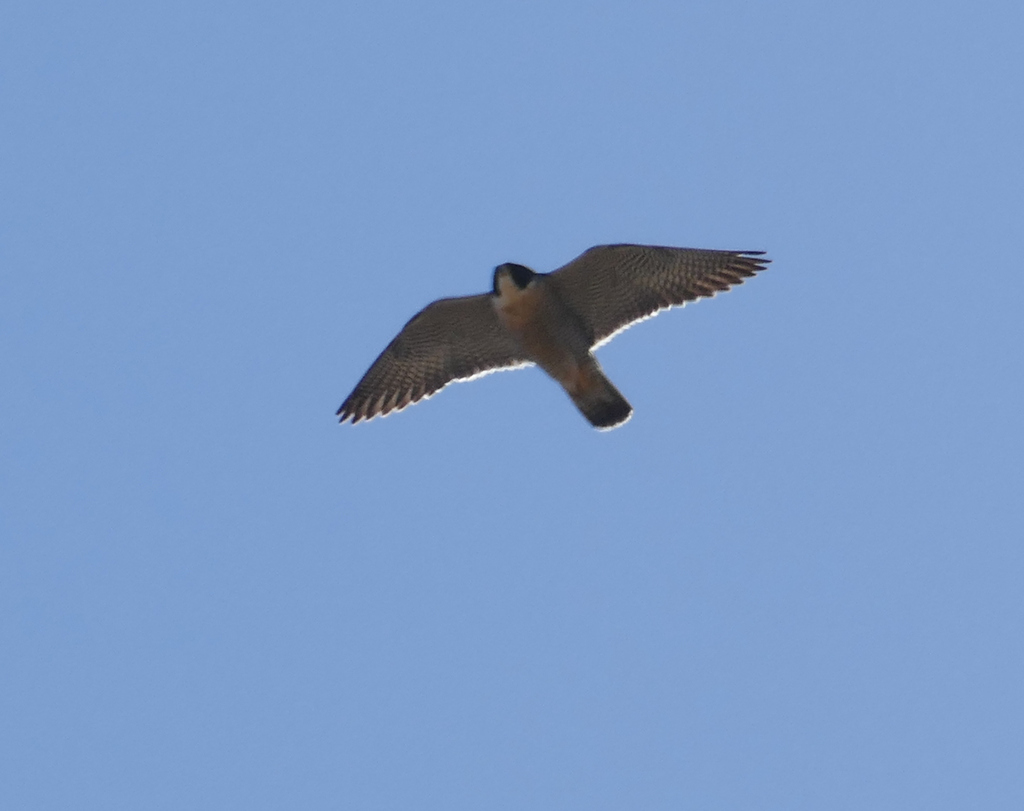
(c) Wendy McCrady, some rights reserved (CC BY) · licence
Family: Falconidae · Class: Aves · Order: Falconiformes
Conservation status: FP · Delisted · G4T4 S3S4
Falco peregrinus anatum (American Peregrine Falcon) is a California animal in the Falconidae family.
The American peregrine falcon is a medium-sized raptor measuring 36 to 49 cm (14 to 19 inches) in length with a wingspan of 74 to 120 cm (29 to 47 inches). Adults weigh 530 to 1,600 grams (1.2 to 3.5 pounds), with females significantly larger than males. The species displays a distinctive slate-blue to blackish crown and back, with lighter underparts marked by dark barring. A prominent dark "mustache" stripe extends below each eye, contrasting with white cheek patches. The long, pointed wings create a characteristic sickle-shaped silhouette in flight, and the species possesses a uniquely notched beak adapted for severing prey spinal columns. Historically, American peregrine falcons ranged throughout much of North America from central Alaska and northern Canada south to Mexico. The subspecies nests from central Alaska, central Yukon Territory, and northern Alberta and Saskatchewan, east to the Maritimes and south through the continental United States, excluding coastal areas north of the Columbia River in Washington and British Columbia (USFWS 2004). The range extends through western Canada and the United States to Baja California, Sonora, and the highlands of central Mexico. In California, the species occurs statewide and is regularly observed in various regions including the Salton Sea area. Peregrine falcons inhabit diverse environments including coastal areas, river valleys, mountain ranges, and urban settings. They require cliff faces, tall buildings, or other elevated structures for nesting sites. The species adapts readily to human-modified landscapes, successfully nesting on skyscrapers, bridges, and industrial structures. Nesting sites typically feature ledges or cavities on vertical surfaces that provide protection from weather and predators. Peregrine falcons are renowned aerial hunters, primarily feeding on medium-sized birds captured during high-speed hunting dives that can exceed 300 km/h (186 mph). Their diet includes pigeons, doves, waterfowl, shorebirds, and other raptors. Breeding occurs from March through August, with pairs typically producing 3 to 4 eggs. American peregrine falcons that nest in subarctic regions generally migrate to South America for winter, while those nesting at lower latitudes show variable migration patterns, with some populations remaining year-round residents. The American peregrine falcon was listed as endangered in 1970 due to severe population declines caused by DDT pesticide use, which caused eggshell thinning and reproductive failure. Following DDT prohibition and intensive recovery efforts including captive breeding and reintroduction programs, populations recovered sufficiently for the subspecies to be removed from the federal endangered species list in 1999 (USFWS 1999). The species is also delisted at the state level in California. Current threats include habitat loss, human disturbance at nest sites, collisions with structures, and continued pesticide exposure. Despite recovery, the species maintains a state rank of S3S4 in California, indicating populations are vulnerable to extirpation but not immediately imperiled. Ongoing monitoring and habitat protection ensure continued population stability.
Classification
Class: Aves · Order: Falconiformes · Family: Falconidae
Conservation status
FP · Delisted · G4T4 S3S4
Frequently asked questions
How is Falco peregrinus anatum classified?
Falco peregrinus anatum belongs to class Aves, order Falconiformes, family Falconidae.
What family does Falco peregrinus anatum belong to?
Falco peregrinus anatum is in the Falconidae family.
Is Falco peregrinus anatum protected or of conservation concern?
Falco peregrinus anatum carries the following status: FP · Delisted · G4T4 S3S4.
What is Falco peregrinus anatum?
The American peregrine falcon is a medium-sized raptor measuring 36 to 49 cm (14 to 19 inches) in length with a wingspan of 74 to 120 cm (29 to 47 inches).
Is Falco peregrinus anatum found in California?
Yes. Falco peregrinus anatum is recorded in California in The California Species Project's catalogue.
Related species
Other California species in the same genus, family, or bioregion.
Data from The California Species Project — 14,000+ California species with verified data from CNPS, CDFW, USFWS, and more.