Falco peregrinus tundrius
Arctic peregrine falcon
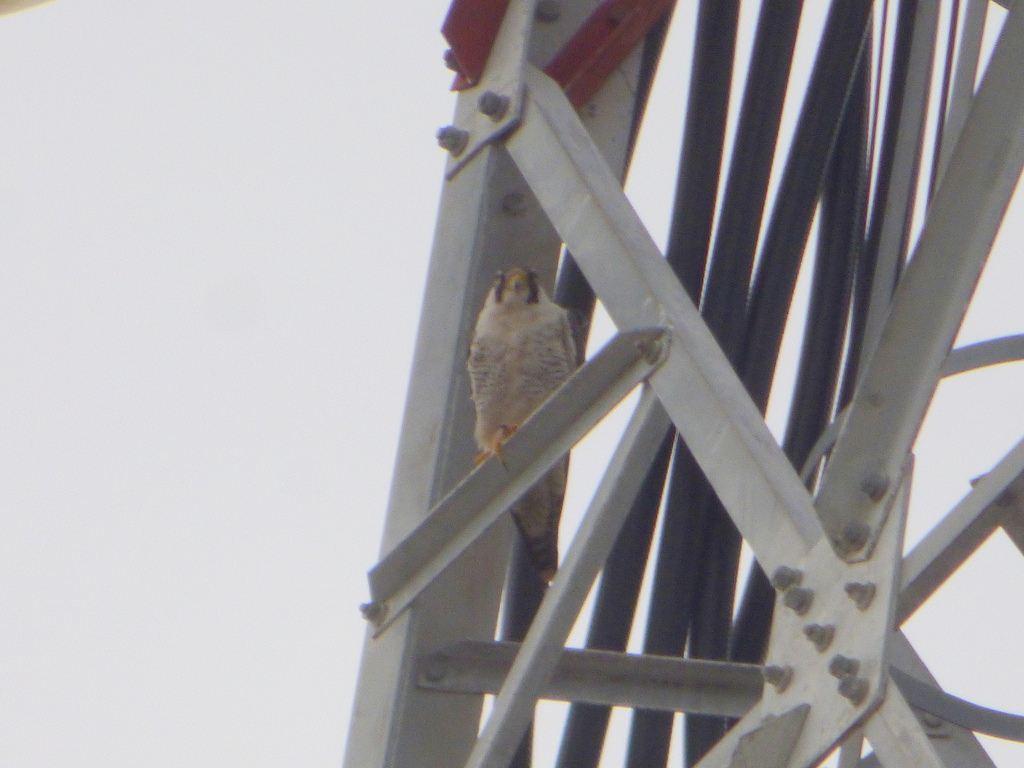
(c) Pablo H Capovilla, some rights reserved (CC BY) · licence
Family: Falconidae · Class: Aves · Order: Falconiformes
Conservation status: Delisted (Recovered)
Falco peregrinus tundrius (Arctic peregrine falcon) is a California animal in the Falconidae family.
The Arctic peregrine falcon is a medium-sized raptor measuring 15 to 21 inches (38 to 53 cm) in length with a wingspan of approximately 40 inches (102 cm). As with many raptors, females are larger than males. Adults display slate blue-gray wings and backs barred with black, pale undersides, and white faces marked with distinctive black stripes on each cheek. The species possesses large, dark eyes and a notched beak adapted for killing prey by severing the spinal column at the neck. Younger birds appear darker below and browner overall. The name "Falco" derives from the Latin word "falx," meaning sickle, referencing the distinctive sickle-shaped silhouette of the peregrine's extended wings in flight. Arctic peregrine falcons breed in the tundra regions of Alaska, northern Canada, and Greenland, generally nesting north of 54° N latitude. During migration and winter, these birds travel extensively throughout North America, with many individuals wintering as far south as Central and South America. In California, Arctic peregrines are observed primarily as migrants and winter visitors along coastal areas, mountain ranges, and river valleys. This subspecies inhabits open tundra landscapes during the breeding season, typically nesting on cliff faces, rocky outcrops, and elevated structures. During migration and winter, Arctic peregrine falcons utilize diverse habitats including coastal areas, urban environments, agricultural fields, and wetlands where prey is abundant. They often perch on tall structures such as buildings, bridges, and communication towers in urban settings. Arctic peregrine falcons are renowned for their exceptional hunting prowess, diving at speeds exceeding 240 mph to capture prey in dramatic aerial strikes. Their diet consists primarily of medium-sized birds including shorebirds, waterfowl, and songbirds, which they typically catch in flight. Breeding occurs from May through August in arctic regions, with females laying 3 to 4 eggs in shallow scrapes on cliff ledges. Incubation lasts approximately 32 days, and young fledge after 35 to 42 days. The Arctic peregrine falcon was listed as endangered under the Endangered Species Act in 1970, primarily due to severe population declines caused by DDT pesticide use. DDT thinned eggshells, leading to reproductive failure and dramatic population crashes. Following the ban on DDT and intensive conservation efforts, populations recovered substantially. The subspecies was removed from the endangered species list in 1994, marking one of the early success stories of the Endangered Species Act (USFWS 1994). According to the California Department of Fish and Wildlife, the species has recovered and is not currently tracked by the California Natural Diversity Database. Post-delisting monitoring continues to document stable or increasing populations across the subspecies' range, with breeding bird surveys showing significant population increases in recent decades.
Classification
Class: Aves · Order: Falconiformes · Family: Falconidae
Conservation status
Delisted (Recovered)
Frequently asked questions
How is Falco peregrinus tundrius classified?
Falco peregrinus tundrius belongs to class Aves, order Falconiformes, family Falconidae.
What family does Falco peregrinus tundrius belong to?
Falco peregrinus tundrius is in the Falconidae family.
Is Falco peregrinus tundrius protected or of conservation concern?
Falco peregrinus tundrius carries the following status: Delisted (Recovered).
What is Falco peregrinus tundrius?
The Arctic peregrine falcon is a medium-sized raptor measuring 15 to 21 inches (38 to 53 cm) in length with a wingspan of approximately 40 inches (102 cm).
Is Falco peregrinus tundrius found in California?
Yes. Falco peregrinus tundrius is recorded in California in The California Species Project's catalogue.
Related species
Other California species in the same genus, family, or bioregion.
Data from The California Species Project — 14,000+ California species with verified data from CNPS, CDFW, USFWS, and more.