Falco sparverius
American Kestrel
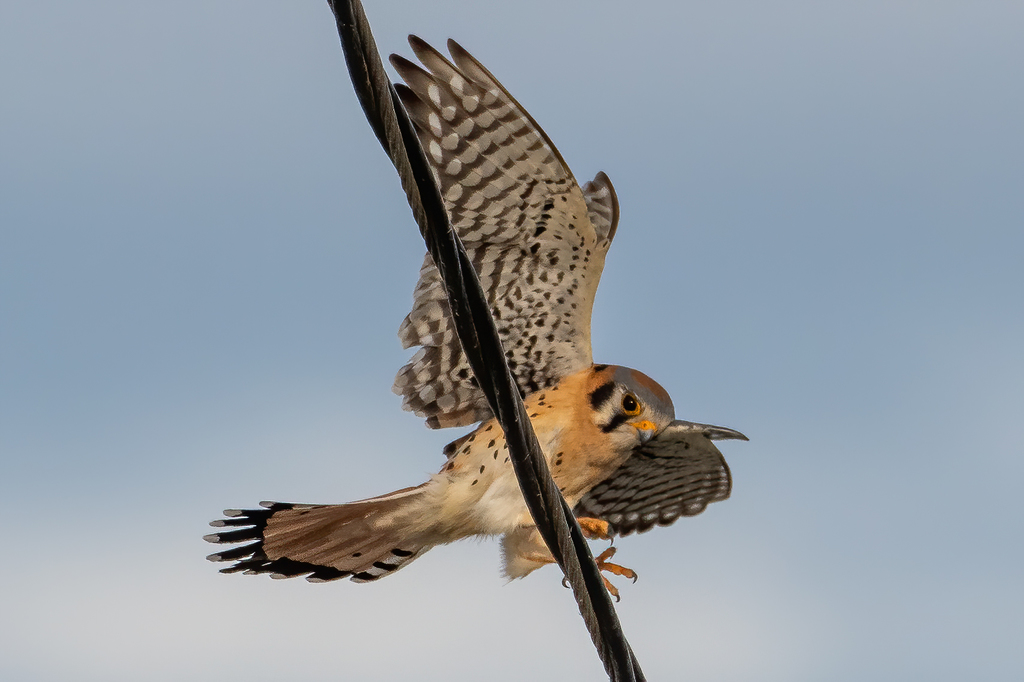
(c) Jonathan Eisen, some rights reserved (CC BY) · licence
Family: Falconidae · Class: Aves · Order: Falconiformes
Falco sparverius (American Kestrel) is a California animal in the Falconidae family.
The American Kestrel is North America's smallest falcon, measuring 22 to 31 cm (8.7 to 12.2 inches) in length with a wingspan of 51 to 61 cm (20 to 24 inches). Adults weigh 80 to 165 grams (2.8 to 5.8 ounces), with females approximately 10% larger than males. Males display rufous backs and tails with blue-gray wings, while females exhibit rufous coloration throughout with dark barring. Both sexes show distinctive black facial markings resembling vertical stripes below each eye and white cheek patches. The species has a long, pointed tail with a prominent black subterminal band. American Kestrels breed throughout California from sea level to elevations exceeding 2,100 meters (6,900 feet). The species occurs year-round in most of the state, with some populations exhibiting altitudinal migration from high-elevation breeding areas to lower elevations during winter. According to the North American Breeding Bird Survey, California supports stable breeding populations across diverse geographic regions, from the Central Valley to montane forests. This species occupies open and semi-open habitats including grasslands, agricultural fields, desert scrub, oak woodlands, and urban areas with suitable nesting sites. American Kestrels require elevated perches for hunting and cavities for nesting, utilizing natural tree holes, cliff crevices, nest boxes, and human-made structures. They show preference for areas with short vegetation that facilitates prey detection and capture. American Kestrels are opportunistic predators that hunt primarily from perches, employing a sit-and-wait strategy. Their diet consists predominantly of small mammals, particularly voles and mice, supplemented by insects, small birds, reptiles, and amphibians. Breeding occurs from March through July, with females laying 3 to 5 eggs in cavities without nest construction. Incubation lasts 29 to 31 days, performed primarily by females while males provide food. Nestlings fledge after 28 to 31 days but remain dependent on parents for several weeks. The species exhibits strong site fidelity, with pairs often returning to successful nesting territories. While not federally or state-listed in California, American Kestrel populations have experienced regional declines. The North American Bird Conservation Initiative identifies the species as a common bird in steep decline, with continental populations decreasing by approximately 66% since 1966. In California, Christmas Bird Count data indicate mixed population trends, with some regions showing stability while others exhibit declines. Primary threats include habitat loss from agricultural intensification and urban development, reduced availability of nesting cavities, pesticide use affecting prey populations, and competition with European Starlings for nest sites. Conservation efforts focus on maintaining grassland habitats, installing nest boxes, and promoting wildlife-friendly farming practices. The species benefits from integrated pest management in agricultural areas and preservation of open space corridors.
Classification
Class: Aves · Order: Falconiformes · Family: Falconidae
Frequently asked questions
How is Falco sparverius classified?
Falco sparverius belongs to class Aves, order Falconiformes, family Falconidae.
What family does Falco sparverius belong to?
Falco sparverius is in the Falconidae family.
What is Falco sparverius?
The American Kestrel is North America's smallest falcon, measuring 22 to 31 cm (8.7 to 12.2 inches) in length with a wingspan of 51 to 61 cm (20 to 24 inches).
Is Falco sparverius found in California?
Yes. Falco sparverius is recorded in California in The California Species Project's catalogue.
Related species
Other California species in the same genus, family, or bioregion.
Data from The California Species Project — 14,000+ California species with verified data from CNPS, CDFW, USFWS, and more.