Falco tinnunculus
Eurasian Kestrel
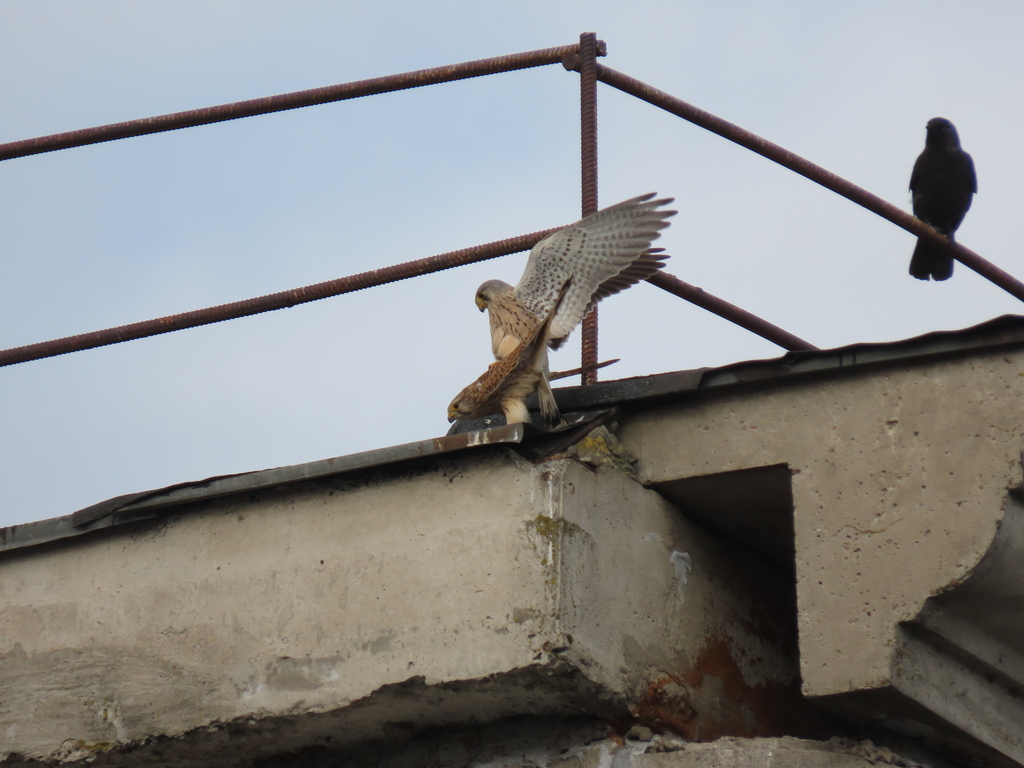
(c) Дмитрий Кошелев, some rights reserved (CC BY) · licence
Family: Falconidae · Class: Aves · Order: Falconiformes
Falco tinnunculus (Eurasian Kestrel) is a California animal in the Falconidae family.
The Eurasian Kestrel is a small falcon measuring 32-39 cm (12.6-15.4 inches) in length with a wingspan of 65-82 cm (25.6-32.3 inches). Males weigh 136-252 grams, while females are slightly larger at 154-314 grams. Males display distinctive plumage with blue-grey heads and tails, chestnut-brown backs with black spots, and pale underparts with dark streaking. Females and juveniles are predominantly brown with heavy barring across the wings, back, and tail. Both sexes have yellow legs, cere, and eye-rings, with dark eyes and hooked bills typical of raptors. The Eurasian Kestrel has one of the most extensive global distributions of any bird species, naturally occurring across Europe, Asia, and Africa. In North America, the species is considered a rare vagrant, with documented sightings primarily along the Atlantic and Pacific coasts. California records are extremely limited, with fewer than a dozen confirmed observations since the mid-20th century. Most California sightings have occurred in coastal areas, particularly around the San Francisco Bay Area and Southern California, typically during migration periods. Eurasian Kestrels occupy diverse habitats including open woodlands, farmland, grasslands, urban parks, and coastal areas. They prefer areas with scattered trees or structures for nesting and perching, combined with open ground for hunting. The species adapts well to human-modified landscapes and commonly nests in buildings, cliff faces, tree holes, and nest boxes. They typically occur from sea level to elevations of 4,500 meters in their native range. This species employs distinctive hunting behavior, hovering motionless in flight while scanning for prey below, a technique called wind-hovering or kiting. Their diet consists primarily of small mammals, particularly voles and mice, supplemented by insects, small birds, reptiles, and amphibians. Eurasian Kestrels are generally solitary outside the breeding season. Breeding occurs from April through July, with females laying 3-6 eggs in scrapes on cliff ledges, building cavities, or abandoned nests of other species. Incubation lasts 27-29 days, and young fledge after 27-35 days. The Eurasian Kestrel holds no federal or state listing status in California, as it is not considered an established resident species. Globally, the IUCN Red List classifies the species as Least Concern, with stable populations across most of its range. However, some European populations have experienced declines due to agricultural intensification and habitat loss. In California, vagrant individuals pose no conservation concern, and their presence is monitored primarily for scientific interest and biogeographical documentation. The species' occurrence in California likely results from weather-driven displacement during migration or dispersal from established populations in adjacent regions.
Classification
Class: Aves · Order: Falconiformes · Family: Falconidae
Frequently asked questions
How is Falco tinnunculus classified?
Falco tinnunculus belongs to class Aves, order Falconiformes, family Falconidae.
What family does Falco tinnunculus belong to?
Falco tinnunculus is in the Falconidae family.
What is Falco tinnunculus?
The Eurasian Kestrel is a small falcon measuring 32-39 cm (12.6-15.4 inches) in length with a wingspan of 65-82 cm (25.6-32.3 inches).
Is Falco tinnunculus found in California?
Yes. Falco tinnunculus is recorded in California in The California Species Project's catalogue.
Related species
Other California species in the same genus, family, or bioregion.
Data from The California Species Project — 14,000+ California species with verified data from CNPS, CDFW, USFWS, and more.