Fannia canicularis
Lesser House Fly
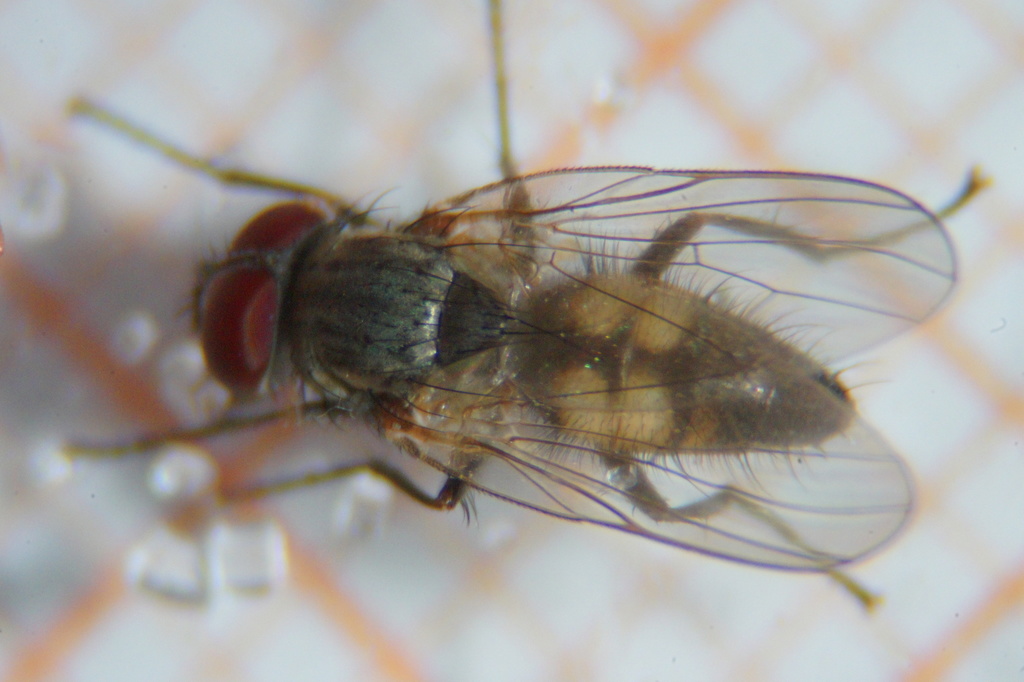
no rights reserved · CC0
Family: Fanniidae · Class: Insecta · Order: Diptera
Fannia canicularis (Lesser House Fly) is a California animal in the Fanniidae family.
The lesser house fly (Fannia canicularis) is a small dipteran insect measuring 3.5 to 6 mm (0.14 to 0.24 inches) in length, making it noticeably smaller than the common house fly (Musca domestica). The species displays a slender body form and is distinguished by its straight median wing vein, a diagnostic feature separating it from related species. Adults are typically dark-colored with relatively inconspicuous markings. Fannia canicularis has a cosmopolitan distribution, occurring across North America, Europe, and other temperate regions worldwide. In North America, the species is found throughout the United States and extends into Canada, where NatureServe reports occurrences in Alberta, Labrador, Manitoba, New Brunswick, Nova Scotia, Ontario, Saskatchewan, and Yukon Territory. The species is well-established in California and occurs throughout the state's varied climatic zones. This synanthropic species demonstrates a strong association with human habitats and structures. Lesser house flies readily enter buildings and are commonly found in homes, barns, stables, and other domestic settings. The species shows a preference for areas with abundant organic matter, particularly locations containing decomposing materials that serve as larval breeding sites. Unlike many fly species that prefer outdoor environments, F. canicularis has adapted to indoor conditions and thrives in close association with human activities. The behavioral ecology of the lesser house fly is characterized by distinctive flight patterns and reproductive habits. Adults are best known for their tendency to circle repeatedly near the center of rooms, creating characteristic looping flight paths that distinguish them from other domestic flies (BugGuide). This circling behavior is particularly pronounced in indoor environments. Larvae are saprophagous, feeding on decaying organic matter including carrion, manure, and other decomposing materials. The species completes its development through complete metamorphosis, with eggs laid in suitable organic substrates where larvae can access adequate nutrition. Among the Fanniidae family, F. canicularis holds particular medical significance as the species most frequently associated with myiasis, a condition where fly larvae develop in living tissue. While not typically considered a major pest species, the lesser house fly can become locally abundant in suitable environments and may contribute to nuisance problems in domestic settings. The conservation status of Fannia canicularis reflects its widespread distribution and apparent stability. The species carries no federal or state conservation listings and is not considered threatened or endangered. NatureServe assigns no specific conservation rank, indicating the species is sufficiently common and widespread that detailed population monitoring is unnecessary. The lesser house fly's close association with human environments and its cosmopolitan distribution suggest that populations remain stable across its range. The species' adaptability to various climatic conditions and its successful exploitation of anthropogenic habitats indicate that F. canicularis faces no immediate conservation concerns.
Classification
Class: Insecta · Order: Diptera · Family: Fanniidae
Frequently asked questions
How is Fannia canicularis classified?
Fannia canicularis belongs to class Insecta, order Diptera, family Fanniidae.
What family does Fannia canicularis belong to?
Fannia canicularis is in the Fanniidae family.
What is Fannia canicularis?
The lesser house fly (Fannia canicularis) is a small dipteran insect measuring 3.5 to 6 mm (0.14 to 0.24 inches) in length, making it noticeably smaller than the common house fly (Musca domestica).
Is Fannia canicularis found in California?
Yes. Fannia canicularis is recorded in California in The California Species Project's catalogue.
More California species
This species has no close relatives in our California data — here are other species to explore.
Data from The California Species Project — 14,000+ California species with verified data from CNPS, CDFW, USFWS, and more.