Feltia jaculifera
Dingy Cutworm Moth
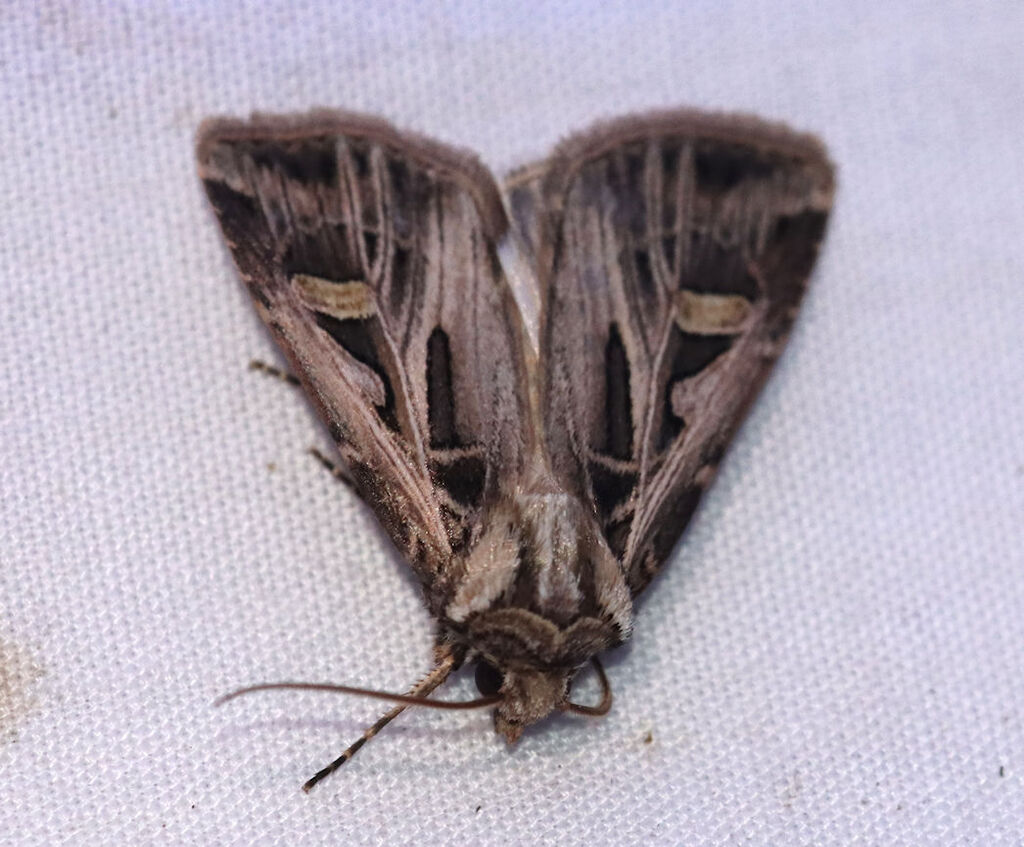
(c) hr_dragonfly, some rights reserved (CC BY) · licence
Family: Noctuidae · Class: Insecta · Order: Lepidoptera
Feltia jaculifera (Dingy Cutworm Moth) is a California animal in the Noctuidae family.
The dingy cutworm moth is a medium-sized noctuid moth with forewings measuring approximately 16-20 mm in length. Adults display sexually dimorphic wing patterns, with males exhibiting grayish-brown forewings marked by a gray discal lunule, distinct veins, and a terminal band, while females show more uniformly brownish-gray coloration (BugGuide). The hindwings are pale with yellowish fringe in both sexes. Larvae are distinctive, displaying light grayish dorsal coloration with smooth skin and four equally-sized black dots arranged on the dorsal surface of each abdominal segment, contrasting with their pale yellowish ventral surface. Feltia jaculifera occurs across most of North America from coast to coast, with notable exceptions in Arizona, southern California, and Newfoundland (BugGuide). The species ranges northward to the Northwest Territories, Yukon, and Alaska. In California, moth photographers have documented the species during June through September, with peak activity occurring in summer months (Moth Photographers Group). Colorado records show the species occurring at elevations ranging from 4,352 feet to 7,932 feet, indicating considerable altitudinal tolerance. The species inhabits diverse open environments including agricultural fields, gardens, waste places, and other disturbed habitats (BugGuide). Adults are strictly nocturnal and are readily attracted to artificial lights, making them commonly encountered at moth sheets and light traps. The moths show strong phototropic behavior, often appearing at gas station lights and UV light installations. Adult flight periods vary geographically but generally occur during late summer and fall months. In Rhode Island populations, adults fly primarily in September with extended activity recorded throughout August and October (BugGuide). Western populations show earlier emergence, with Colorado specimens collected from August through September. The species exhibits a univoltine life cycle with larvae overwintering and pupating the following season. Larvae are polyphagous generalist feeders, documented on more than 40 plant species including economically important crops such as alfalfa (BugGuide). This broad host range contributes to the species' widespread distribution and ecological success across diverse habitats. Caterpillars feed at night and hide in soil during daylight hours, following typical cutworm behavior patterns. Feltia jaculifera holds no special conservation status and appears to maintain stable populations across its extensive range. The species has been designated as a Species of Greatest Conservation Need in both New York and Louisiana state wildlife action plans, though this designation reflects data deficiency rather than population decline (BugGuide). The moth's adaptability to disturbed habitats and agricultural environments, combined with its broad host plant range, suggests resilience to habitat modification. Climate change impacts on northern populations remain unstudied, though the species' transcontinental distribution likely provides demographic stability through source-sink population dynamics.
Classification
Class: Insecta · Order: Lepidoptera · Family: Noctuidae
Frequently asked questions
How is Feltia jaculifera classified?
Feltia jaculifera belongs to class Insecta, order Lepidoptera, family Noctuidae.
What family does Feltia jaculifera belong to?
Feltia jaculifera is in the Noctuidae family.
What is Feltia jaculifera?
The dingy cutworm moth is a medium-sized noctuid moth with forewings measuring approximately 16-20 mm in length.
Is Feltia jaculifera found in California?
Yes. Feltia jaculifera is recorded in California in The California Species Project's catalogue.
Related species
Other California species in the same genus, family, or bioregion.
Data from The California Species Project — 14,000+ California species with verified data from CNPS, CDFW, USFWS, and more.