Feltia subterranea
Subterranean Dart Moth
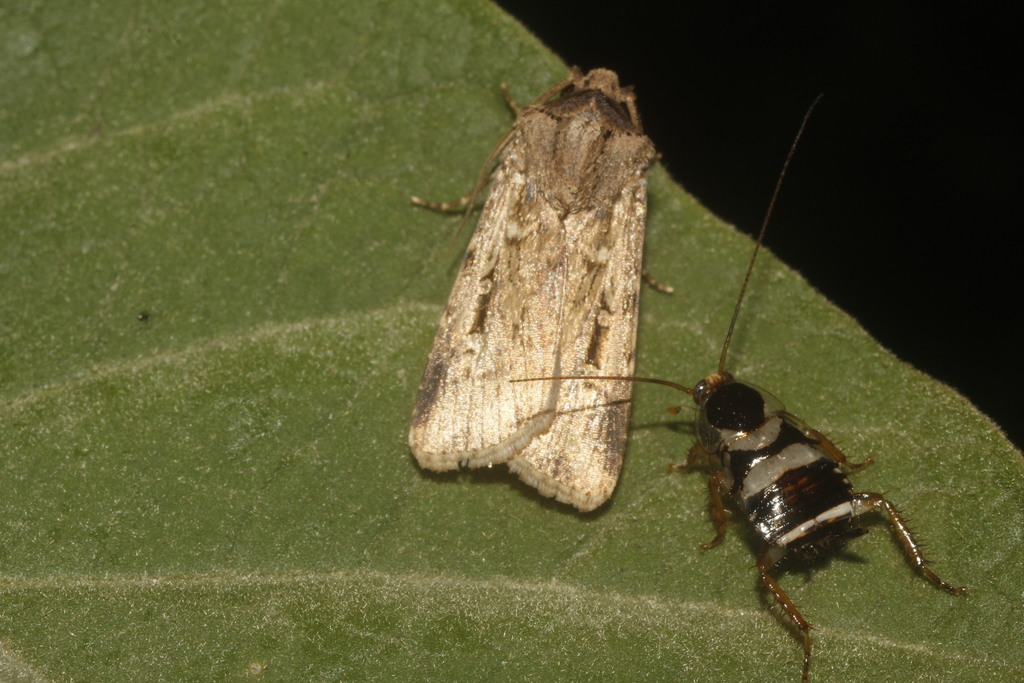
(c) Juan Cruzado Cortés, some rights reserved (CC BY-SA) · licence
Family: Noctuidae · Class: Insecta · Order: Lepidoptera
Feltia subterranea (Subterranean Dart Moth) is a California animal in the Noctuidae family.
The Subterranean Dart Moth (Feltia subterranea) is a medium-sized nocturnal moth in the family Noctuidae, subfamily Noctuinae. Adults have a wingspan ranging from 35 to 42 millimeters (1.4 to 1.7 inches). The forewings are grayish-brown to dark brown with subtle darker markings, including the characteristic reniform and orbicular spots typical of dart moths. The hindwings are pale grayish-white with darker veining and a narrow dark marginal band. Males can be distinguished from females by their more feathered antennae and slightly smaller size. This species has a limited distribution in western North America, with populations documented in California, Oregon, and Washington. In California, the Subterranean Dart Moth occurs primarily in the northern and central regions, including the Sierra Nevada foothills and coastal ranges. Specific county records include populations in Nevada, Placer, El Dorado, and Tuolumne counties, typically at elevations between 300 and 1,500 meters (1,000 to 4,900 feet). The species inhabits oak woodlands, mixed coniferous forests, and chaparral communities. Adults are most commonly found in areas with open canopy structure and diverse understory vegetation. The moth shows a preference for sites with well-drained soils and moderate moisture levels. Habitat requirements appear closely tied to the presence of suitable host plants for larval development. Subterranean Dart Moths are univoltine, producing one generation per year. Adults are active from late September through November, with peak flight activity occurring in October. Males are attracted to artificial lights and pheromone traps, while females are more cryptic in their behavior. Mating typically occurs during the first few hours after sunset. After mating, females deposit eggs singly on or near host plant stems and in soil crevices. The larval stage overwinters, with caterpillars feeding on roots and lower stems of various herbaceous plants and grasses. Larvae are subterranean in habit, as suggested by the species name, spending most of their development below ground or at the soil surface. Pupation occurs in earthen cells constructed by mature larvae in spring. The conservation status of Feltia subterranea remains poorly documented, with no current federal or state listing designations as of December 2025. Population trends are largely unknown due to limited systematic monitoring efforts. The species faces potential threats from habitat loss due to urban development, agricultural conversion, and altered fire regimes in oak woodland and chaparral habitats. Climate change may affect the timing of adult emergence and larval development, particularly in marginal habitats. The moth's specialized habitat requirements and limited flight period make it potentially vulnerable to environmental changes, though comprehensive population assessments are needed to determine actual conservation needs.
Classification
Class: Insecta · Order: Lepidoptera · Family: Noctuidae
Frequently asked questions
How is Feltia subterranea classified?
Feltia subterranea belongs to class Insecta, order Lepidoptera, family Noctuidae.
What family does Feltia subterranea belong to?
Feltia subterranea is in the Noctuidae family.
What is Feltia subterranea?
The Subterranean Dart Moth (Feltia subterranea) is a medium-sized nocturnal moth in the family Noctuidae, subfamily Noctuinae.
Is Feltia subterranea found in California?
Yes. Feltia subterranea is recorded in California in The California Species Project's catalogue.
Related species
Other California species in the same genus, family, or bioregion.
Data from The California Species Project — 14,000+ California species with verified data from CNPS, CDFW, USFWS, and more.