Feron atrimentum
Striped Volcano Gall Wasp
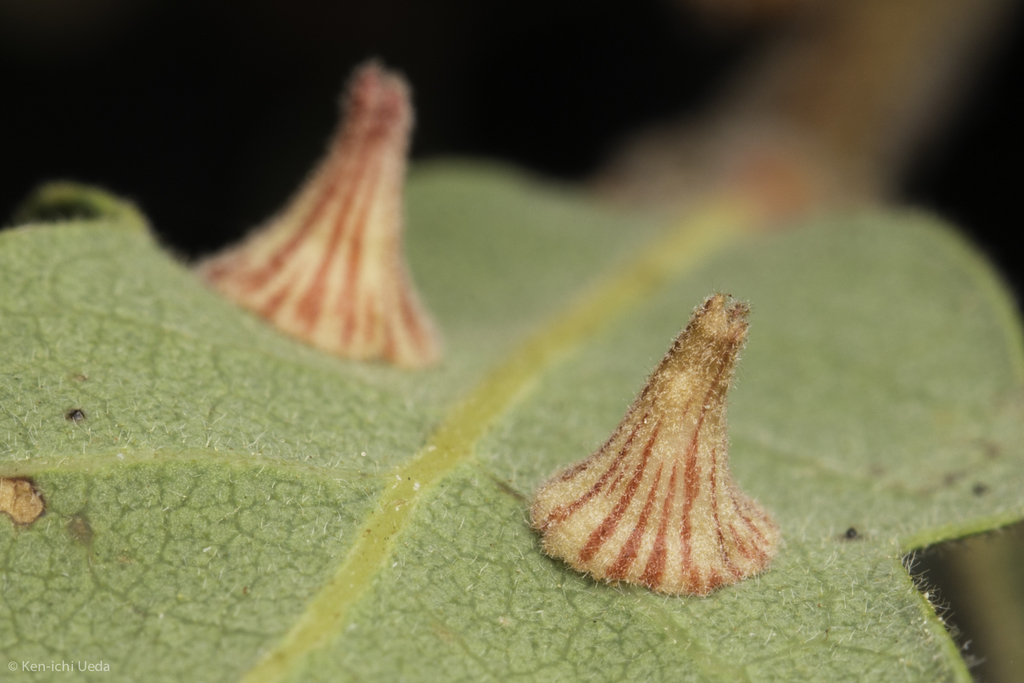
(c) Ken-ichi Ueda, some rights reserved (CC BY) · licence
Family: Cynipidae · Class: Insecta · Order: Hymenoptera
Feron atrimentum (Striped Volcano Gall Wasp) is a California animal in the Cynipidae family.
The Striped Volcano Gall Wasp is a small cynipid wasp that produces distinctive galls on blue oak trees throughout California. Adults measure approximately 4 mm in length and belong to the family Cynipidae, a group of highly specialized wasps that induce plant galls for larval development (BugGuide 2023). This species is endemic to California and occurs primarily in areas where its host plant, blue oak (Quercus douglasii), is found. Documented locations include San Benito County, where specimens have been collected near the Antelope Fire Control Station in Willow Springs (BugGuide 2013). The species' distribution likely extends throughout the blue oak woodland regions of California's Central Valley foothills and surrounding areas. The Striped Volcano Gall Wasp inhabits blue oak woodlands and associated plant communities where Quercus douglasii occurs. Blue oak woodlands are typically found at elevations between 150 to 1,200 meters in California's Central Valley foothills, Coast Ranges, and Sierra Nevada foothills. These habitats are characterized by Mediterranean climate conditions with hot, dry summers and mild, wet winters. This species exhibits a complex life cycle typical of many gall wasps, with two distinct generations per year producing different gall types. The spring generation is bisexual, producing both male and female offspring, while the summer generation is unisexual, consisting only of females that reproduce parthenogenetically. Each generation induces morphologically distinct galls on the blue oak host, with both gall types measuring up to approximately 4 mm in size (BugGuide 2023). The larvae develop entirely within these galls, which provide both nutrition and protection during development. Adults emerge to mate and locate suitable oviposition sites on blue oak branches or leaves. The wasp's reproductive strategy involves inserting eggs into specific plant tissues of the blue oak, along with chemical secretions that induce the formation of specialized gall structures. These galls serve as both nurseries and food sources for the developing larvae. The alternating generations allow the species to exploit different seasonal conditions and potentially different microhabitats on the host plant. No formal conservation status has been assigned to the Striped Volcano Gall Wasp at federal or state levels. However, like many species dependent on blue oak ecosystems, it may face habitat pressures from urban development, agricultural conversion, and climate change impacts on blue oak woodlands. Blue oak habitats have experienced significant fragmentation and reduction throughout California's Central Valley and foothills regions. The species' apparent specialization on a single host plant species makes it potentially vulnerable to factors affecting blue oak populations, including drought stress, development pressure, and altered fire regimes. Scientific documentation of this species remains limited, with most biological information derived from gall collections and community science observations rather than comprehensive ecological studies.
Classification
Class: Insecta · Order: Hymenoptera · Family: Cynipidae
Frequently asked questions
How is Feron atrimentum classified?
Feron atrimentum belongs to class Insecta, order Hymenoptera, family Cynipidae.
What family does Feron atrimentum belong to?
Feron atrimentum is in the Cynipidae family.
What is Feron atrimentum?
The Striped Volcano Gall Wasp is a small cynipid wasp that produces distinctive galls on blue oak trees throughout California.
Is Feron atrimentum found in California?
Yes. Feron atrimentum is recorded in California in The California Species Project's catalogue.
Related species
Other California species in the same genus, family, or bioregion.
Data from The California Species Project — 14,000+ California species with verified data from CNPS, CDFW, USFWS, and more.