Flabellinopsis iodinea
Spanish Shawl
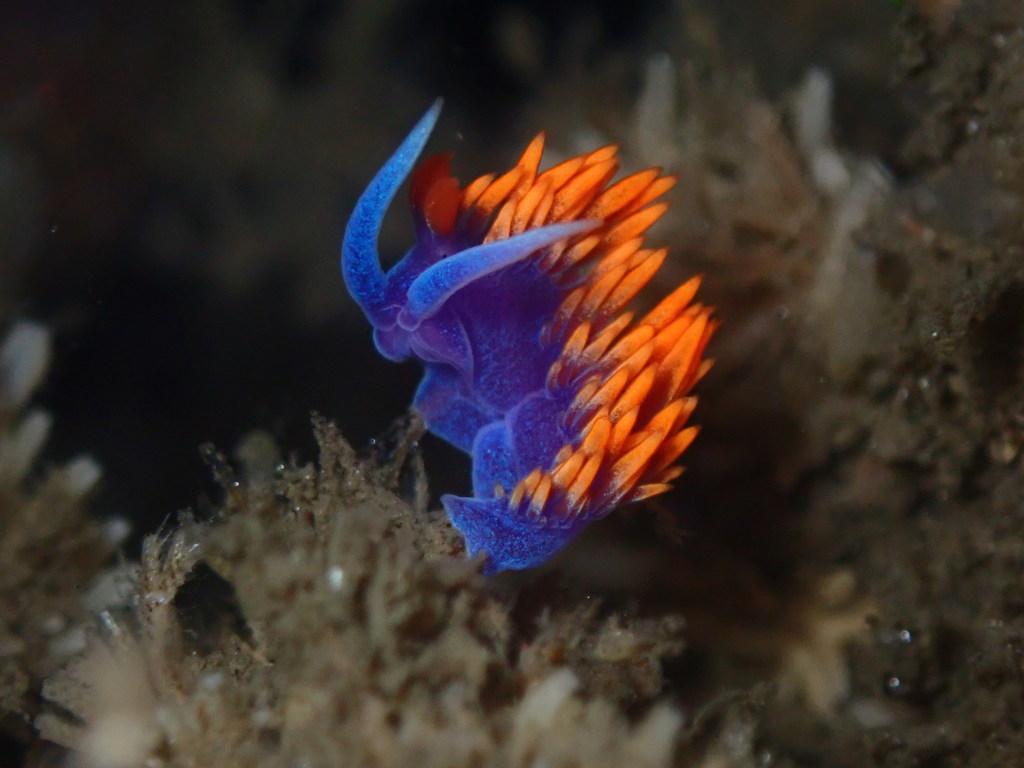
(c) Cricket Raspet, some rights reserved (CC BY) · licence
Family: Flabellinopsidae · Class: Gastropoda · Order: Nudibranchia
Flabellinopsis iodinea (Spanish Shawl) is a California animal in the Flabellinopsidae family.
The Spanish shawl is a vibrant marine nudibranch distinguished by its striking purple body with bright orange cerata extending along its back. Adults typically measure 25 to 50 mm (1 to 2 inches) in length, with some individuals reaching up to 75 mm. The elongated body displays an iridescent purple coloration that can appear blue under certain lighting conditions. The numerous finger-like projections (cerata) are bright orange to red and contain extensions of the digestive system. Two prominent oral tentacles and rhinophores extend from the head region, serving sensory functions. Flabellinopsis iodinea occurs along the Pacific Coast from British Columbia to Baja California, Mexico. In California, the species is found in nearshore waters from the intertidal zone to depths of approximately 100 feet (30 meters). According to the California Department of Fish and Wildlife, Spanish shawl nudibranchs have been observed in the Monterey Bay area, though occurrences appear relatively infrequent compared to other invertebrate species in the region. This nudibranch inhabits rocky substrates, kelp forests, and areas with abundant hydroid growth. The species prefers areas with moderate to strong water movement and typically occurs on vertical surfaces or overhangs where prey organisms are abundant. Spanish shawl nudibranchs are commonly found on pier pilings, jetties, and natural rock formations where their hydroid prey colonizes surfaces. As specialized carnivores, Spanish shawl nudibranchs feed primarily on hydroids, particularly species in the genus Eudendrium. The cerata serve dual functions as digestive extensions and defensive structures, as they can store stinging cells (nematocysts) obtained from their hydroid prey. These stored nematocysts provide protection against predators. The species exhibits typical nudibranch reproductive behavior, with individuals functioning as simultaneous hermaphrodites. During mating, pairs exchange sperm and subsequently lay ribbons of eggs on hard surfaces. The eggs develop into planktonic larvae that eventually settle and metamorphose into juvenile nudibranchs. Spanish shawl nudibranchs currently hold no federal or state conservation listing status. NatureServe ranks the species as G4 (Apparently Secure), indicating that while the species may be uncommon in parts of its range, it is not considered to be at immediate risk of extinction. Population trends have not been extensively studied, though the species appears to maintain stable populations throughout its range. Primary threats include coastal development that alters nearshore habitats, pollution, and potential climate change impacts on ocean chemistry and temperature. The species' dependence on specific hydroid prey makes it potentially vulnerable to changes in prey abundance related to environmental conditions. Marine protected areas along the California coast provide some habitat protection for this species and its associated ecosystem.
Classification
Class: Gastropoda · Order: Nudibranchia · Family: Flabellinopsidae
Frequently asked questions
How is Flabellinopsis iodinea classified?
Flabellinopsis iodinea belongs to class Gastropoda, order Nudibranchia, family Flabellinopsidae.
What family does Flabellinopsis iodinea belong to?
Flabellinopsis iodinea is in the Flabellinopsidae family.
What is Flabellinopsis iodinea?
The Spanish shawl is a vibrant marine nudibranch distinguished by its striking purple body with bright orange cerata extending along its back.
Is Flabellinopsis iodinea found in California?
Yes. Flabellinopsis iodinea is recorded in California in The California Species Project's catalogue.
More California species
This species has no close relatives in our California data — here are other species to explore.
Data from The California Species Project — 14,000+ California species with verified data from CNPS, CDFW, USFWS, and more.