Flatormenis saucia
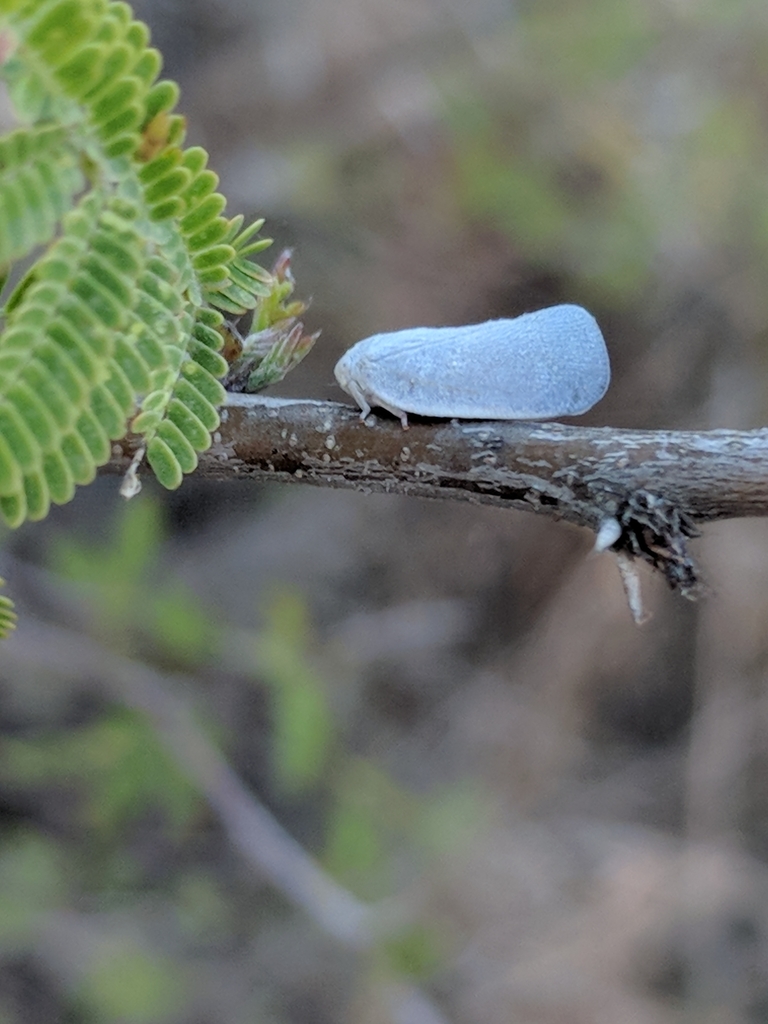
(c) Alison Northup, some rights reserved (CC BY) · licence
Family: Flatidae · Class: Insecta · Order: Hemiptera
Flatormenis saucia is a California animal in the Flatidae family.
Flatormenis saucia is a planthopper species in the family Flatidae, order Hemiptera. This insect belongs to the superfamily Fulgoroidea, a diverse group of plant-feeding insects commonly known as planthoppers. Like other members of Flatidae, F. saucia possesses the characteristic flattened appearance and broad forewings that distinguish this family from other planthopper groups. Specific morphological details for F. saucia remain poorly documented in the scientific literature. Flatidae species typically measure 3-15 mm in length, with broad, often colorful forewings that may be held roof-like over the body when at rest. Many species in this family exhibit cryptic coloration that provides camouflage against bark or plant surfaces, though some display more conspicuous patterns or colors. The geographic distribution of F. saucia within California has not been comprehensively documented in available sources. According to Bartlett et al. (2014), the species is included in reviews of North American planthoppers, suggesting it occurs within the continental United States. However, specific county-level distribution data and elevational ranges for this species remain unreported in current literature. Habitat preferences for F. saucia are not well established in the scientific record. Flatidae species generally inhabit areas with their host plants, which vary considerably among species in the family. Some flatids are associated with woody plants including shrubs and trees, while others utilize herbaceous vegetation. Without documented host plant associations for F. saucia, specific habitat requirements cannot be definitively characterized. The ecology and life history of F. saucia have not been detailed in available literature. Like other planthoppers, this species likely feeds by piercing plant tissues with needle-like mouthparts and extracting plant fluids. Flatidae species typically undergo incomplete metamorphosis, developing through multiple nymphal stages before reaching sexual maturity. Nymphs often differ significantly from adults in appearance and may be found on different plant parts or even different host species. Reproductive behavior, seasonal activity patterns, and specific dietary preferences for F. saucia remain undocumented. Many planthopper species exhibit complex relationships with their host plants and may be quite specific in their feeding requirements, but these associations have not been established for this species. The conservation status of F. saucia has not been formally assessed by state or federal agencies. The species does not appear on endangered species lists or species of concern databases as of December 2025. However, the lack of detailed ecological information makes it difficult to evaluate population trends or potential conservation needs. Current knowledge gaps for this species include fundamental aspects of its biology, distribution, host plant relationships, and conservation status. The limited documentation reflects a broader pattern common among many invertebrate species, particularly smaller insects that may be difficult to study or have restricted distributions. Further taxonomic and ecological research would be valuable for understanding the role of F. saucia within California's diverse invertebrate communities.
Classification
Class: Insecta · Order: Hemiptera · Family: Flatidae
Frequently asked questions
How is Flatormenis saucia classified?
Flatormenis saucia belongs to class Insecta, order Hemiptera, family Flatidae.
What family does Flatormenis saucia belong to?
Flatormenis saucia is in the Flatidae family.
What is Flatormenis saucia?
Flatormenis saucia is a planthopper species in the family Flatidae, order Hemiptera.
Is Flatormenis saucia found in California?
Yes. Flatormenis saucia is recorded in California in The California Species Project's catalogue.
More California species
This species has no close relatives in our California data — here are other species to explore.
Data from The California Species Project — 14,000+ California species with verified data from CNPS, CDFW, USFWS, and more.