Fratercula cirrhata
Tufted Puffin
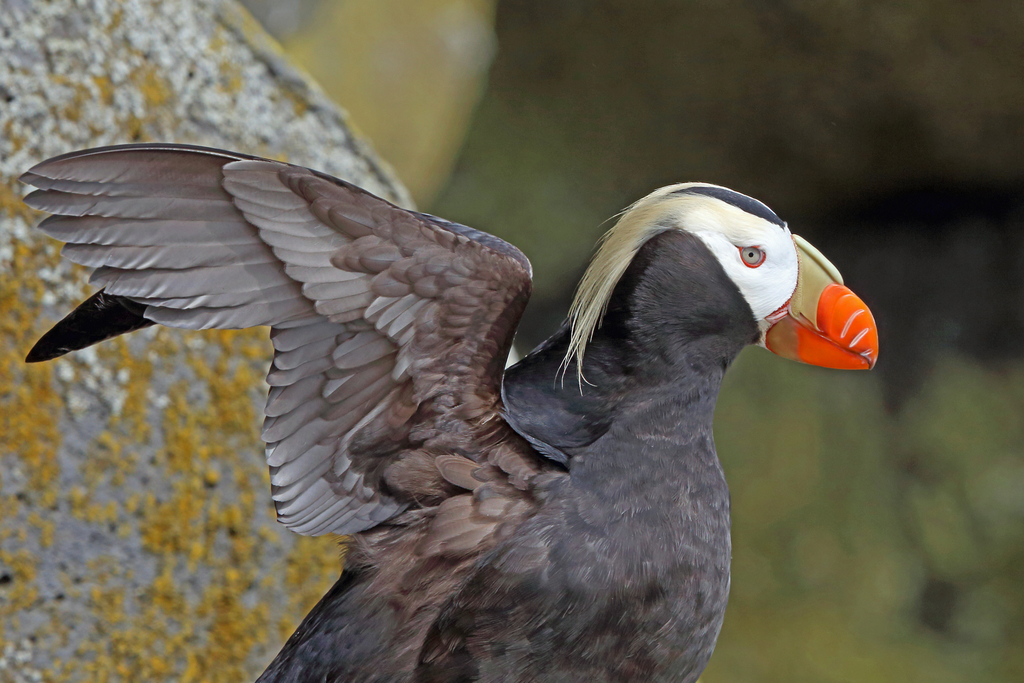
(c) Nigel Voaden, some rights reserved (CC BY) · licence
Family: Alcidae · Class: Aves · Order: Charadriiformes
Conservation status: G5 S1S2
Fratercula cirrhata (Tufted Puffin) is a California animal in the Alcidae family.
The Tufted Puffin is a large, stocky seabird measuring 35 to 41 cm (14 to 16 inches) in length with a wingspan of 64 to 71 cm (25 to 28 inches). Adults weigh between 500 to 900 grams (1.1 to 2.0 pounds). During breeding season, adults develop distinctive bright orange bills with red and yellow coloration, white facial patches, and prominent golden-yellow tufts of feathers extending from behind the eyes. The body is primarily black with white underparts. Outside the breeding season, the bill becomes smaller and duller, facial patches turn gray, and the characteristic tufts are lost. Juveniles lack the ornate plumage and possess smaller, darker bills. Historically, Tufted Puffins bred along the entire California coast from the Oregon border south to the Channel Islands. The current breeding range in California is severely restricted, with active colonies documented only on the Farallon Islands and Castle Rock near Crescent City in Del Norte County. Small numbers may occasionally breed on other offshore rocks, but the species has been extirpated from most historical breeding sites including the Channel Islands, where the last confirmed breeding occurred in the 1990s. Tufted Puffins nest colonially on offshore islands, sea stacks, and coastal headlands. They require grassy slopes, cliff tops, or rocky areas with sufficient soil depth for excavating burrows. Nesting burrows extend 1 to 2 meters into the ground, often in areas with dense vegetation cover. During the non-breeding season, the species is entirely pelagic, inhabiting waters over the continental shelf and beyond. The species feeds primarily on small schooling fish including anchovies, sardines, herring, and juvenile rockfish. Adults can carry multiple fish crosswise in their bills, with records of up to 62 fish carried simultaneously. Breeding occurs from May through August, with pairs laying a single white egg in their earthen burrow. Incubation lasts 40 to 45 days, shared by both parents. Chicks fledge after 45 to 55 days and head directly to sea. Tufted Puffins are not federally listed but are considered critically imperiled in California with a state rank of S1S2, indicating extreme rarity. The California breeding population has declined dramatically from an estimated 2,000 to 3,000 pairs in the early 1900s to fewer than 100 pairs currently. Primary threats include climate change effects on prey availability, particularly the reduction of cold-water fish species, gillnet entanglement, oil spills, and introduced predators at breeding colonies. Ocean acidification and rising sea temperatures associated with climate change have altered marine food webs, reducing the abundance of preferred prey species. The species faces additional pressure from human disturbance at the few remaining breeding sites and potential impacts from offshore wind energy development.
Classification
Class: Aves · Order: Charadriiformes · Family: Alcidae
Conservation status
G5 S1S2
Frequently asked questions
How is Fratercula cirrhata classified?
Fratercula cirrhata belongs to class Aves, order Charadriiformes, family Alcidae.
What family does Fratercula cirrhata belong to?
Fratercula cirrhata is in the Alcidae family.
Is Fratercula cirrhata protected or of conservation concern?
Fratercula cirrhata carries the following status: G5 S1S2.
What is Fratercula cirrhata?
The Tufted Puffin is a large, stocky seabird measuring 35 to 41 cm (14 to 16 inches) in length with a wingspan of 64 to 71 cm (25 to 28 inches).
Is Fratercula cirrhata found in California?
Yes. Fratercula cirrhata is recorded in California in The California Species Project's catalogue.
Related species
Other California species in the same genus, family, or bioregion.
Data from The California Species Project — 14,000+ California species with verified data from CNPS, CDFW, USFWS, and more.