Fratercula corniculata
Horned Puffin
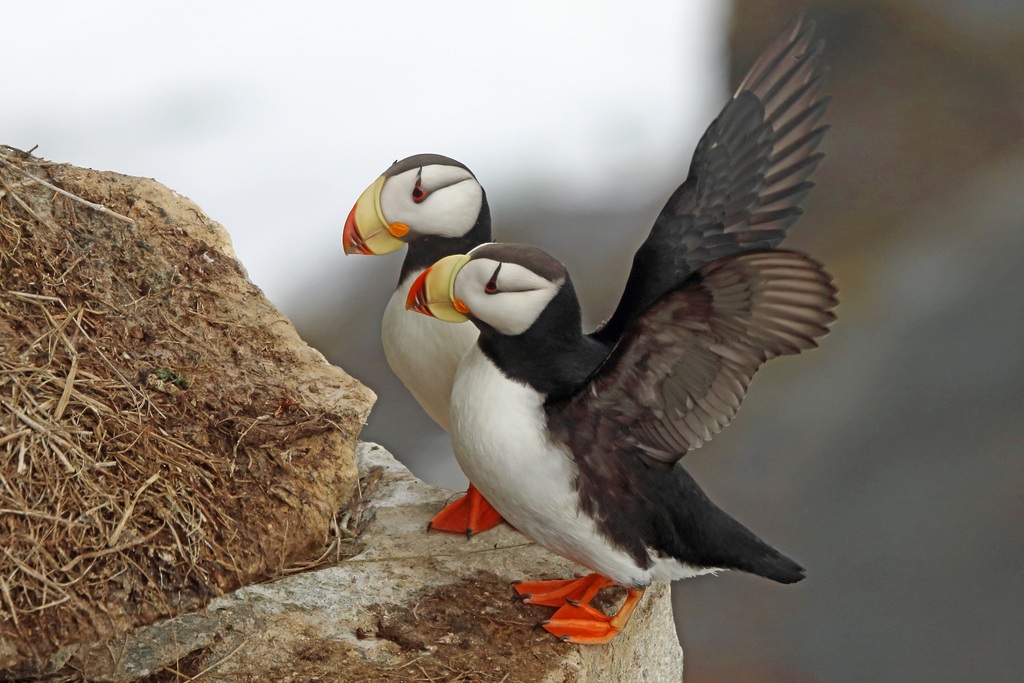
(c) Nigel Voaden, some rights reserved (CC BY) · licence
Family: Alcidae · Class: Aves · Order: Charadriiformes
Fratercula corniculata (Horned Puffin) is a California animal in the Alcidae family.
The Horned Puffin is a medium-sized seabird measuring 37-41 cm (14.5-16 inches) in length with a wingspan of 58-61 cm (23-24 inches). Adults weigh 500-620 grams (1.1-1.4 pounds). During breeding season, the species displays distinctive black and white plumage with a white breast and belly contrasting sharply with black upperparts and wings. The head exhibits a white face mask bordered by black, creating a distinctive facial pattern. The bill becomes enlarged and triangular during breeding season, colored bright orange-red with a yellow tip and base. Small, fleshy black horn-like projections above each eye give the species its common name. In winter plumage, the face becomes darker gray and the bill shrinks and dulls to a brownish color. Juveniles resemble winter adults but with smaller, darker bills. Historically, Horned Puffins occurred along the California coast as far south as Monterey County during winter months. The species breeds primarily in Alaska, the Aleutian Islands, and northern Pacific regions including the Bering Sea and Sea of Okhotsk. In California waters, Horned Puffins are irregular winter visitors, most commonly observed from October through March in offshore waters from Del Norte County south to central California. Sightings have become increasingly rare in recent decades, with most recent records from Humboldt and Mendocino counties. The species inhabits pelagic marine environments, preferring deeper offshore waters over the continental shelf and slope. During the non-breeding season, Horned Puffins remain entirely at sea, often associating with other alcids in mixed foraging flocks. They prefer areas with upwelling currents that concentrate prey species. Breeding habitat consists of coastal cliffs, rocky islands, and offshore stacks where pairs excavate burrows in soil or utilize rock crevices. Horned Puffins are pursuit divers, using their wings for underwater propulsion while hunting small fish, primarily capelin, sand lance, herring, and anchovies. They also consume marine invertebrates including euphausiid krill, copepods, and squid. Breeding occurs from May through August on northern breeding grounds. Pairs exhibit strong site fidelity, returning to the same burrow sites annually. Females lay a single white egg in burrows excavated 0.5-1.5 meters deep. Both parents incubate the egg for 40-42 days and feed the chick for 38-44 days until fledging. The Horned Puffin is not federally listed under the Endangered Species Act and lacks specific conservation status in California due to its irregular occurrence. The global population is estimated at 1.2 million individuals, classified as Least Concern by the International Union for Conservation of Nature. However, climate change poses increasing threats through altered ocean temperatures affecting prey distribution and availability. Ocean acidification and changing current patterns may impact food webs supporting the species. In California waters, declining winter occurrence may reflect broader ecosystem changes or shifts in migration patterns.
Classification
Class: Aves · Order: Charadriiformes · Family: Alcidae
Frequently asked questions
How is Fratercula corniculata classified?
Fratercula corniculata belongs to class Aves, order Charadriiformes, family Alcidae.
What family does Fratercula corniculata belong to?
Fratercula corniculata is in the Alcidae family.
What is Fratercula corniculata?
The Horned Puffin is a medium-sized seabird measuring 37-41 cm (14.5-16 inches) in length with a wingspan of 58-61 cm (23-24 inches).
Is Fratercula corniculata found in California?
Yes. Fratercula corniculata is recorded in California in The California Species Project's catalogue.
Related species
Other California species in the same genus, family, or bioregion.
Data from The California Species Project — 14,000+ California species with verified data from CNPS, CDFW, USFWS, and more.