Fregata ariel
Lesser Frigatebird
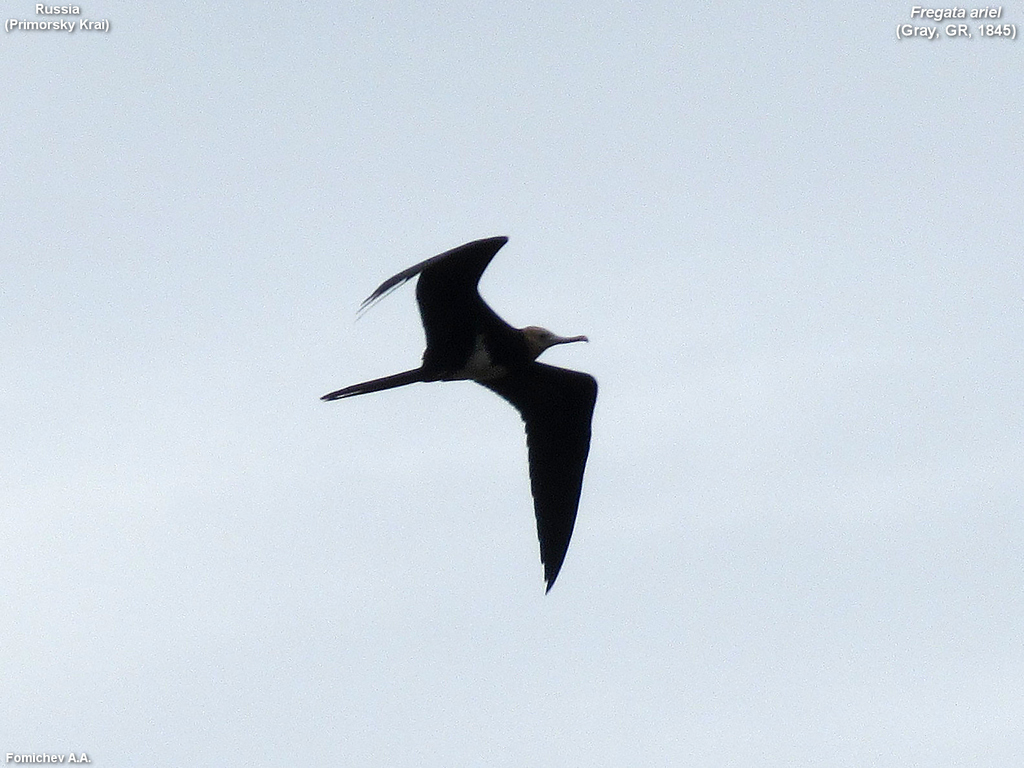
(c) Alexander A. Fomichev, some rights reserved (CC BY) · licence
Family: Fregatidae · Class: Aves · Order: Pelecaniformes
Fregata ariel (Lesser Frigatebird) is a California animal in the Fregatidae family.
The Lesser Frigatebird is a large seabird with distinctive sexual dimorphism and exceptional aerial capabilities. Adult males measure 71-81 cm (28-32 inches) in length with a wingspan of 155-193 cm (61-76 inches), weighing 625-875 grams. Males display glossy black plumage with a white breast patch and conspicuous inflatable red gular pouch used during courtship displays. Adult females are slightly larger, measuring 73-84 cm in length, and exhibit black plumage with white breast and upper belly. Both sexes possess deeply forked tails, long narrow wings, and hooked bills adapted for their aerial lifestyle. Juveniles display white heads and underparts with brownish upperparts. The Lesser Frigatebird has a pantropical distribution across the Indian and Pacific Oceans. In California waters, this species occurs as a vagrant, with most records from offshore waters and islands including the Channel Islands. The species breeds on remote oceanic islands including Christmas Island, the Galápagos, and various Pacific atolls. Non-breeding individuals disperse widely across tropical and subtropical waters, occasionally reaching temperate latitudes during post-breeding movements. Lesser Frigatebirds inhabit marine environments exclusively, rarely venturing over land except at breeding colonies and during vagrancy. They prefer warm oceanic waters with surface temperatures above 20°C (68°F) and are most commonly observed over continental shelf waters and upwelling zones where prey concentrations are highest. During breeding, they nest colonially on low shrubs, mangroves, or bare ground on coral atolls and volcanic islands. This species exhibits highly specialized feeding behavior, primarily practicing kleptoparasitism by harassing other seabirds to force regurgitation of prey. They also capture flying fish and squid from the surface using their hooked bills in aerial dips, though they cannot dive or swim effectively due to minimal waterproofing of their plumage. Lesser Frigatebirds are opportunistic predators that also consume turtle hatchlings, fish eggs, and occasionally scavenge carrion. Breeding occurs in loose colonies with males establishing territories and inflating their red throat pouches to attract females. The species typically lays a single white egg in a stick nest, with an incubation period of approximately 40-50 days. Both parents participate in feeding the chick, which may remain dependent for up to six months. The Lesser Frigatebird is classified as Least Concern globally by the International Union for Conservation of Nature, with stable populations estimated at 290,000-590,000 individuals worldwide. However, breeding colonies face threats from habitat modification, introduced predators, and climate change impacts on nesting islands. Plastic pollution poses an emerging threat through ingestion and entanglement. In California, the species remains a rare vagrant with irregular occurrence patterns, typically associated with warm water intrusions from El Niño events.
Classification
Class: Aves · Order: Pelecaniformes · Family: Fregatidae
Frequently asked questions
How is Fregata ariel classified?
Fregata ariel belongs to class Aves, order Pelecaniformes, family Fregatidae.
What family does Fregata ariel belong to?
Fregata ariel is in the Fregatidae family.
What is Fregata ariel?
The Lesser Frigatebird is a large seabird with distinctive sexual dimorphism and exceptional aerial capabilities.
Is Fregata ariel found in California?
Yes. Fregata ariel is recorded in California in The California Species Project's catalogue.
Related species
Other California species in the same genus, family, or bioregion.
Data from The California Species Project — 14,000+ California species with verified data from CNPS, CDFW, USFWS, and more.