Fregata magnificens
Magnificent Frigatebird
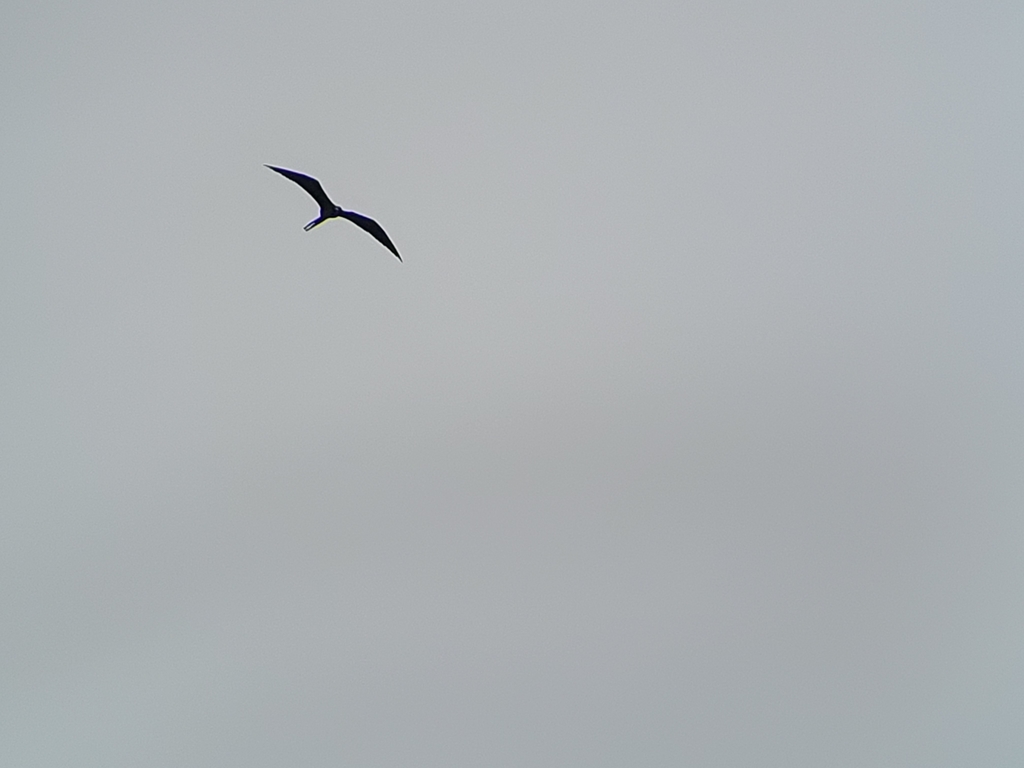
(c) Megan Massa, some rights reserved (CC BY) · licence
Family: Fregatidae · Class: Aves · Order: Pelecaniformes
Fregata magnificens (Magnificent Frigatebird) is a California animal in the Fregatidae family.
The Magnificent Frigatebird is a large seabird with distinctive morphological adaptations for aerial piracy and soaring flight. Adults measure 89-114 cm (35-45 inches) in length with an exceptionally long wingspan reaching 215-245 cm (85-96 inches). The species exhibits pronounced sexual dimorphism: males are entirely black with a distinctive inflatable red gular pouch displayed during courtship, while females are black with white breast patches and rusty head markings. Both sexes possess long, slender wings, a deeply forked tail, and a long, pale blue-grey to blackish hooked bill adapted for seizing prey and kleptoparasitism (Birds of the World). In California, Magnificent Frigatebirds occur as nonbreeding visitors along the coast, with regular sightings from central California southward. The species ranges north exceptionally to Alaska but is most commonly observed from central California to northern Peru in the Pacific. Birds also move through the Gulf of California and occasionally reach inland locations such as the Salton Sea (Birds of the World). The species does not breed in California waters, with nearest breeding colonies located on islands off Mexico's Pacific coast. Magnificent Frigatebirds inhabit warm coastal and pelagic waters, frequenting coasts and offshore islands throughout their range. They roost in trees along coasts, often selecting taller vegetation than that used for nesting. The species prefers areas with consistent thermal updrafts that support their energy-efficient soaring flight pattern. During nonbreeding periods in California, birds are typically observed over nearshore waters, coastal lagoons, and occasionally inland water bodies. The species exhibits highly specialized feeding behavior, primarily engaging in kleptoparasitism by harassing other seabirds to force regurgitation of recently caught fish. They also capture flying fish, squid, and jellyfish from the water surface using their long, hooked bills. Magnificent Frigatebirds are exceptional soarers, capable of remaining airborne for extended periods while expending minimal energy. Their reduced preen gland and minimal waterproofing require them to avoid prolonged contact with water. Breeding occurs in colonial settings on tropical islands, where males establish territories and display their inflated red throat pouches to attract females. Females typically lay a single white egg, with both parents sharing incubation duties over approximately 50 days. The Magnificent Frigatebird is not federally listed under the Endangered Species Act, though local populations face various conservation challenges. Primary threats include habitat loss at breeding colonies, disturbance from human activities, plastic pollution, and climate change impacts on marine food webs. Introduced mammalian predators pose significant risks to eggs and nestlings at breeding sites, with documented impacts from feral cats on nesting islands. The species' dependence on healthy marine ecosystems makes it vulnerable to overfishing and ocean acidification. No other birds prey on adult frigatebirds due to their large size and aggressive nature (Birds of the World). Conservation efforts focus on protecting breeding habitat and managing introduced predators at key nesting sites throughout the species' range.
Classification
Class: Aves · Order: Pelecaniformes · Family: Fregatidae
Frequently asked questions
How is Fregata magnificens classified?
Fregata magnificens belongs to class Aves, order Pelecaniformes, family Fregatidae.
What family does Fregata magnificens belong to?
Fregata magnificens is in the Fregatidae family.
What is Fregata magnificens?
The Magnificent Frigatebird is a large seabird with distinctive morphological adaptations for aerial piracy and soaring flight.
Is Fregata magnificens found in California?
Yes. Fregata magnificens is recorded in California in The California Species Project's catalogue.
Related species
Other California species in the same genus, family, or bioregion.
Data from The California Species Project — 14,000+ California species with verified data from CNPS, CDFW, USFWS, and more.