Fregata minor
Great Frigatebird
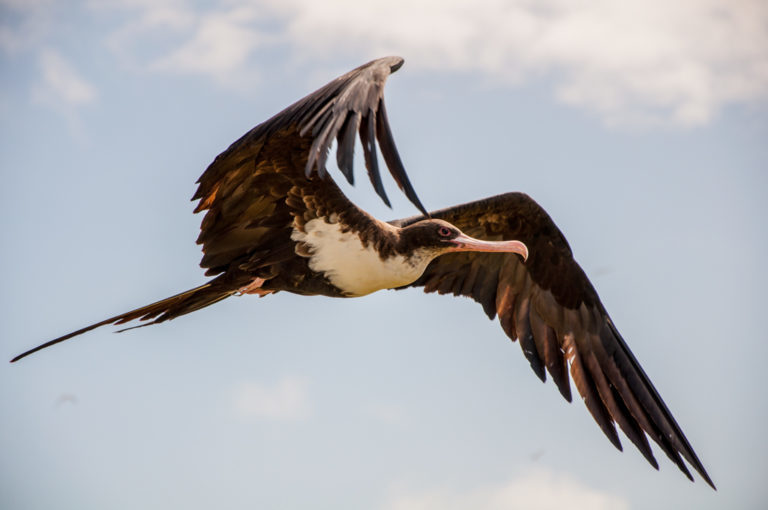
(c) James Weaver, some rights reserved (CC BY) · licence
Family: Fregatidae · Class: Aves · Order: Pelecaniformes
Fregata minor (Great Frigatebird) is a California animal in the Fregatidae family.
The Great Frigatebird is a large seabird measuring 86 to 100 cm (34 to 39 inches) in length with a wingspan reaching 205 to 230 cm (81 to 91 inches). Adult males are predominantly black with a glossy green sheen on the head and back, and display a bright red gular pouch that inflates during courtship displays. Adult females are larger than males, with black plumage, a white breast, and a grayish-white head. Juveniles have white heads and breasts with brownish-black backs. The species has a deeply forked tail, long pointed wings, and a long hooked bill adapted for aerial feeding. Historically, Great Frigatebirds bred on several islands off the California coast, including the Channel Islands. The species has experienced significant range contraction in California waters. Current breeding populations in the region are extremely limited, with occasional sightings reported along the Southern California coast and around offshore islands. The species maintains stable populations in tropical Pacific regions, including Hawaii, the Galápagos Islands, and various Pacific atolls. Great Frigatebirds inhabit coastal and marine environments, favoring areas with mangrove swamps, coral atolls, and rocky islands for nesting. They require islands with minimal human disturbance and adequate roosting sites, typically nesting in low shrubs or trees 1 to 6 meters (3 to 20 feet) above ground. The species prefers warm oceanic waters with abundant flying fish and squid populations. Great Frigatebirds are highly aerial, spending most of their lives in flight over ocean waters. They are kleptoparasitic, frequently harassing other seabirds to force them to regurgitate fish, which the frigatebirds catch in mid-air. Their diet consists primarily of flying fish, squid, jellyfish, and fish eggs skimmed from the ocean surface. They also consume seabird chicks and eggs when available. Breeding is seasonal, typically occurring during warmer months. Females lay a single white egg in a stick nest, with an incubation period of 50 to 60 days. Chicks remain dependent on parents for up to 12 months, one of the longest dependency periods among seabirds. The Great Frigatebird is not federally listed under the Endangered Species Act, though populations have declined in some regions due to habitat loss and human disturbance. In California, the species faces challenges from development on nesting islands, introduced predators, climate change effects on marine food webs, and plastic pollution. The species' limited breeding sites make populations vulnerable to localized threats. Conservation efforts focus on protecting nesting islands from development and managing introduced predators that threaten eggs and chicks.
Classification
Class: Aves · Order: Pelecaniformes · Family: Fregatidae
Frequently asked questions
How is Fregata minor classified?
Fregata minor belongs to class Aves, order Pelecaniformes, family Fregatidae.
What family does Fregata minor belong to?
Fregata minor is in the Fregatidae family.
What is Fregata minor?
The Great Frigatebird is a large seabird measuring 86 to 100 cm (34 to 39 inches) in length with a wingspan reaching 205 to 230 cm (81 to 91 inches).
Is Fregata minor found in California?
Yes. Fregata minor is recorded in California in The California Species Project's catalogue.
Related species
Other California species in the same genus, family, or bioregion.
Data from The California Species Project — 14,000+ California species with verified data from CNPS, CDFW, USFWS, and more.