Fulmarus glacialis
Northern Fulmar
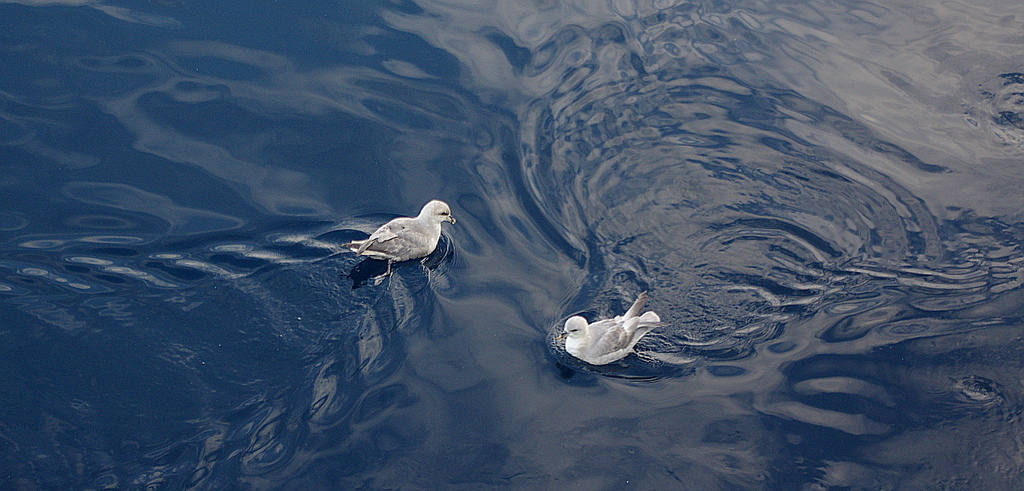
(c) Георгий Виноградов (Georgy Vinogradov), some rights reserved (CC BY) · licence
Family: Procellariidae · Class: Aves · Order: Procellariiformes
Fulmarus glacialis (Northern Fulmar) is a California animal in the Procellariidae family.
The Northern Fulmar is a robust seabird measuring 45 to 50 cm (18 to 20 inches) in length with a wingspan of 102 to 112 cm (40 to 44 inches). Adults weigh between 450 to 1,000 grams (1.0 to 2.2 pounds). The species exhibits two distinct color morphs: a light morph with white head, neck, and underparts contrasting with blue-gray upperparts, and a darker morph displaying uniform blue-gray to brownish-gray plumage throughout. The bill is yellowish with a distinctive hooked tip and prominent tubular nostrils characteristic of petrels. Wings are long and narrow, adapted for dynamic soaring flight over oceanic waters. Northern Fulmars breed across the North Pacific and North Atlantic, with Pacific populations nesting from Alaska south to California. In California, breeding colonies are established on offshore islands and coastal headlands from Del Norte County south to the Channel Islands. The species maintains year-round populations along California's coast, with numbers fluctuating seasonally as northern breeding birds move south during winter months. Outside the breeding season, Northern Fulmars disperse widely across the North Pacific, ranging from the Bering Sea to waters off Baja California. This species inhabits open oceanic waters and coastal marine environments, typically remaining within 200 km of shore but occasionally venturing into deeper pelagic zones. Breeding sites are located on steep coastal cliffs, rocky ledges, and offshore islands where birds construct simple nests on bare rock or thin soil substrates. Northern Fulmars prefer areas with consistent upwelling currents that concentrate marine prey. During non-breeding periods, the species follows oceanographic features such as continental shelf edges and areas of high primary productivity. Northern Fulmars are highly social seabirds that feed primarily on marine zooplankton, small fish, squid, and crustaceans. They employ surface-seizing and shallow diving techniques to capture prey, often feeding in large flocks where food is abundant. Breeding occurs annually from May through September, with pairs returning to traditional cliff-side colonies. Females lay a single white egg in a shallow scrape, and both parents incubate for approximately 50 days. Chicks fledge after 46 to 53 days but may remain dependent on parents for several additional weeks. The species exhibits strong site fidelity, with adults returning to the same colony sites across multiple breeding seasons. Northern Fulmars are not federally or state listed in California and maintain stable populations globally. However, the species faces emerging threats from marine plastic pollution, with studies documenting high rates of plastic ingestion that can impact survival and reproduction. Climate change effects on marine food webs, particularly shifts in zooplankton distribution and abundance, pose potential long-term challenges. Commercial fishing operations present risks through bycatch mortality and competition for prey resources. Oil spills and other marine contaminants represent localized but significant threats to coastal populations, particularly during breeding seasons when birds are concentrated at colony sites.
Classification
Class: Aves · Order: Procellariiformes · Family: Procellariidae
Frequently asked questions
How is Fulmarus glacialis classified?
Fulmarus glacialis belongs to class Aves, order Procellariiformes, family Procellariidae.
What family does Fulmarus glacialis belong to?
Fulmarus glacialis is in the Procellariidae family.
What is Fulmarus glacialis?
The Northern Fulmar is a robust seabird measuring 45 to 50 cm (18 to 20 inches) in length with a wingspan of 102 to 112 cm (40 to 44 inches).
Is Fulmarus glacialis found in California?
Yes. Fulmarus glacialis is recorded in California in The California Species Project's catalogue.
Related species
Other California species in the same genus, family, or bioregion.
Data from The California Species Project — 14,000+ California species with verified data from CNPS, CDFW, USFWS, and more.